The Feasts of God: Difference between revisions
No edit summary |
No edit summary |
||
| (15 intermediate revisions by 2 users not shown) | |||
| Line 1: | Line 1: | ||
{{그림 |회당에서_가르치시는_예수님.jpg|너비= 300px |정렬=오른쪽섬네일 |타이틀=Jesus set an example of worshiping in spirit and in truth}} | <!-- interlanguage:start -->[[ko:하나님의 절기]][[vi:Lễ trọng thể của Đức Chúa Trời]][[es:Las fiestas solemnes de Dios]]<!-- interlanguage:end -->{{그림 |회당에서_가르치시는_예수님.jpg|너비= 300px |정렬=오른쪽섬네일 |타이틀=Jesus set an example of worshiping in spirit and in truth}} | ||
The '''feasts of God''' refer to the feasts in the [[Bible]], which [[God]] commanded His people to keep. As for a weekly feast, there is the [[Sabbath|Sabbath day]]. As for the annual feasts, there are the [[Passover]], the [[Feast of Unleavened Bread]], the [[Day of Resurrection]] [<nowiki/>[[ | The '''feasts of God''' refer to the feasts in the [[Bible]], which [[God]] commanded His people to keep. As for a weekly feast, there is the [[Sabbath|Sabbath day]]. As for the annual feasts, there are the [[Passover]], the [[The Feast of Unleavened Bread|Feast of Unleavened Bread]], the [[Day of Resurrection]] [<nowiki/>[[Feast of Firstfruits]]], the [[Pentecost]] [<nowiki/>[[Feast of Weeks]]], the [[Feast of Trumpets]], the [[Day of Atonement]], and the [[Feast of Tabernacles]]. The seven annual feasts are grouped into three times and are called the ''Seven Feasts in Three Times''.<ref>{{Cite web |url=https://www.biblegateway.com/passage/?search=Leviticus+23&OLWordSearchRange=beg&version=NIV |title=Leviticus 23 |publisher= }}</ref><ref name=":2">{{Cite web |url=https://www.biblegateway.com/passage/?search=Deuteronomy+16%3A16&version=NIV |title=Deuteronomy 16:16 |publisher= }}</ref> | ||
Each feast contains the meaning of commemorating the love of [[Christ]], who sacrificed Himself for the salvation of mankind, and the power of God, who leads mankind to the [[Heaven|kingdom of heaven]]. It is also a prophecy that shows God’s work of salvation. | Each feast contains the meaning of commemorating the love of [[Christ]], who sacrificed Himself for the salvation of mankind, and the power of God, who leads mankind to the [[Kingdom of Heaven|kingdom of heaven]]. It is also a prophecy that shows God’s work of salvation. | ||
==Weekly Feast== | ==Weekly Feast== | ||
===Sabbath=== | ===Sabbath=== | ||
*'''Date:''' Seventh day. It falls on Saturday among the seven days of the week. | *'''Date:''' Seventh day. It falls on Saturday among the seven days of the week. | ||
*'''Origin:''' The Sabbath day means ''a day of rest'', which originated from the fact that God rested on the seventh day after [[Six-Day Creation|creating the heavens and the earth]] for six days. God blessed and made this day holy, and appointed it as the commemoration day of the [[Creator]].<ref>{{Cite web|url=https://www.biblegateway.com/passage/?search=Genesis+2%3A1-3&version=NIV |title=Genesis 2:1–3}}</ref> Sabbath in Hebrew is ''Shabbat'' (שַׁבָּת) which derived from the word ''Shavat'' ([https://www.studylight.org/lexicons/eng/hebrew/7676.html שָׁבַת]), meaning “to cease” or “to rest.” | *'''Origin:''' The Sabbath day means ''a day of rest'', which originated from the fact that God rested on the seventh day after [[Six-Day Creation|creating the heavens and the earth]] for six days. God blessed and made this day holy, and appointed it as the commemoration day of the [[The Creator|Creator]].<ref>{{Cite web|url=https://www.biblegateway.com/passage/?search=Genesis+2%3A1-3&version=NIV |title=Genesis 2:1–3}}</ref> Sabbath in Hebrew is ''Shabbat'' (שַׁבָּת) which derived from the word ''Shavat'' ([https://www.studylight.org/lexicons/eng/hebrew/7676.html שָׁבַת]), meaning “to cease” or “to rest.” | ||
*'''Ceremony in the Old Testament:''' The [[Priest|priests]] slaughtered lambs and offered them as a burnt offering, along with a grain offering and a drink offering.<ref>{{Cite web|url=https://www.biblegateway.com/passage/?search=Numbers+28%3A9-10&version=NIV |title=Numbers 28:9–10}}</ref> They made twelve loaves and set them before God.<ref>{{Cite web|url=https://www.biblegateway.com/passage/?search=Leviticus+24%3A5-8&version=NIV |title=Leviticus 24:5–8}}</ref> On this day, no one, whether people or animals, did any work.<ref>{{Cite web |url=https://www.biblegateway.com/passage/?search=Exodus+20%3A8-11&version=NIV |title=Exodus 20:8–11 |publisher= }}</ref> | *'''Ceremony in the Old Testament:''' The [[Priest|priests]] slaughtered lambs and offered them as a burnt offering, along with a grain offering and a drink offering.<ref>{{Cite web|url=https://www.biblegateway.com/passage/?search=Numbers+28%3A9-10&version=NIV |title=Numbers 28:9–10}}</ref> They made twelve loaves and set them before God.<ref>{{Cite web|url=https://www.biblegateway.com/passage/?search=Leviticus+24%3A5-8&version=NIV |title=Leviticus 24:5–8}}</ref> On this day, no one, whether people or animals, did any work.<ref>{{Cite web |url=https://www.biblegateway.com/passage/?search=Exodus+20%3A8-11&version=NIV |title=Exodus 20:8–11 |publisher= }}</ref> | ||
*'''Ceremony in the New Testament:''' Jesus, who came as the reality of sacrifice of the Old Testament times,<ref>{{Cite web|url=https://www.biblegateway.com/passage/?search=Hebrews+9%3A11-12&version=NIV |title=Hebrews 9:11–12}}</ref><ref>Chapter 32 The Passover and the Last Supper, ''THE MYSTERY OF GOD AND THE SPRING OF THE WATER OF LIFE'', Ahnsahnghong, pg. 202, Melchizedek Pub. Co., Ltd</ref> preached on the Sabbath day from the Scriptures, setting an example of [[Worship|worshiping]] in spirit and in truth.<ref name=":0">{{Cite web|url=https://www.biblegateway.com/passage/?search=John+4%3A21-23&version=NIV |title=John 4:21–23}}</ref> Therefore, we worship in spirit and in truth on the Sabbath day in the New Testament times. | *'''Ceremony in the New Testament:''' Jesus, who came as the reality of sacrifice of the Old Testament times,<ref>{{Cite web|url=https://www.biblegateway.com/passage/?search=Hebrews+9%3A11-12&version=NIV |title=Hebrews 9:11–12}}</ref><ref>Chapter 32 The Passover and the Last Supper, ''THE MYSTERY OF GOD AND THE SPRING OF THE WATER OF LIFE'', Ahnsahnghong, pg. 202, Melchizedek Pub. Co., Ltd</ref> preached on the Sabbath day from the Scriptures, setting an example of [[Worship|worshiping]] in spirit and in truth.<ref name=":0">{{Cite web|url=https://www.biblegateway.com/passage/?search=John+4%3A21-23&version=NIV |title=John 4:21–23}}</ref> Therefore, we worship in spirit and in truth on the Sabbath day in the New Testament times. | ||
| Line 14: | Line 14: | ||
==Annual Feasts== | ==Annual Feasts== | ||
The annual feasts of God originated from the work of [[Moses]]. When the Israelites were enslaved in Egypt, God appointed Moses as their leader to free them and lead them to Canaan. Moses’ work for about a year from the time of the [[Exodus]] became the origin of each feast. This shows us Jesus’ work of salvation—how He would come as our Savior, free the people of God from the sinful world, and lead them to the kingdom of heaven, that is, the heavenly Canaan.<ref>{{Cite web|url=https://www.biblegateway.com/passage/?search=Deuteronomy+18%3A18&version=NIV |title=Deuteronomy 18:18|publisher=}}</ref><ref>{{Cite web|url=https://www.biblegateway.com/passage/?search=Acts+3%3A20-24&version=NIV |title=Acts 3:20–24|publisher=}}</ref><ref>{{Cite web |url=https://www.biblegateway.com/passage/?search=Hebrews+3%3A2-6&version=NIV |title=Hebrews 3:2–6 |publisher= }}</ref> | The annual feasts of God originated from the work of [[Moses]]. When the Israelites were enslaved in Egypt, God appointed Moses as their leader to free them and lead them to Canaan. Moses’ work for about a year from the time of the [[The Exodus|Exodus]] became the origin of each feast. This shows us Jesus’ work of salvation—how He would come as our Savior, free the people of God from the sinful world, and lead them to the kingdom of heaven, that is, the heavenly Canaan.<ref>{{Cite web|url=https://www.biblegateway.com/passage/?search=Deuteronomy+18%3A18&version=NIV |title=Deuteronomy 18:18|publisher=}}</ref><ref>{{Cite web|url=https://www.biblegateway.com/passage/?search=Acts+3%3A20-24&version=NIV |title=Acts 3:20–24|publisher=}}</ref><ref>{{Cite web |url=https://www.biblegateway.com/passage/?search=Hebrews+3%3A2-6&version=NIV |title=Hebrews 3:2–6 |publisher= }}</ref> | ||
The annual feasts consist of seven feasts, which are grouped into three times, hence they are called the ''Seven Feasts in Three Times''. Three representative feasts are the '''Feast of Unleavened Bread''', the '''Feast of Weeks,''' and the '''Feast of Tabernacles'''.<ref name=":2" /> | The annual feasts consist of seven feasts, which are grouped into three times, hence they are called the ''Seven Feasts in Three Times''. Three representative feasts are the '''Feast of Unleavened Bread''', the '''Feast of Weeks,''' and the '''Feast of Tabernacles'''.<ref name=":2" /> | ||
| Line 25: | Line 25: | ||
{{그림 |최후의 만찬 유월절.jpg|너비= 350px |정렬=오른쪽섬네일 |타이틀=Jesus keeps the Passover of the new covenant with His disciples.}} | {{그림 |최후의 만찬 유월절.jpg|너비= 350px |정렬=오른쪽섬네일 |타이틀=Jesus keeps the Passover of the new covenant with His disciples.}} | ||
*'''Date:''' Evening of the 14th day of the first month (Nisan) by the sacred calendar | *'''Date:''' Evening of the 14th day of the first month (Nisan) by the sacred calendar | ||
*'''Origin:''' The word ''Passover'' means “disasters pass over.” It originated from the history of the Israelites, who were slaves in Egypt; around the 15th century [[ | *'''Origin:''' The word ''Passover'' means “disasters pass over.” It originated from the history of the Israelites, who were slaves in Egypt; around the 15th century [[BC and AD|B.C.]], they were protected from the plague and were set free by keeping the Passover.<ref name=":8">{{Cite web |url=https://www.biblegateway.com/passage/?search=Exodus+12&OLWordSearchRange=beg&version=NIV |title=Exodus 12 |publisher= }}</ref> Passover in Hebrew is ''pesach (פֶּסַח)'' which is derived from the word ''pasach (פָּסַח)'', meaning “to pass over.” In Greek, it is ''pascha (πασχα)''. | ||
*'''Ceremony in the Old Testament:''' They slaughtered a year-old lamb and put the blood on the sides and tops of the doorframes. They ate the meat roasted over the fire, with bitter herbs and bread made without yeast. They did not leave any of it until morning. They did not break the bones of the Passover lambs.<ref>{{Cite web |url=https://www.biblegateway.com/passage/?search=Deuteronomy+16%3A1-7&version=NIV |title=Deuteronomy 16:1–7 |publisher= }}</ref><ref>{{Cite web |url=https://www.biblegateway.com/passage/?search=Numbers+9%3A11-12&version=NIV |title=Numbers 9:11–12 |publisher= }}</ref><ref>{{Cite web |url=https://www.biblegateway.com/passage/?search=Exodus+12%3A42-47&version=NIV |title=Exodus 12:42–47 |publisher= }}</ref> | *'''Ceremony in the Old Testament:''' They slaughtered a year-old lamb and put the blood on the sides and tops of the doorframes. They ate the meat roasted over the fire, with bitter herbs and bread made without yeast. They did not leave any of it until morning. They did not break the bones of the Passover lambs.<ref>{{Cite web |url=https://www.biblegateway.com/passage/?search=Deuteronomy+16%3A1-7&version=NIV |title=Deuteronomy 16:1–7 |publisher= }}</ref><ref>{{Cite web |url=https://www.biblegateway.com/passage/?search=Numbers+9%3A11-12&version=NIV |title=Numbers 9:11–12 |publisher= }}</ref><ref>{{Cite web |url=https://www.biblegateway.com/passage/?search=Exodus+12%3A42-47&version=NIV |title=Exodus 12:42–47 |publisher= }}</ref> | ||
*'''Ceremony in the New Testament:''' After the [[Foot-Washing Ceremony]],<ref name="세족식">{{Cite web|url=https://www.biblegateway.com/passage/?search=John+13%3A4-15&version=NIV |title=John 13:4–15}}</ref> we eat bread and wine, which represent the flesh and blood of Jesus, the reality of the Passover lamb.<ref name=":9">{{Cite web|url=https://www.biblegateway.com/passage/?search=1+Corinthians+5%3A7-8&version=NIV |title=1 Corinthians 5:7–8}}</ref><ref name="Matthew 유월절">{{Cite web|url=https://www.biblegateway.com/passage/?search=Matthew+26%3A19-28&version=NIV |title=Matthew 26:19–28}}</ref> | *'''Ceremony in the New Testament:''' After the [[Foot-Washing Ceremony]],<ref name="세족식">{{Cite web|url=https://www.biblegateway.com/passage/?search=John+13%3A4-15&version=NIV |title=John 13:4–15}}</ref> we eat bread and wine, which represent the flesh and blood of Jesus, the reality of the Passover lamb.<ref name=":9">{{Cite web|url=https://www.biblegateway.com/passage/?search=1+Corinthians+5%3A7-8&version=NIV |title=1 Corinthians 5:7–8}}</ref><ref name="Matthew 유월절">{{Cite web|url=https://www.biblegateway.com/passage/?search=Matthew+26%3A19-28&version=NIV |title=Matthew 26:19–28}}</ref> | ||
*'''History:''' The first Passover was celebrated at the time of the Israelites’ Exodus. They kept the Passover a second time the following year,<ref>{{Cite web|url=https://www.biblegateway.com/passage/?search=Numbers+9%3A1-5&version=NIV |title=Numbers 9:1–5}}</ref> in the Desert of Sinai, and a third time on the plains of [[Jericho]] at the end of their 40-year journey, then they entered Canaan that year.<ref>{{Cite web|url=https://www.biblegateway.com/passage/?search=Joshua+5%3A10-12&version=NIV |title=Joshua 5:10–12}}</ref> In the time of Hezekiah, which was about 800 years after the time of Moses, the Israelites kept the Passover.<ref name="히스기야 유월절">{{Cite web|url=https://www.biblegateway.com/passage/?search=2+Chronicles+30%3A1-12&version=NIV |title=2 Chronicles 30:1–12}}</ref> It is also recorded in the Bible that King Josiah kept the Passover and God acknowledged him to have obeyed all the laws of God with all his heart, soul, and strength.<ref>{{Cite web|url=https://www.biblegateway.com/passage/?search=2+Kings+23%3A21-25&version=NIV |title=2 Kings 23:21–25}}</ref> In the New Testament times, [[Jesus Christ]] established the Passover of the [[New Covenant|new covenant]]. Keeping the Passover with bread and wine, which represent His flesh and blood, Jesus opened the way to the [[Forgiveness of Sins|forgiveness of sins]] and eternal life for mankind.<ref name="Matthew 유월절" /> The [[Apostle|apostles]] and the saints of the early Church kept the Passover of the new covenant every year on the evening of the 14th day of the first month by the sacred calendar since [[Ascension of Jesus|Jesus’ ascension]].<ref name=":9" /> | *'''History:''' The first Passover was celebrated at the time of the Israelites’ Exodus. They kept the Passover a second time the following year,<ref>{{Cite web|url=https://www.biblegateway.com/passage/?search=Numbers+9%3A1-5&version=NIV |title=Numbers 9:1–5}}</ref> in the Desert of Sinai, and a third time on the plains of [[Jericho]] at the end of their 40-year journey, then they entered Canaan that year.<ref>{{Cite web|url=https://www.biblegateway.com/passage/?search=Joshua+5%3A10-12&version=NIV |title=Joshua 5:10–12}}</ref> In the time of Hezekiah, which was about 800 years after the time of Moses, the Israelites kept the Passover.<ref name="히스기야 유월절">{{Cite web|url=https://www.biblegateway.com/passage/?search=2+Chronicles+30%3A1-12&version=NIV |title=2 Chronicles 30:1–12}}</ref> It is also recorded in the Bible that King Josiah kept the Passover and God acknowledged him to have obeyed all the laws of God with all his heart, soul, and strength.<ref>{{Cite web|url=https://www.biblegateway.com/passage/?search=2+Kings+23%3A21-25&version=NIV |title=2 Kings 23:21–25}}</ref> In the New Testament times, [[Jesus Christ]] established the Passover of the [[New Covenant|new covenant]]. Keeping the Passover with bread and wine, which represent His flesh and blood, Jesus opened the way to the [[Forgiveness of Sins|forgiveness of sins]] and eternal life for mankind.<ref name="Matthew 유월절" /> The [[Apostle|apostles]] and the saints of the early Church kept the Passover of the new covenant every year on the evening of the 14th day of the first month by the sacred calendar since [[The Ascension of Jesus|Jesus’ ascension]].<ref name=":9" /> | ||
*'''Blessing:''' ① Jesus said that whoever eats and drinks His flesh and blood will receive the forgiveness of sins and eternal life.<ref name="Matthew 유월절" /><ref>{{Cite web |url=https://www.biblegateway.com/passage/?search=John+6%3A53-54&version=NIV |title=John 6:53–54 |publisher= }}</ref> The Passover is the truth that frees all human beings from their slavery to sin and death caused by their sins.<ref name=":5">{{Cite web|url=https://www.biblegateway.com/passage/?search=Romans+6%3A23&version=NIV |title=Romans 6:23}}</ref><ref>{{Cite web|url=https://www.biblegateway.com/passage/?search=John+8%3A34&version=NIV |title=John 8:34}}</ref> ② Those who eat the flesh and drink the blood of Jesus on the Passover can remain in God and become God’s possessions,<ref>{{Cite web|url=https://www.biblegateway.com/passage/?search=John+6%3A56&version=NIV |title=John 6:56}}</ref> and be protected from disasters.<ref>{{Cite web|url=https://www.biblegateway.com/passage/?search=Isaiah+43%3A1-2&version=NIV |title=Isaiah 43:1–2}}</ref> ③ The Passover is the day when other gods are judged;<ref>{{Cite web|url=https://www.biblegateway.com/passage/?search=Exodus+12%3A11-13&version=NIV |title=Exodus 12:11–13}}</ref> through the Passover, we can fully keep the [[First Commandment|first commandment]], “You shall have no other gods before me.”<ref>{{Cite web |url=https://www.biblegateway.com/passage/?search=Exodus+20%3A1-3&version=NIV |title=Exodus 20:1–3 |publisher= }}</ref> | *'''Blessing:''' ① Jesus said that whoever eats and drinks His flesh and blood will receive the forgiveness of sins and eternal life.<ref name="Matthew 유월절" /><ref>{{Cite web |url=https://www.biblegateway.com/passage/?search=John+6%3A53-54&version=NIV |title=John 6:53–54 |publisher= }}</ref> The Passover is the truth that frees all human beings from their slavery to sin and death caused by their sins.<ref name=":5">{{Cite web|url=https://www.biblegateway.com/passage/?search=Romans+6%3A23&version=NIV |title=Romans 6:23}}</ref><ref>{{Cite web|url=https://www.biblegateway.com/passage/?search=John+8%3A34&version=NIV |title=John 8:34}}</ref> ② Those who eat the flesh and drink the blood of Jesus on the Passover can remain in God and become God’s possessions,<ref>{{Cite web|url=https://www.biblegateway.com/passage/?search=John+6%3A56&version=NIV |title=John 6:56}}</ref> and be protected from disasters.<ref>{{Cite web|url=https://www.biblegateway.com/passage/?search=Isaiah+43%3A1-2&version=NIV |title=Isaiah 43:1–2}}</ref> ③ The Passover is the day when other gods are judged;<ref>{{Cite web|url=https://www.biblegateway.com/passage/?search=Exodus+12%3A11-13&version=NIV |title=Exodus 12:11–13}}</ref> through the Passover, we can fully keep the [[First Commandment|first commandment]], “You shall have no other gods before me.”<ref>{{Cite web |url=https://www.biblegateway.com/passage/?search=Exodus+20%3A1-3&version=NIV |title=Exodus 20:1–3 |publisher= }}</ref> | ||
<small>{{참고|Passover|New Covenant Passover|설명=}}</small> | <small>{{참고|Passover|The New Covenant Passover||설명=}}</small> | ||
===Feast of Unleavened Bread=== | ===Feast of Unleavened Bread=== | ||
| Line 38: | Line 38: | ||
*'''Ceremony in the Old Testament:''' They ate unleavened bread for seven days from the 15th day of the first month by the sacred calendar<ref>{{Cite web |url=https://www.biblegateway.com/passage/?search=Leviticus+23%3A4-6&version=NIV |title=Leviticus 23:4–6 |publisher= }}</ref> to commemorate the sufferings they had experienced until they crossed the Red Sea. | *'''Ceremony in the Old Testament:''' They ate unleavened bread for seven days from the 15th day of the first month by the sacred calendar<ref>{{Cite web |url=https://www.biblegateway.com/passage/?search=Leviticus+23%3A4-6&version=NIV |title=Leviticus 23:4–6 |publisher= }}</ref> to commemorate the sufferings they had experienced until they crossed the Red Sea. | ||
*'''Ceremony in the New Testament:''' The saints participate in Christ’s suffering by worshiping and fasting on the Feast of Unleavened Bread.<ref>{{Cite web |url=https://www.biblegateway.com/passage/?search=Mark+2%3A19-20&version=NIV |title=Mark 2:19–20 |publisher= }}</ref> | *'''Ceremony in the New Testament:''' The saints participate in Christ’s suffering by worshiping and fasting on the Feast of Unleavened Bread.<ref>{{Cite web |url=https://www.biblegateway.com/passage/?search=Mark+2%3A19-20&version=NIV |title=Mark 2:19–20 |publisher= }}</ref> | ||
*'''Fulfillment of the Prophecy:''' The Feast of Unleavened Bread represents [[ | *'''Fulfillment of the Prophecy:''' The Feast of Unleavened Bread represents [[Crucifixion|the suffering of Jesus]] on the cross. After keeping the last Passover with His disciples, Jesus was arrested that night and went through all kinds of affliction.<ref>{{Cite web |url=https://www.biblegateway.com/passage/?search=Isaiah+53%3A3-8&version=NIV |title=Isaiah 53:3–8 |publisher= }}</ref> The following day, He suffered on the [[cross]] for hours from nine in the morning to three in the afternoon.<ref>{{Cite web |url=https://www.biblegateway.com/passage/?search=matthew+26-27&OLWordSearchRange=beg&version=NIV |title=Matthew 26-27 |publisher= }}</ref> The Israelites’ entering the Red Sea represents Jesus’ entering the tomb, and their landing from the Red Sea represents [[Jesus' Resurrection|Jesus’ resurrection]]. This meaning is shown through [[baptism]].<ref>{{Cite web |url=https://www.biblegateway.com/passage/?search=1+Corinthians+10%3A1-2&version=NIV |title=1 Corinthians 10:1–2 |publisher= }}</ref><ref>{{Cite web |url=https://www.biblegateway.com/passage/?search=1+Peter+3%3A21&version=NIV |title=1 Peter 3:21 |publisher= }}</ref> | ||
<small>{{참고|Feast of Unleavened Bread|l1=|설명=}}</small> | <small>{{참고|Feast of Unleavened Bread|l1=|설명=}}</small> | ||
| Line 53: | Line 53: | ||
{{그림 |오순절.jpg|너비= 270px |정렬=오른쪽섬네일 |타이틀=The saints of the early Church devote themselves to prayer while waiting for Pentecost}} | {{그림 |오순절.jpg|너비= 270px |정렬=오른쪽섬네일 |타이틀=The saints of the early Church devote themselves to prayer while waiting for Pentecost}} | ||
*'''Date:''' The 50th day from the Day of Firstfruits (Resurrection Day) | *'''Date:''' The 50th day from the Day of Firstfruits (Resurrection Day) | ||
*'''Origin:''' On the fortieth day after the Israelites crossed the Red Sea, Moses went up on Mount Sinai at the call of God.<ref>{{Cite web|url=https://www.biblegateway.com/passage/?search=Exodus+19%3A1-7&version=NIV |title=Exodus 19:1–7|publisher=}}</ref> Three days later, God descended on Mount Sinai, declared the covenant,<ref>{{Cite web|url=https://www.biblegateway.com/passage/?search=Exodus+19%3A16-23&version=NIV |title=Exodus 19:16–23:33|publisher=}}</ref> and told Moses to come up again to receive the tablets of stone with the law and commands written on them. On the fiftieth day after crossing the Red Sea, Moses went up to Mount Sinai and received the tablets of stone of the [[Ten Commandments]] from God while staying there for 40 days.<ref name=":1">{{Cite web|url=https://www.biblegateway.com/passage/?search=Exodus+24%3A12-18&version=NIV |title=Exodus 24:12–18|publisher=}}</ref> God appointed the day Moses went up Mount Sinai to receive the Ten Commandments as the Feast of Weeks and had the Israelites commemorate it. | *'''Origin:''' On the fortieth day after the Israelites crossed the Red Sea, Moses went up on Mount Sinai at the call of God.<ref>{{Cite web|url=https://www.biblegateway.com/passage/?search=Exodus+19%3A1-7&version=NIV |title=Exodus 19:1–7|publisher=}}</ref> Three days later, God descended on Mount Sinai, declared the covenant,<ref>{{Cite web|url=https://www.biblegateway.com/passage/?search=Exodus+19%3A16-23&version=NIV |title=Exodus 19:16–23:33|publisher=}}</ref> and told Moses to come up again to receive the tablets of stone with the law and commands written on them. On the fiftieth day after crossing the Red Sea, Moses went up to Mount Sinai and received the tablets of stone of the [[The Ten Commandments|Ten Commandments]] from God while staying there for 40 days.<ref name=":1">{{Cite web|url=https://www.biblegateway.com/passage/?search=Exodus+24%3A12-18&version=NIV |title=Exodus 24:12–18|publisher=}}</ref> God appointed the day Moses went up Mount Sinai to receive the Ten Commandments as the Feast of Weeks and had the Israelites commemorate it. | ||
*'''Ceremony in the Old Testament:''' On the fiftieth day after the Day of Firstfruits, they presented an offering of new grain to God<ref>{{Cite web |url=https://www.biblegateway.com/passage/?search=Leviticus+23%3A15-18&version=NIV |title=Leviticus 23:15–18 |publisher= }}</ref> and offered a burnt offering in accordance with the feast.<ref>{{Cite web|url=https://www.biblegateway.com/passage/?search=Numbers+28%3A26-31&version=NIV |title=Numbers 28:26–31|publisher=}}</ref> | *'''Ceremony in the Old Testament:''' On the fiftieth day after the Day of Firstfruits, they presented an offering of new grain to God<ref>{{Cite web |url=https://www.biblegateway.com/passage/?search=Leviticus+23%3A15-18&version=NIV |title=Leviticus 23:15–18 |publisher= }}</ref> and offered a burnt offering in accordance with the feast.<ref>{{Cite web|url=https://www.biblegateway.com/passage/?search=Numbers+28%3A26-31&version=NIV |title=Numbers 28:26–31|publisher=}}</ref> | ||
*'''Ceremony in the New Testament:''' In obedience to Jesus’ command, “Do not leave [[Jerusalem]], but wait for the gift my Father promised,”<ref>{{Cite web|url=https://www.biblegateway.com/passage/?search=Acts+1%3A3-4&version=NIV |title=Acts 1:3–4|publisher=}}</ref> about 120 saints prayed earnestly for ten days after the Ascension Day. On the fiftieth day after Jesus’ [[resurrection]], they gathered in Mark’s upper room to celebrate the Day of Pentecost.<ref>{{Cite web|url=https://www.biblegateway.com/passage/?search=Acts+1%3A13-15&version=NIV |title=Acts 1:13–15|publisher=}}</ref> Since then, the saints of the early Church kept the Pentecost, praying for the Holy Spirit, every year.<ref>{{Cite web|url=https://www.biblegateway.com/passage/?search=1+Corinthians+16%3A8&version=NIV |title=1 Corinthians 16:8|publisher=}}</ref><ref>{{Cite web |url=https://www.biblegateway.com/passage/?search=Acts+20%3A6-16&version=NIV |title=Acts 20:6–16 |publisher= }}</ref> | *'''Ceremony in the New Testament:''' In obedience to Jesus’ command, “Do not leave [[Jerusalem]], but wait for the gift my Father promised,”<ref>{{Cite web|url=https://www.biblegateway.com/passage/?search=Acts+1%3A3-4&version=NIV |title=Acts 1:3–4|publisher=}}</ref> about 120 saints prayed earnestly for ten days after the Ascension Day. On the fiftieth day after Jesus’ [[resurrection]], they gathered in Mark’s upper room to celebrate the Day of Pentecost.<ref>{{Cite web|url=https://www.biblegateway.com/passage/?search=Acts+1%3A13-15&version=NIV |title=Acts 1:13–15|publisher=}}</ref> Since then, the saints of the early Church kept the Pentecost, praying for the Holy Spirit, every year.<ref>{{Cite web|url=https://www.biblegateway.com/passage/?search=1+Corinthians+16%3A8&version=NIV |title=1 Corinthians 16:8|publisher=}}</ref><ref>{{Cite web |url=https://www.biblegateway.com/passage/?search=Acts+20%3A6-16&version=NIV |title=Acts 20:6–16 |publisher= }}</ref> | ||
*'''Fulfillment of the Prophecy:''' Moses went up Mount Sinai to receive the Ten Commandments on the fiftieth day after crossing the Red Sea. This represented that Jesus would enter the [[Most Holy Place]] in heaven on the fiftieth day after His resurrection (Day of Pentecost) and pour out the [[The Holy Spirit|Holy Spirit]].<ref>Chapter 2 The Seven Feasts in Three Times, ''THE MYSTERY OF GOD AND THE SPRING OF THE WATER OF LIFE'', Ahnsahnghong, pg. 17, Melchizedek Pub. Co., Ltd</ref> Just as Jesus said, “You will receive power when the Holy Spirit comes on you, and you will be my witnesses in Jerusalem, and in all Judea and [[Samaria]], and to the ends of the earth,”<ref name=":02">{{Cite web|url=https://www.biblegateway.com/passage/?search=Acts+1%3A3-9&version=NIV |title=Acts 1:3–9|publisher=}}</ref> the Holy Spirit of Pentecost became a catalyst for the spread of the [[gospel]] of Jesus Christ throughout the world. Since then, the early Church grew rapidly.<ref>{{Cite web|url=https://www.biblegateway.com/passage/?search=Acts+2%3A14-41&version=NIV |title=Acts 2:14–41|publisher=}}</ref><ref>{{Cite web|url=https://www.biblegateway.com/passage/?search=Acts+4%3A1-4&version=NIV |title=Acts 4:1–4|publisher=}}</ref> However, after the apostles died, the [[church]], having become secularized and corrupt, forsook the truth and began to practice lawlessness. This provoked God to take back the Holy Spirit which was poured on the Day of Pentecost. This was a fulfillment of the prophecy of Moses breaking the tablets of the Ten Commandments that he had received, when he saw the Israelites worshiping an idol while he was coming down the mountain.<ref name=":6">{{Cite web|url=https://www.biblegateway.com/passage/?search=Exodus+32%3A1-19%2C+27-28&OLWordSearchRange=beg&version=NIV |title=Exodus 32:1–19, 27-28|publisher=}}</ref><ref>Chapter 15 The Feasts of God, ''MY SHEEP LISTEN TO MY VOICE'', Joo-cheol Kim, pg. 172, Melchizedek Pub. Co., Ltd</ref> | *'''Fulfillment of the Prophecy:''' Moses went up Mount Sinai to receive the Ten Commandments on the fiftieth day after crossing the Red Sea. This represented that Jesus would enter the [[The Most Holy Place|Most Holy Place]] in heaven on the fiftieth day after His resurrection (Day of Pentecost) and pour out the [[The Holy Spirit|Holy Spirit]].<ref>Chapter 2 The Seven Feasts in Three Times, ''THE MYSTERY OF GOD AND THE SPRING OF THE WATER OF LIFE'', Ahnsahnghong, pg. 17, Melchizedek Pub. Co., Ltd</ref> Just as Jesus said, “You will receive power when the Holy Spirit comes on you, and you will be my witnesses in Jerusalem, and in all Judea and [[Samaria]], and to the ends of the earth,”<ref name=":02">{{Cite web|url=https://www.biblegateway.com/passage/?search=Acts+1%3A3-9&version=NIV |title=Acts 1:3–9|publisher=}}</ref> the Holy Spirit of Pentecost became a catalyst for the spread of the [[gospel]] of Jesus Christ throughout the world. Since then, the early Church grew rapidly.<ref>{{Cite web|url=https://www.biblegateway.com/passage/?search=Acts+2%3A14-41&version=NIV |title=Acts 2:14–41|publisher=}}</ref><ref>{{Cite web|url=https://www.biblegateway.com/passage/?search=Acts+4%3A1-4&version=NIV |title=Acts 4:1–4|publisher=}}</ref> However, after the apostles died, the [[church]], having become secularized and corrupt, forsook the truth and began to practice lawlessness. This provoked God to take back the Holy Spirit which was poured on the Day of Pentecost. This was a fulfillment of the prophecy of Moses breaking the tablets of the Ten Commandments that he had received, when he saw the Israelites worshiping an idol while he was coming down the mountain.<ref name=":6">{{Cite web|url=https://www.biblegateway.com/passage/?search=Exodus+32%3A1-19%2C+27-28&OLWordSearchRange=beg&version=NIV |title=Exodus 32:1–19, 27-28|publisher=}}</ref><ref>Chapter 15 The Feasts of God, ''MY SHEEP LISTEN TO MY VOICE'', Joo-cheol Kim, pg. 172, Melchizedek Pub. Co., Ltd</ref> | ||
<small>{{참고|Feast of Weeks|Pentecost|설명=}}</small> | <small>{{참고|Feast of Weeks|Pentecost|설명=}}</small> | ||
| Line 171: | Line 171: | ||
*[[Sabbath]] | *[[Sabbath]] | ||
*[[Passover]] | *[[Passover]] | ||
*[[Feast of Unleavened Bread]] | *[[The Feast of Unleavened Bread|Feast of Unleavened Bread]] | ||
*[[ | *[[Feast of Firstfruits]] | ||
*[[Feast of Weeks]] | *[[Feast of Weeks]] | ||
*[[Feast of Trumpets]] | *[[Feast of Trumpets]] | ||
Latest revision as of 10:59, 20 October 2025

The feasts of God refer to the feasts in the Bible, which God commanded His people to keep. As for a weekly feast, there is the Sabbath day. As for the annual feasts, there are the Passover, the Feast of Unleavened Bread, the Day of Resurrection [Feast of Firstfruits], the Pentecost [Feast of Weeks], the Feast of Trumpets, the Day of Atonement, and the Feast of Tabernacles. The seven annual feasts are grouped into three times and are called the Seven Feasts in Three Times.[1][2]
Each feast contains the meaning of commemorating the love of Christ, who sacrificed Himself for the salvation of mankind, and the power of God, who leads mankind to the kingdom of heaven. It is also a prophecy that shows God’s work of salvation.
Weekly Feast
Sabbath
- Date: Seventh day. It falls on Saturday among the seven days of the week.
- Origin: The Sabbath day means a day of rest, which originated from the fact that God rested on the seventh day after creating the heavens and the earth for six days. God blessed and made this day holy, and appointed it as the commemoration day of the Creator.[3] Sabbath in Hebrew is Shabbat (שַׁבָּת) which derived from the word Shavat (שָׁבַת), meaning “to cease” or “to rest.”
- Ceremony in the Old Testament: The priests slaughtered lambs and offered them as a burnt offering, along with a grain offering and a drink offering.[4] They made twelve loaves and set them before God.[5] On this day, no one, whether people or animals, did any work.[6]
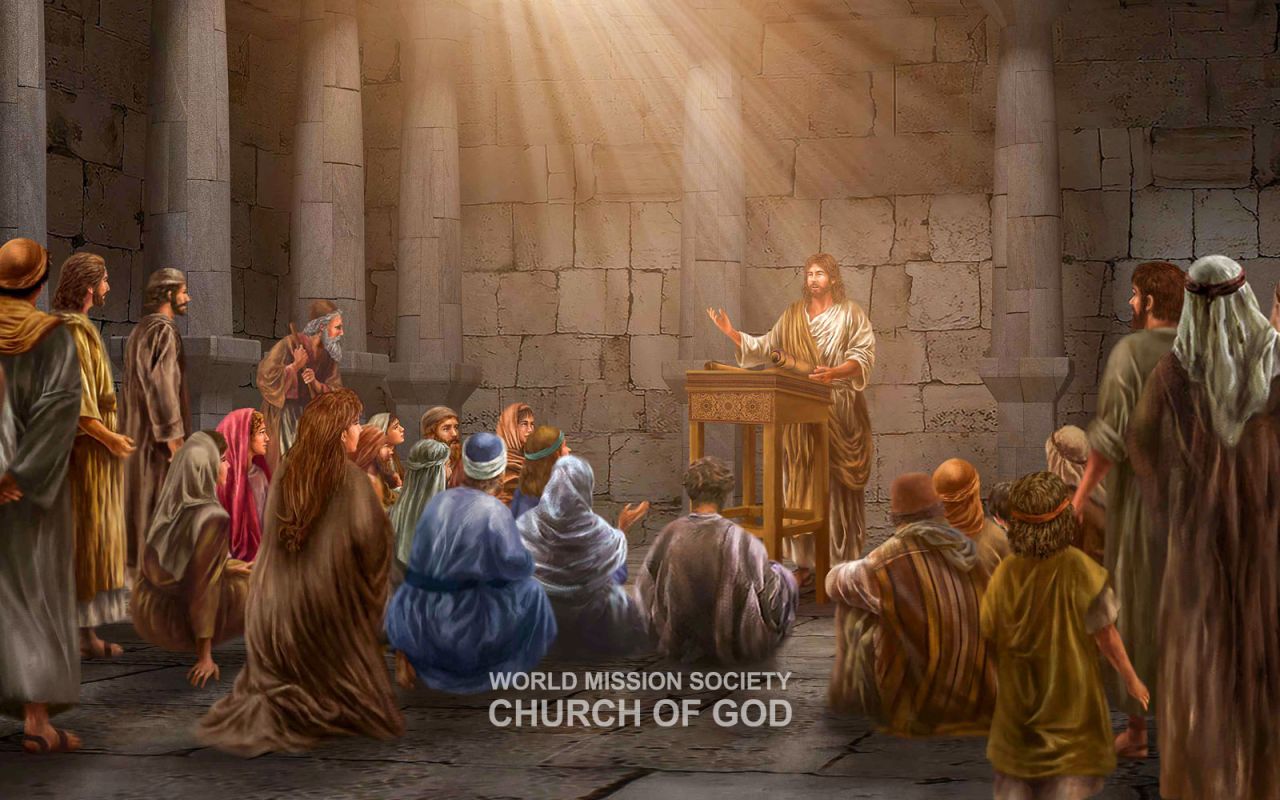
- Ceremony in the New Testament: Jesus, who came as the reality of sacrifice of the Old Testament times,[7][8] preached on the Sabbath day from the Scriptures, setting an example of worshiping in spirit and in truth.[9] Therefore, we worship in spirit and in truth on the Sabbath day in the New Testament times.
- Blessing: ① The Sabbath is a sign between God and His people. If we keep the Sabbath, we are acknowledged as the people of God the Creator.[10] ② Since the Sabbath is the symbol of the eternal rest that we will receive later in heaven, the saints who keep the Sabbath day holy can enter the kingdom of heaven.[11]
Annual Feasts
The annual feasts of God originated from the work of Moses. When the Israelites were enslaved in Egypt, God appointed Moses as their leader to free them and lead them to Canaan. Moses’ work for about a year from the time of the Exodus became the origin of each feast. This shows us Jesus’ work of salvation—how He would come as our Savior, free the people of God from the sinful world, and lead them to the kingdom of heaven, that is, the heavenly Canaan.[12][13][14]
The annual feasts consist of seven feasts, which are grouped into three times, hence they are called the Seven Feasts in Three Times. Three representative feasts are the Feast of Unleavened Bread, the Feast of Weeks, and the Feast of Tabernacles.[2]
- First Time: Passover, Feast of Unleavened Bread
- Second Time: Day of Firstfruits, Feast of Weeks
- Third Time: Feast of Trumpets, Day of Atonement, Feast of Tabernacles
Passover


- Date: Evening of the 14th day of the first month (Nisan) by the sacred calendar
- Origin: The word Passover means “disasters pass over.” It originated from the history of the Israelites, who were slaves in Egypt; around the 15th century B.C., they were protected from the plague and were set free by keeping the Passover.[15] Passover in Hebrew is pesach (פֶּסַח) which is derived from the word pasach (פָּסַח), meaning “to pass over.” In Greek, it is pascha (πασχα).
- Ceremony in the Old Testament: They slaughtered a year-old lamb and put the blood on the sides and tops of the doorframes. They ate the meat roasted over the fire, with bitter herbs and bread made without yeast. They did not leave any of it until morning. They did not break the bones of the Passover lambs.[16][17][18]
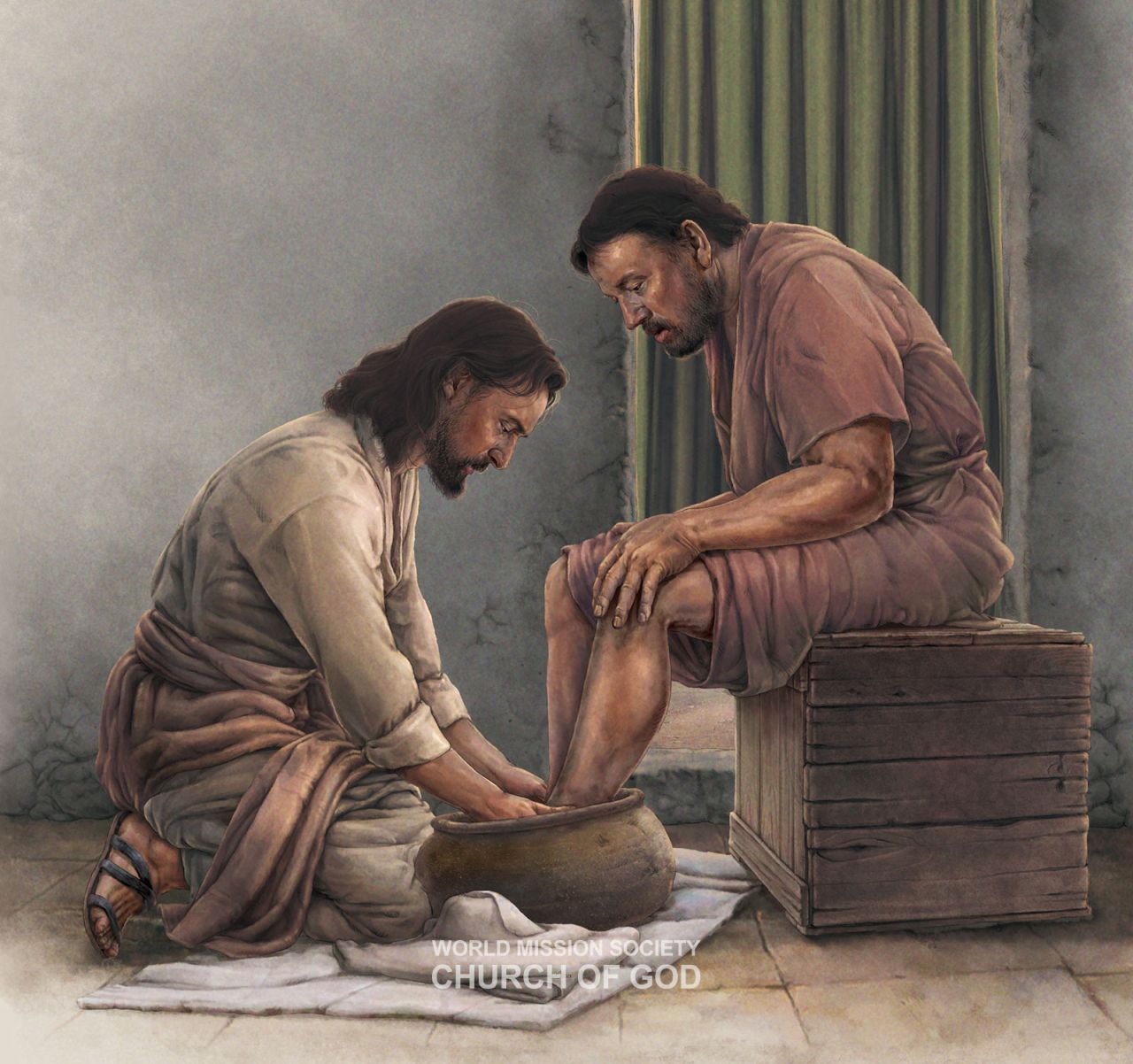
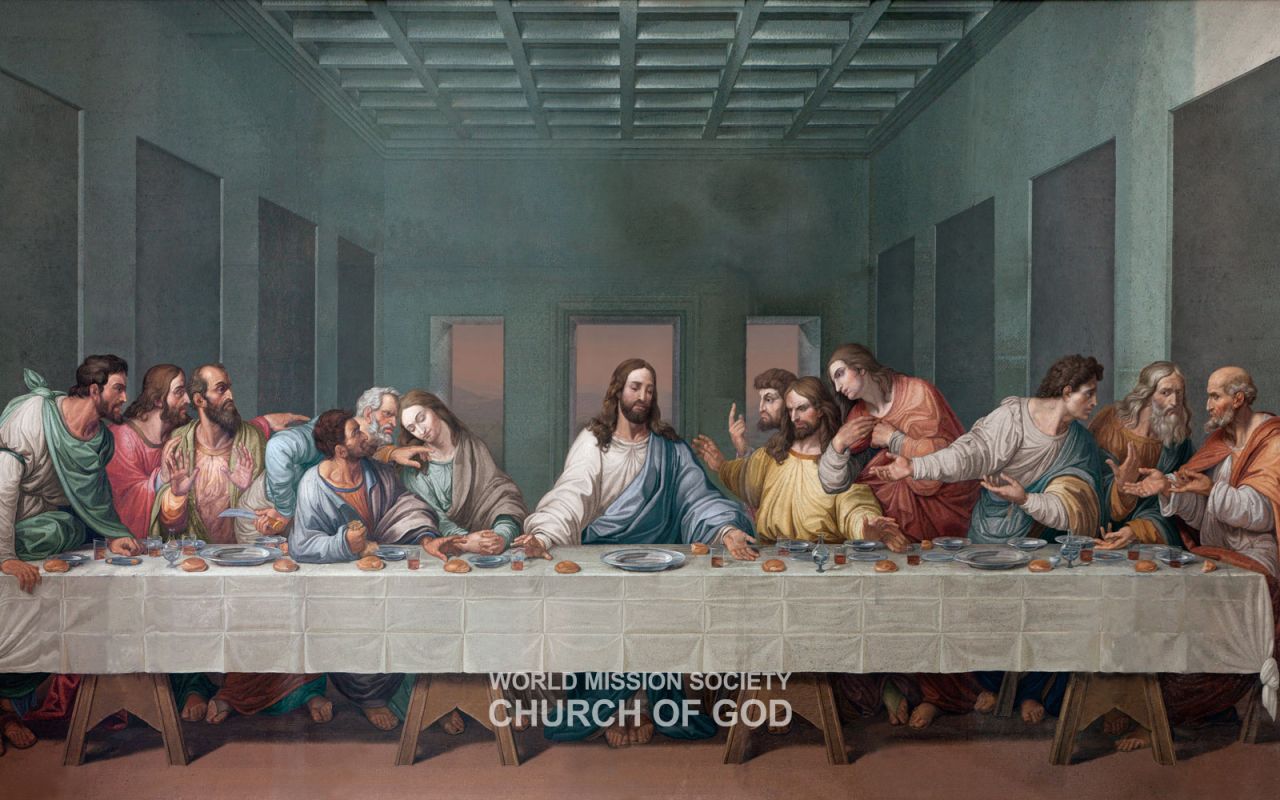
- Ceremony in the New Testament: After the Foot-Washing Ceremony,[19] we eat bread and wine, which represent the flesh and blood of Jesus, the reality of the Passover lamb.[20][21]
- History: The first Passover was celebrated at the time of the Israelites’ Exodus. They kept the Passover a second time the following year,[22] in the Desert of Sinai, and a third time on the plains of Jericho at the end of their 40-year journey, then they entered Canaan that year.[23] In the time of Hezekiah, which was about 800 years after the time of Moses, the Israelites kept the Passover.[24] It is also recorded in the Bible that King Josiah kept the Passover and God acknowledged him to have obeyed all the laws of God with all his heart, soul, and strength.[25] In the New Testament times, Jesus Christ established the Passover of the new covenant. Keeping the Passover with bread and wine, which represent His flesh and blood, Jesus opened the way to the forgiveness of sins and eternal life for mankind.[21] The apostles and the saints of the early Church kept the Passover of the new covenant every year on the evening of the 14th day of the first month by the sacred calendar since Jesus’ ascension.[20]
- Blessing: ① Jesus said that whoever eats and drinks His flesh and blood will receive the forgiveness of sins and eternal life.[21][26] The Passover is the truth that frees all human beings from their slavery to sin and death caused by their sins.[27][28] ② Those who eat the flesh and drink the blood of Jesus on the Passover can remain in God and become God’s possessions,[29] and be protected from disasters.[30] ③ The Passover is the day when other gods are judged;[31] through the Passover, we can fully keep the first commandment, “You shall have no other gods before me.”[32]
Feast of Unleavened Bread

- Date: The 15th day of the first month by the sacred calendar
- Origin: After Jacob moved to Egypt with his family at Joseph’s recommendation, the Israelites prospered greatly. The new Pharaoh, who knew nothing about Joseph, felt threatened by the large population of Israel and enslaved them.[33] After about 400 years of brutal slavery, the Israelites kept the Passover under the guidance of Moses, the prophet sent by God, and were delivered from Egypt the next day.[15] On the 15th day of the first month by the sacred calendar, the Israelites, who departed from Rameses, arrived in front of the Red Sea, and camped there.[34] Meanwhile, Pharaoh changed his mind and began to chase the Israelites. Having fallen in a dilemma, the people grumbled against Moses. Then God divided the Red Sea with the staff of Moses and led the people through the sea.[35] All the people were in tension and fear until they crossed the sea. God appointed the Feast of Unleavened Bread to have them remember their suffering.
- Ceremony in the Old Testament: They ate unleavened bread for seven days from the 15th day of the first month by the sacred calendar[36] to commemorate the sufferings they had experienced until they crossed the Red Sea.
- Ceremony in the New Testament: The saints participate in Christ’s suffering by worshiping and fasting on the Feast of Unleavened Bread.[37]
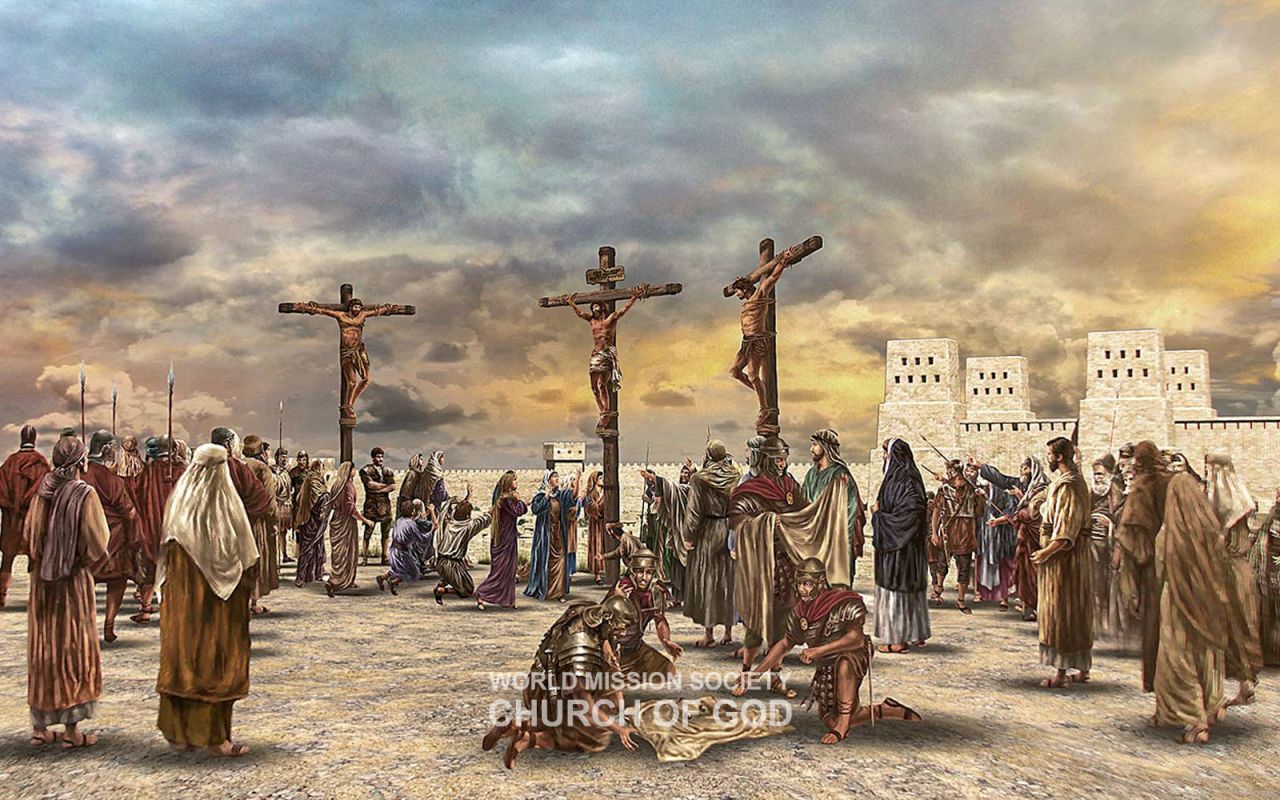
- Fulfillment of the Prophecy: The Feast of Unleavened Bread represents the suffering of Jesus on the cross. After keeping the last Passover with His disciples, Jesus was arrested that night and went through all kinds of affliction.[38] The following day, He suffered on the cross for hours from nine in the morning to three in the afternoon.[39] The Israelites’ entering the Red Sea represents Jesus’ entering the tomb, and their landing from the Red Sea represents Jesus’ resurrection. This meaning is shown through baptism.[40][41]
Day of Firstfruits (Day of Resurrection)

- Date: The day (Sunday) after the first Sabbath following the Feast of Unleavened Bread
- Origin: The Israelites faced an intense and fearful moment as the Egyptian army pursued them, but they overcame the crisis safely with God’s help. The people crossed the Red Sea and landed from the Red Sea at dawn on the 22nd day of the first month by the sacred calendar, and the Egyptian army was drowned in the Red Sea.[42] God appointed the day they landed from the Red Sea as the Day of Firstfruits, so they could remember God’s powerful work for generations to come.
- Ceremony in the Old Testament: On the day after the Sabbath following the Feast of Unleavened Bread, a sheaf of the first grain was waved and offered to God.[43] In addition, a burnt offering, a grain offering, and a drink offering were offered according to the regulations. The people were able to eat new grain after the ceremony of the Day of Firstfruits.[44]
- Ceremony in the New Testament: The ceremony of breaking bread is conducted, following the example of Jesus.[45]
- Fulfillment of the Prophecy: In the Old Testament times, the offering of the Day of Firstfruits represents Jesus Christ. By being resurrected, Jesus became “the firstfruits of those who had fallen asleep.”[46] Just as the offering of the Day of Firstfruits was presented on the day after the first Sabbath following the Feast of Unleavened Bread, Jesus was resurrected on the day after the first Sabbath following His death on the cross on the Feast of Unleavened Bread.[47] According to this prophecy, the Resurrection Day, which commemorates the resurrection of Jesus, is celebrated on Sunday, the day after the first Sabbath following the Feast of Unleavened Bread.
Feast of Weeks (Pentecost)
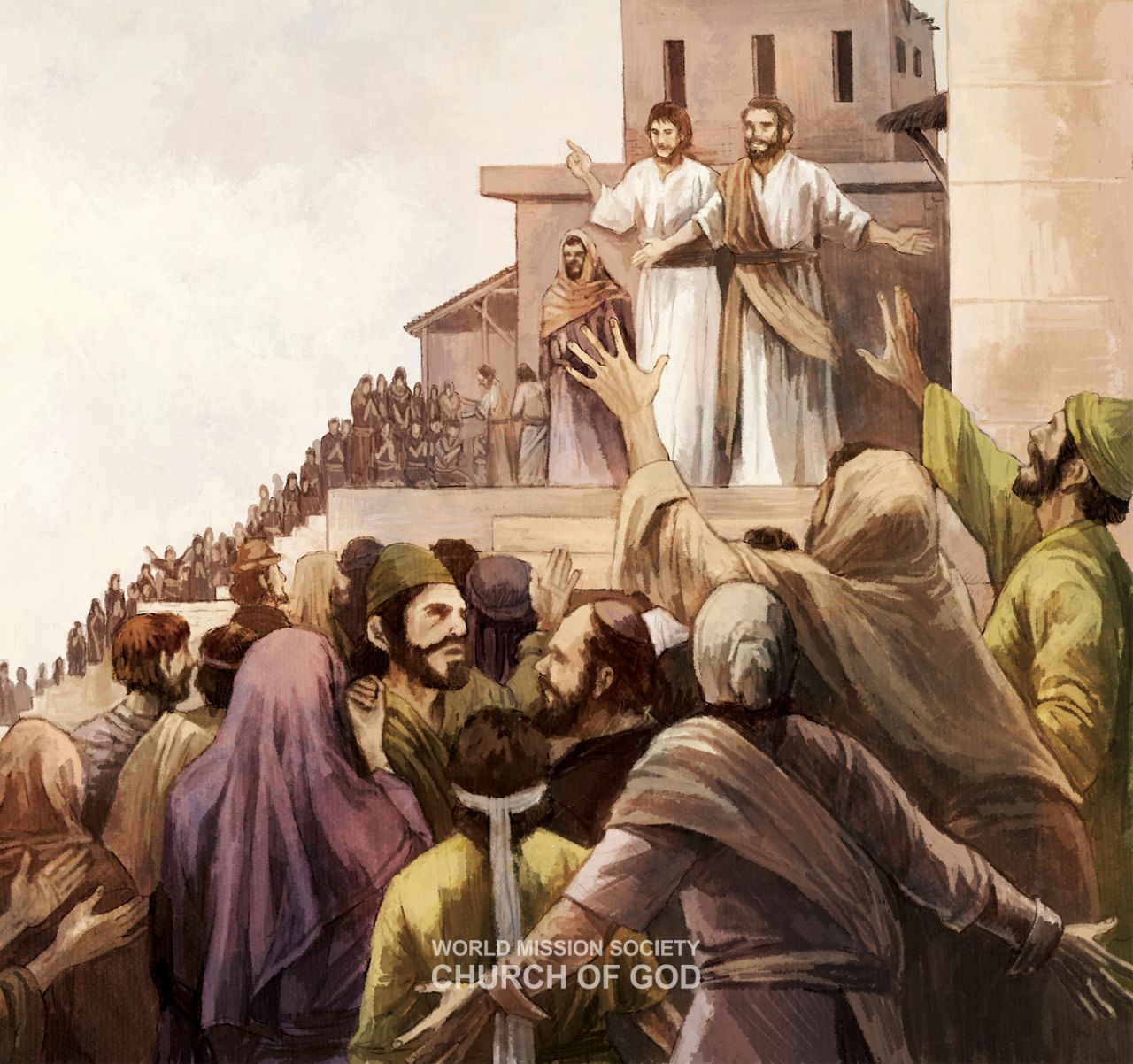

- Date: The 50th day from the Day of Firstfruits (Resurrection Day)
- Origin: On the fortieth day after the Israelites crossed the Red Sea, Moses went up on Mount Sinai at the call of God.[48] Three days later, God descended on Mount Sinai, declared the covenant,[49] and told Moses to come up again to receive the tablets of stone with the law and commands written on them. On the fiftieth day after crossing the Red Sea, Moses went up to Mount Sinai and received the tablets of stone of the Ten Commandments from God while staying there for 40 days.[50] God appointed the day Moses went up Mount Sinai to receive the Ten Commandments as the Feast of Weeks and had the Israelites commemorate it.
- Ceremony in the Old Testament: On the fiftieth day after the Day of Firstfruits, they presented an offering of new grain to God[51] and offered a burnt offering in accordance with the feast.[52]
- Ceremony in the New Testament: In obedience to Jesus’ command, “Do not leave Jerusalem, but wait for the gift my Father promised,”[53] about 120 saints prayed earnestly for ten days after the Ascension Day. On the fiftieth day after Jesus’ resurrection, they gathered in Mark’s upper room to celebrate the Day of Pentecost.[54] Since then, the saints of the early Church kept the Pentecost, praying for the Holy Spirit, every year.[55][56]
- Fulfillment of the Prophecy: Moses went up Mount Sinai to receive the Ten Commandments on the fiftieth day after crossing the Red Sea. This represented that Jesus would enter the Most Holy Place in heaven on the fiftieth day after His resurrection (Day of Pentecost) and pour out the Holy Spirit.[57] Just as Jesus said, “You will receive power when the Holy Spirit comes on you, and you will be my witnesses in Jerusalem, and in all Judea and Samaria, and to the ends of the earth,”[58] the Holy Spirit of Pentecost became a catalyst for the spread of the gospel of Jesus Christ throughout the world. Since then, the early Church grew rapidly.[59][60] However, after the apostles died, the church, having become secularized and corrupt, forsook the truth and began to practice lawlessness. This provoked God to take back the Holy Spirit which was poured on the Day of Pentecost. This was a fulfillment of the prophecy of Moses breaking the tablets of the Ten Commandments that he had received, when he saw the Israelites worshiping an idol while he was coming down the mountain.[61][62]
Feast of Trumpets

- Date: The 1st day of the seventh month by the sacred calendar
- Origin: When Moses did not come down from Mount Sinai, even 40 days after going up there to receive the Ten Commandments, they thought he was dead, made a golden calf, and worshiped it as a god to lead them. This made God furious, and upon seeing the people worshiping the idol, Moses broke the tablets of stone of the Ten Commandments. On that day, about 3,000 people who had participated in idolatry were killed.[61] After this took place, Moses pitched a tent outside the camp some distance away and prayed to God. The people removed all of their ornaments, and stood and worshiped God, each at the entrance to his tent.[63] God forgave the people’s sins and commanded Moses to come up Mount Sinai to receive the Ten Commandments again. Moses prepared the tablets of stone, went up Mount Sinai on the first day of the sixth month by the sacred calendar,[64] stayed there for forty days, and came down on the tenth day of the seventh month after receiving the second set of the Ten Commandments.[65] God appointed this day as the Day of Atonement and sounded a trumpet on the first day of the seventh month, ten days before the Day of Atonement. This is the Feast of Trumpets.[66]
- Ceremony in the Old Testament: In preparation for the Day of Atonement, they sounded the trumpet calling for repentance. They forbade any work and offered a grain offering and a burnt offering according to the feast.[67]
- Ceremony in the New Testament: We have a worship service to prepare for the Day of Atonement by confessing to God our sins committed for the past year and offering prayers of repentance.[9]
Day of Atonement
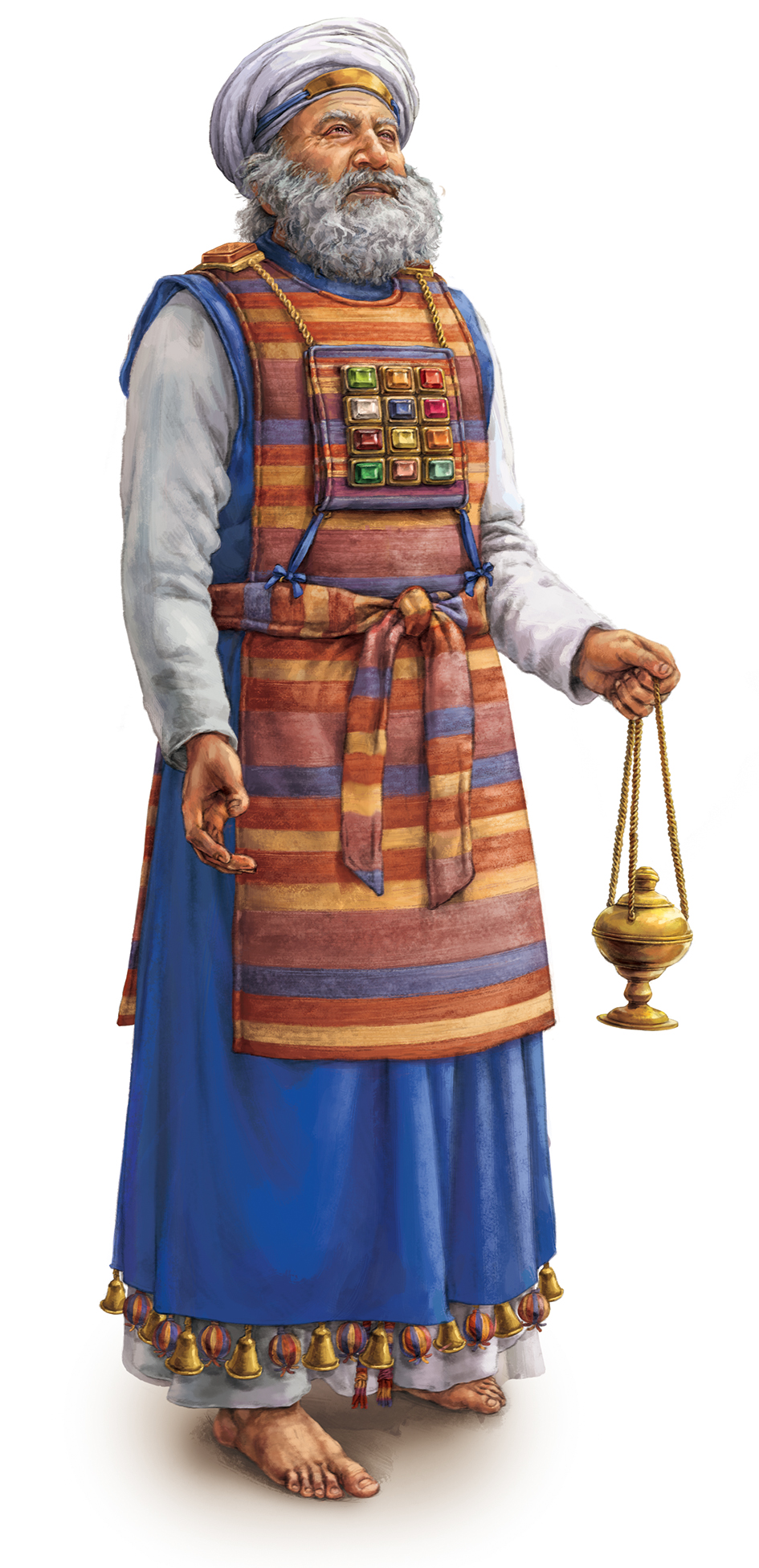

- Date: The 10th day of the seventh month by the sacred calendar
- Origin: The Day of Atonement originated from the day when Moses came down the mountain after receiving the second set of the Ten Commandments.[65][68] Allowing the Israelites to receive the Ten Commandments again contains God’s will to forgive them.
- Ceremony in the Old Testament: The high priest offered a bull for a sin offering and a ram for a burnt offering.[69] And from the people he took two male goats for a sin offering and a ram for a burnt offering. He cast lots for the two goats—one lot for God and the other for the scapegoat. After laying his hand on the head of the scapegoat for the people’s sins, he sent it to a solitary place in the desert.[70] After slaughtering the sin offerings, the high priest went into the Most Holy Place with the censer and the blood of the sin offerings to perform a ceremony for atonement.[71]
- Ceremony in the New Testament: It is a day to confess our sins and be forgiven. We worship in spirit and in truth.[9]
- Fulfillment of the Prophecy: The ceremony performed on the Day of Atonement in the Old Testament shows the principle of the forgiveness of sins. When a person sinned, he brought an animal to the priests to be sacrificed for his sin. When the priest carried out the rite of atonement by slaughtering the animal and shedding its blood,[72] the sin was first carried over to the sanctuary and eventually handed over to the scapegoat on the Day of Atonement. As a result, the sanctuary was cleansed, and the sin ceased to exist as the scapegoat died while wandering around the desert. The sanctuary and the sin offering represent Christ,[73][74] and the scapegoat represents Satan.[75][76] Humans are spiritual sinners who have been cast down from heaven after committing the sin deserving of the death penalty.[77][78][27] God Himself became the sanctuary, took our sins, and was sacrificed on the cross for the sins of all mankind. He took over the sins and transgressions of people for a while but made an atonement at once with His precious blood and handed over all the sins to Satan.[79] This opened the way for mankind to come to the heavenly Most Holy Place,[80] and at the same time, the devil, the author of sin, will carry all the sins and be confined in the abyss, and finally enter the eternal lake of fire.[81]
Feast of Tabernacles


- Date: From the 15th day to the 22nd day of the seventh month by the sacred calendar
- Origin: After Moses received the second of the Ten Commandments and came down the mountain, he explained in detail how to build the Tabernacle for storing the Ten Commandments and the materials for the Tabernacle.[82][83] The people willingly offered the materials for the Tabernacle, and for seven days from the fifteenth day of the month, gold, silver, cloth, and wood were gathered in abundance.[84] God appointed the Feast of Tabernacles to commemorate the Israelites’ gathering of the materials for the Tabernacle.[85][86] It is also called the “Feast of Ingathering,” meaning a feast celebrated in the season to harvest and store crops.[87][88]
- Ceremony in the Old Testament: The people made tabernacles with tree branches, such as palm branches and myrtle branches, and rejoiced, staying there for seven days.[89] They helped each other in need and kept the feast holy.[90]
- Ceremony in the New Testament: A preaching festival is held for seven days to gather the saints, the temple materials.[91][92]
- Fulfillment of the Prophecy: The Feast of Tabernacles is a prophecy of preaching to gather the saints, the materials of the spiritual temple in the New Testament. Jesus set an example of preaching on the Feast of Tabernacles and gave us the blessing of the Holy Spirit, the water of life, on the last day of the Feast.[93] The Bible sometimes describes the Holy Spirit as rain.[94][95][96] God’s promise to bring rain on those who come to Jerusalem to celebrate the Feast of Tabernacles[97] is fulfilled as God gives us the Holy Spirit on that day. In Revelation 22, it is prophesied that the Spirit and the Bride, God the Father and God the Mother,[98][99] will give the water of life in the last days.[100] Just as those who believed in Jesus in the Age of the Son received the water of life, in the Age of the Holy Spirit, those who believe in the Holy Spirit and the Bride, the Second Coming Jesus and the Jerusalem Mother, can receive the promised Holy Spirit on the Feast of Tabernacles.
Seven Feasts in Three Times
| Feasts | Content |
| Passover | Date: Evening of the 14th day of the first month by the sacred calendar
Origin: The Israelites were freed from Egypt by the power of the Passover Ceremony in Old Testament: Slaughtering a year-old male lamb, eating the meat roasted over fire, with unleavened bread and bitter herbs Ceremony in New Testament: Eating bread and wine, which represent Jesus’ flesh and blood Fulfillment of Prophecy: Jesus established the new covenant on the Passover and freed mankind from this sinful world. |
| Feast of Unleavened Bread | Date: The 15th day of the first month by the sacred calendar
Origin: The Israelites suffered until they had crossed the Red Sea after coming out of Egypt Ceremony in the Old Testament: Eating unleavened bread. Ceremony in the New Testament: Fasting Fulfillment of Prophecy: Christ’s suffering on the cross |
| Day of Firstfruits (Day of Resurrection) | Date: The day (Sunday) after the first Sabbath following the Feast of Unleavened Bread
Origin: The day the Israelites landed from the Red Sea Ceremony in the Old Testament: A sheaf of the first grain was offered as a wave offering Ceremony in the New Testament: Breaking bread Fulfillment of Prophecy: Resurrection of Jesus Christ |
| Feast of Weeks (Pentecost) | Date: The 50th day after the Day of Firstfruits
Origin: The day Moses went up to receive the Ten Commandments for the first time Ceremony: An offering of new grain was presented to God Fulfillment of Prophecy: Jesus poured out the Holy Spirit on the 50th day after resurrection |
| Feast of Trumpets | Date: The 1st day of the seventh month by the sacred calendar
Ceremony in the Old Testament: Preparing for the Day of Atonement by blowing a trumpet. Ceremony in the New Testament: Contrite prayer |
| Day of Atonement | Date: The 10th day of the seventh month by the sacred calendar
Origin: Moses received the second set of the Ten Commandments and came down Ceremony in the Old Testament: The high priest entered the Most Holy Place and made atonement. A scapegoat was sent to a solitary place in the desert. Ceremony in the New Testament: Confessing our sins and keeping worship Fulfillment: Sin is finally passed on from Christ to Satan. |
| Feast of Tabernacles | Date: From the 15th day to the 22nd day of the seventh month by the sacred calendar
Origin: The Israelites gathered materials for the tabernacle: Ceremony in the Old Testament: Building tabernacles and staying there for seven days. Ceremony in the New Testament: Preaching festival for 7 days Fulfillment of Prophecy: The work of preaching to gather materials for the spiritual temple |
The Reason We Should Keep the Feasts of God
It is God who instituted the feasts and commanded us to keep them. Every single law established by God is related to our salvation and has God’s will in it. The feasts of the Bible are also closely related to salvation. Some insist that the feasts, including the Sabbath, have been abolished in the New Testament, quoting some verses such as “I will stop her Sabbath days, all her appointed feasts” (Hosea 2:11), “Do not let anyone judge you with regard to a religious festival, a New Moon celebration, or a Sabbath day” (Colossians 2:16), “You are observing special days and months and seasons and years! I fear for you that somehow I have wasted my efforts on you” (Galatians 4:10–11). However, the words in the book of Hosea are a warning against the worshipers of Baal,[101] not the people of God. The words in the books of Colossians and Galatians mean that there is no need to keep the feasts of the law of Moses any longer since Jesus had established the law of Christ through His sacrifice on the cross.[102][103]
The Bible calls those who keep the feasts of God the saints. Without keeping the feasts of God, we cannot be those who are saved. This shows that the feasts of God are essential qualifications for the saints to enter the kingdom of heaven. Jesus, who came as the Savior in the New Testament times, too set an example of keeping the feasts of the new covenant. Those who keep the feasts, which are God’s commandments, by worshiping in spirit and in truth, can receive the blessing of the forgiveness of sins,[104] according to the teachings of Jesus. It is because the feasts of the new covenant give the blessings of the forgiveness of sins and eternal life through the blood of Christ.
He summons the heavens above, and the earth, that he may judge his people: “Gather to me my consecrated ones, who made a covenant with me by sacrifice.”
This calls for patient endurance on the part of the saints who obey God’s commandments and remain faithful to Jesus.
The saints of the New Testament are likened to the temple of God.[105] A temple is a place where sacrifices are offered to God according to the words of the covenant. In the Old Testament times, sacrifices were offered in the temple at the appointed times, such as the annual feasts and the Sabbath. The Old Testament sacrifices were offered with the blood of animals in the temple, but they were replaced by spiritual sacrifices offered by the saints in the New Testament, which is to worship God in spirit and in truth. Since it is written that each saint is the temple of God, those who keep the feasts of God, such as the Sabbath and the seven feasts in three times, can be acknowledged as the saints who will be saved through the blood of Christ.
See also
- Sabbath
- Passover
- Feast of Unleavened Bread
- Feast of Firstfruits
- Feast of Weeks
- Feast of Trumpets
- Day of Atonement
- Feast of Tabernacles
- Day of Resurrection
- Pentecost
References
- ↑ "Leviticus 23".
- ↑ 2.0 2.1 "Deuteronomy 16:16".
- ↑ "Genesis 2:1–3".
- ↑ "Numbers 28:9–10".
- ↑ "Leviticus 24:5–8".
- ↑ "Exodus 20:8–11".
- ↑ "Hebrews 9:11–12".
- ↑ Chapter 32 The Passover and the Last Supper, THE MYSTERY OF GOD AND THE SPRING OF THE WATER OF LIFE, Ahnsahnghong, pg. 202, Melchizedek Pub. Co., Ltd
- ↑ 9.0 9.1 9.2 "John 4:21–23".
- ↑ "Exodus 31:13".
- ↑ "Isaiah 56:1–7".
- ↑ "Deuteronomy 18:18".
- ↑ "Acts 3:20–24".
- ↑ "Hebrews 3:2–6".
- ↑ 15.0 15.1 "Exodus 12".
- ↑ "Deuteronomy 16:1–7".
- ↑ "Numbers 9:11–12".
- ↑ "Exodus 12:42–47".
- ↑ "John 13:4–15".
- ↑ 20.0 20.1 "1 Corinthians 5:7–8".
- ↑ 21.0 21.1 21.2 "Matthew 26:19–28".
- ↑ "Numbers 9:1–5".
- ↑ "Joshua 5:10–12".
- ↑ "2 Chronicles 30:1–12".
- ↑ "2 Kings 23:21–25".
- ↑ "John 6:53–54".
- ↑ 27.0 27.1 "Romans 6:23".
- ↑ "John 8:34".
- ↑ "John 6:56".
- ↑ "Isaiah 43:1–2".
- ↑ "Exodus 12:11–13".
- ↑ "Exodus 20:1–3".
- ↑ "Exodus 1:7–14".
- ↑ "Exodus 12:29–39".
- ↑ "Exodus 14:19–25".
- ↑ "Leviticus 23:4–6".
- ↑ "Mark 2:19–20".
- ↑ "Isaiah 53:3–8".
- ↑ "Matthew 26-27".
- ↑ "1 Corinthians 10:1–2".
- ↑ "1 Peter 3:21".
- ↑ Exodus 14
- ↑ "Leviticus 23:10–11".
- ↑ "Leviticus 23:12–14".
- ↑ "Luke 24:30–31".
- ↑ "1 Corinthians 15:20".
- ↑ "Mark 16:1–9".
- ↑ "Exodus 19:1–7".
- ↑ "Exodus 19:16–23:33".
- ↑ "Exodus 24:12–18".
- ↑ "Leviticus 23:15–18".
- ↑ "Numbers 28:26–31".
- ↑ "Acts 1:3–4".
- ↑ "Acts 1:13–15".
- ↑ "1 Corinthians 16:8".
- ↑ "Acts 20:6–16".
- ↑ Chapter 2 The Seven Feasts in Three Times, THE MYSTERY OF GOD AND THE SPRING OF THE WATER OF LIFE, Ahnsahnghong, pg. 17, Melchizedek Pub. Co., Ltd
- ↑ "Acts 1:3–9".
- ↑ "Acts 2:14–41".
- ↑ "Acts 4:1–4".
- ↑ 61.0 61.1 "Exodus 32:1–19, 27-28".
- ↑ Chapter 15 The Feasts of God, MY SHEEP LISTEN TO MY VOICE, Joo-cheol Kim, pg. 172, Melchizedek Pub. Co., Ltd
- ↑ "Exodus 33:1–11".
- ↑ "Exodus 34:1–4".
- ↑ 65.0 65.1 "Exodus 34:28–29".
- ↑ "Leviticus 23:23–27".
- ↑ "Numbers 29:1–6".
- ↑ "Leviticus 23:26–31".
- ↑ "Leviticus 16:3".
- ↑ "Leviticus 16:5–10".
- ↑ "Exodus 30:1–10".
- ↑ "Leviticus 4:1–5:13".
- ↑ "Jeremiah 17:12–13".
- ↑ "John 1:29".
- ↑ Chapter 15 The Feasts of God, MY SHEEP LISTEN TO MY VOICE, Joo-cheol Kim, pg. 180, Melchizedek Pub. Co., Ltd
- ↑ Azazel, Bible Hub
- ↑ "Luke 19:10".
- ↑ "Matthew 9:12–13".
- ↑ "Hebrews 10:1–4, 9-11".
- ↑ "Hebrews 10:19–20".
- ↑ "Revelation 20:1–10".
- ↑ "Exodus 34:4–35".
- ↑ "Exodus 35:4–19".
- ↑ "Exodus 35:29–36:7".
- ↑ "Numbers 29:11–38".
- ↑ "Deuteronomy 16:13–15".
- ↑ "Exodus 23:16".
- ↑ "Exodus 34:22".
- ↑ "Leviticus 23:33–42".
- ↑ "Deuteronomy 16:13–15".
- ↑ "Revelation 3:12".
- ↑ "Ephesians 2:20–22".
- ↑ "John 7:2–39".
- ↑ "Hosea 6:3".
- ↑ "Joel 2:23".
- ↑ "Zechariah 10:1".
- ↑ "Zechariah 14:12–21".
- ↑ "Revelation 21:9–10".
- ↑ "Galatians 4:26".
- ↑ "Revelation 22:17".
- ↑ "Hosea 2:8–13".
- ↑ "Colossians 2:14–17".
- ↑ "Galatians 4:3–9".
- ↑ "Isaiah 33:20–24".
- ↑ "1 Corinthians 3:16–17".