Sanctuary (Tabernacle): Difference between revisions
No edit summary |
No edit summary Tag: Manual revert |
||
| (5 intermediate revisions by 2 users not shown) | |||
| Line 1: | Line 1: | ||
{{그림 |성소(성막) 모형.jpg |너비= 300px |정렬=오른쪽섬네일 |타이틀=Sanctuary (Tabernacle)}} | <!-- interlanguage:start -->[[ko:성소 (성막)]][[vi:Nơi thánh (đền tạm)]][[es:El santuario (tabernáculo)]][[ne:पवित्रस्थान (पवित्र वासस्थान)]][[pt:O Santuário (Tabernáculo)]]<!-- interlanguage:end -->{{그림 |성소(성막) 모형.jpg |너비= 300px |정렬=오른쪽섬네일 |타이틀=Sanctuary (Tabernacle)}} | ||
'''Sanctuary''' means a holy place<ref>{{Cite web |url=https://www.britannica.com/topic/sanctuary-religion |title=sanctuary |website=Britannica |date= |author= |page= |quote= }}</ref>, where God dwells among people. In the sanctuary, the original engraved tablets of the [[The Ten Commandments|Ten Commandments]], God’s covenant, was kept, and the forgiveness of sins '''''occurred''''' for the Israelites. It consists of an outer place and an inner place, and the first sanctuary was in the form of a movable tent called '''tabernacle.''' Later on, when they built it in a permanent location, it was called '''[[temple]].''' | '''Sanctuary''' means a holy place<ref>{{Cite web |url=https://www.britannica.com/topic/sanctuary-religion |title=sanctuary |website=Britannica |date= |author= |page= |quote= }}</ref>, where God dwells among people. In the sanctuary, the original engraved tablets of the [[The Ten Commandments|Ten Commandments]], God’s covenant, was kept, and the forgiveness of sins '''''occurred''''' for the Israelites. It consists of an outer place and an inner place, and the first sanctuary was in the form of a movable tent called '''tabernacle.''' Later on, when they built it in a permanent location, it was called '''[[temple]].''' | ||
| Line 53: | Line 53: | ||
In the sanctuary where God dwelled, the forgiveness of sins was fulfilled. Sinners could not receive the Ten Commandments, which God gave instead of the tree of life. As it is written, “Without the shedding of blood there is no forgiveness” (Heb 9:22),<ref>{{Cite web |url=https://www.biblegateway.com/passage/?search=Hebrews+9%3A22&version=NIV |title=Hebrews 9:22 |publisher= |quote= }}</ref>the blood of the sacrifice of a sin offering was needed for the forgiveness of sins. Since the time of [[Cain and Abel|Abel]], the tradition of blood sacrifice had been handed down by word of mouth, and it was codified in the time of Moses. | In the sanctuary where God dwelled, the forgiveness of sins was fulfilled. Sinners could not receive the Ten Commandments, which God gave instead of the tree of life. As it is written, “Without the shedding of blood there is no forgiveness” (Heb 9:22),<ref>{{Cite web |url=https://www.biblegateway.com/passage/?search=Hebrews+9%3A22&version=NIV |title=Hebrews 9:22 |publisher= |quote= }}</ref>the blood of the sacrifice of a sin offering was needed for the forgiveness of sins. Since the time of [[Cain and Abel|Abel]], the tradition of blood sacrifice had been handed down by word of mouth, and it was codified in the time of Moses. | ||
In the Old Testament times, the priests sacrificed animals and shed their blood for the forgiveness of sins of the people in the sanctuary according to the [[Law of Moses]]. The sins of the people were temporarily transferred to the sanctuary through the sacrifices on the Sabbath and the feasts, and the sins were finally handed over to a [https://www.britannica.com/topic/scapegoat scapegoat] on the [[Day of Atonement]]. This is a shadow of how the sins of the saints will be temporarily transferred to Christ and then to Satan (the devil) through the feast in the New Testament times. The scapegoat died while wandering around in a solitary place, and the sins of the people were completely forgiven. | In the Old Testament times, the priests sacrificed animals and shed their blood for the forgiveness of sins of the people in the sanctuary according to the [[The Law of Moses]]. The sins of the people were temporarily transferred to the sanctuary through the sacrifices on the Sabbath and the feasts, and the sins were finally handed over to a [https://www.britannica.com/topic/scapegoat scapegoat] on the [[Day of Atonement]]. This is a shadow of how the sins of the saints will be temporarily transferred to Christ and then to Satan (the devil) through the feast in the New Testament times. The scapegoat died while wandering around in a solitary place, and the sins of the people were completely forgiven. | ||
=== Earthly Sanctuary and Heavenly Sanctuary === | === Earthly Sanctuary and Heavenly Sanctuary === | ||
Latest revision as of 14:16, 23 April 2026
_%EB%AA%A8%ED%98%95.jpg)
Sanctuary means a holy place[1], where God dwells among people. In the sanctuary, the original engraved tablets of the Ten Commandments, God’s covenant, was kept, and the forgiveness of sins occurred for the Israelites. It consists of an outer place and an inner place, and the first sanctuary was in the form of a movable tent called tabernacle. Later on, when they built it in a permanent location, it was called temple.
Name
In the Old Testament, the word sanctuary is written in Hebrew as miqdash (מִקְדָּשׁ)[2] or qodesh (קֹדֶשׁ)[3], which mean holiness. The sanctuary was called the place where God dwells among the people,[4] or the temple of God.[5]
The sanctuary sometimes only refers to the outer room, or it can refer to both the outer room and the inner room which is also called the Most Holy Place. In a broader sense, it indicates the structure (the tabernacle) where the outer room and the inner room are located or the whole building (the temple). When the sanctuary was built, it was called the tabernacle because it was a tent made of twisted threads, and also called the Tent of Meeting because it was a place to meet God. Since it was the place to store the ark of testimony (ark of the covenant), it was called the Tent of Testimony, too.[6]
Structure

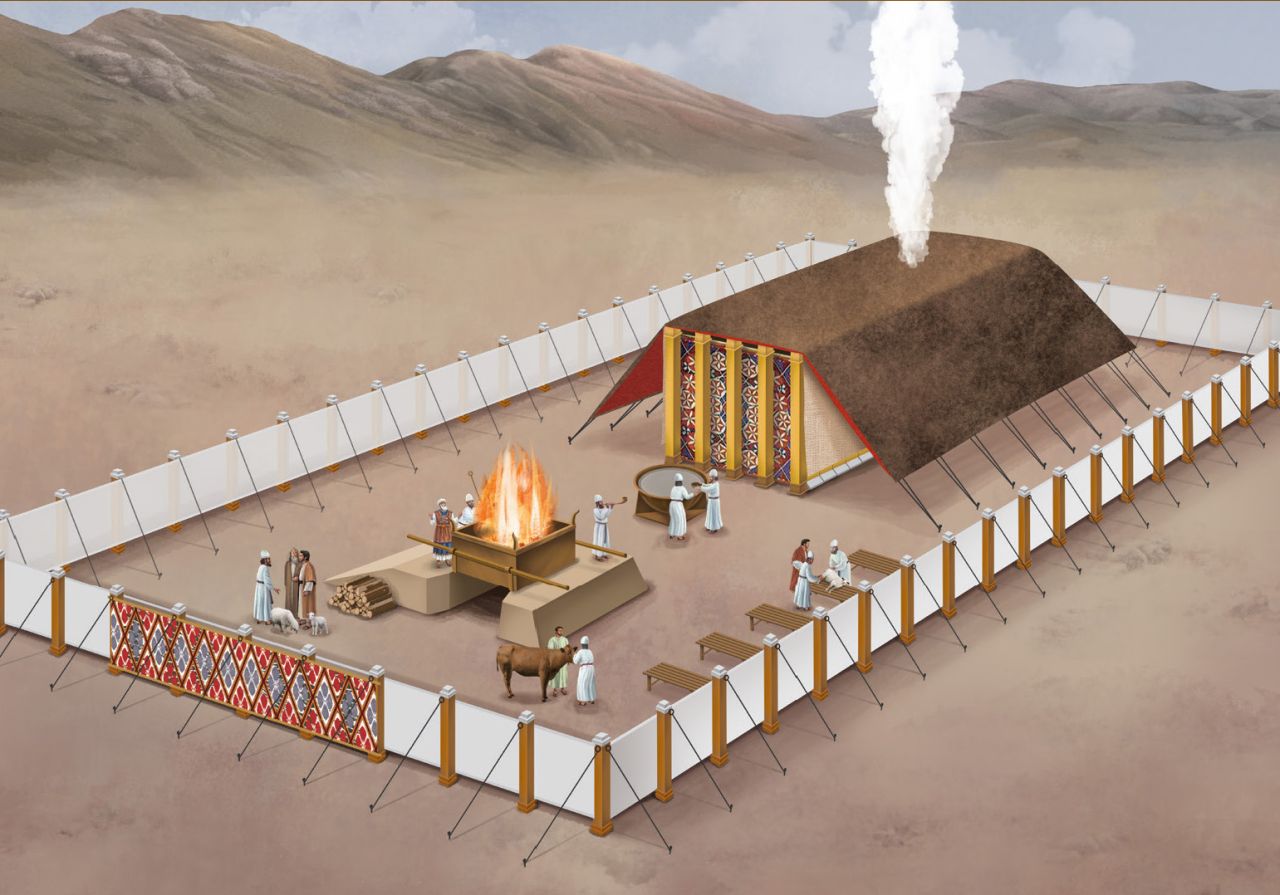
The tabernacle that Moses built was a rectangular-shaped movable temple with 50 cubits wide by 100 cubits long,[7] and it was structured to be easily taken down and reassembled, similar to tents nowadays. Since the Israelites walked around the desert, they could not build a fixed building in one place.
The sanctuary, the most important structure located in the tabernacle, looked like one, but the interior was divided into the front compartment (Holy Place) and the back compartment (Most Holy Place) by a curtain. When the sanctuary was set up, there was a rule: Its back side, where the Most Holy Place is, should face west whereas its front side, where the entrance is, should face the east.[8][9]
Later, it was changed from the movable tabernacle to the stationary temple, but this basic structure and direction were the same.
Now the first covenant had regulations for worship and also an earthly sanctuary. A tabernacle was set up. In its first room were the lampstand, the table and the consecrated bread; this was called the Holy Place. Behind the second curtain was a room called the Most Holy Place, which had the golden altar of incense and the gold-covered ark of the covenant. This ark contained the gold jar of manna, Aaron's staff that had budded, and the stone tablets of the covenant.
Outer Sanctuary
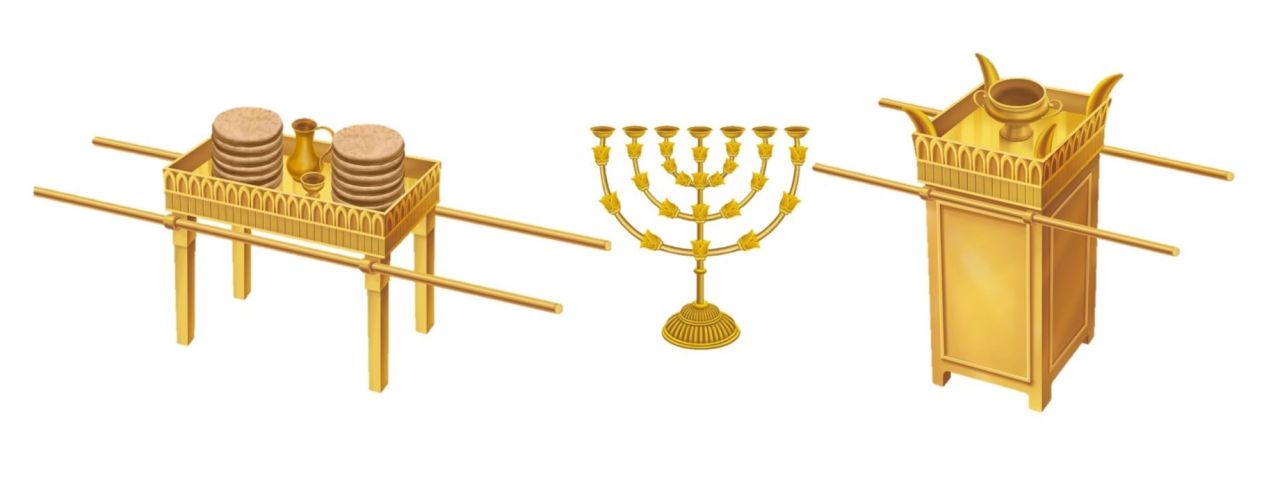

The outer sanctuary is the space from the door of the sanctuary to the front of the curtain. There were the table for the consecrated bread, the golden lampstand, and the altar of incense.
- Table for the Consecrated Bread: It is a table made of wood, measuring two cubits long, a cubit wide, and a cubit and a half high. It was overlaid with pure gold, and a gold molding was made around it. On the table, there were always the bread of the Presence (consecrated bread), its plates and dishes of pure gold, as well as its spoon, pitchers, and bowls for the pouring out of offerings. The bread of the Presence was baked with fine flour, and they were set in two rows, six in each row, on the table. Every Sabbath, the bread was replaced with new ones. It belonged to the high priest and his sons, who ate it in the courtyard of the tabernacles.[10][11]
- Golden Lampstand: The lampstand had a total of seven branches, three on each side, and a cup in the shape of almond flower at the end of each branch. The branches, cups, flowers, and buds shall all be of one piece with the lampstand, hammered out of pure gold. There were the wick trimmers and trays made of pure gold.[12] The seven lamps were used to light the space in front of it. The priests lighted the lamps with clear oil of pressed olives, but kept them on only from evening till morning.[13]
- Altar of Incense: It is made of wood, measuring a cubit long and a cubit wide and two cubits high. All the sides of the top were shaped with the horns, and they were overlaid and molded around with pure gold. Fragrant incense was burnt on the altar every morning and evening when the high priest tended the lamps.[14]
Inner Sanctuary (Most Holy Place)

.jpg)
It is the inner space behind the curtain, and it has the cube structure with the same length, height, and depth. The inner sanctuary is where the ark of the covenant is; the place to store the Ten Commandments. It is called the Most Holy Place because it is considered the most sacred place. No one was allowed to enter the Most Holy Place. Once a year, only the high priest anointed with holy oil can enter it through the sin offering on the Day of Atonement.[15][16]
- Curtain: The cherubim were embroidered on the curtains separating the inner sanctuary from the outer sanctuary. In order to enter the inner sanctuary, they had to go through the curtain.[17]
- Ark of the Covenant: The ark of the covenant is the most important part of the instruments of the tabernacle; it is a wooden chest that is two and a half cubits long, a cubit and a half wide, a cubit and a half high. It was overlaid with pure gold and a gold molding was made around it. Four gold rings were fastened to its four feet and the Levites inserted the poles into the rings on the sides of the chest to carry it. They put the tablets of testimony (the stone tablets of the Ten Commandments) in the ark of the covenant.[18]
- Atonement Cover: The part that covers the ark of the covenant was called the “atonement cover.” God said that He would meet Moses between the two cherubim above the atonement cover. These cherubim represent cherubim who were guarding the tree of life in the Garden of Eden. Here, God’s grace, including the forgiveness of sins, was given to people. The atonement cover is also called the "mercy seat."[19]
Courtyard of the Tabernacle
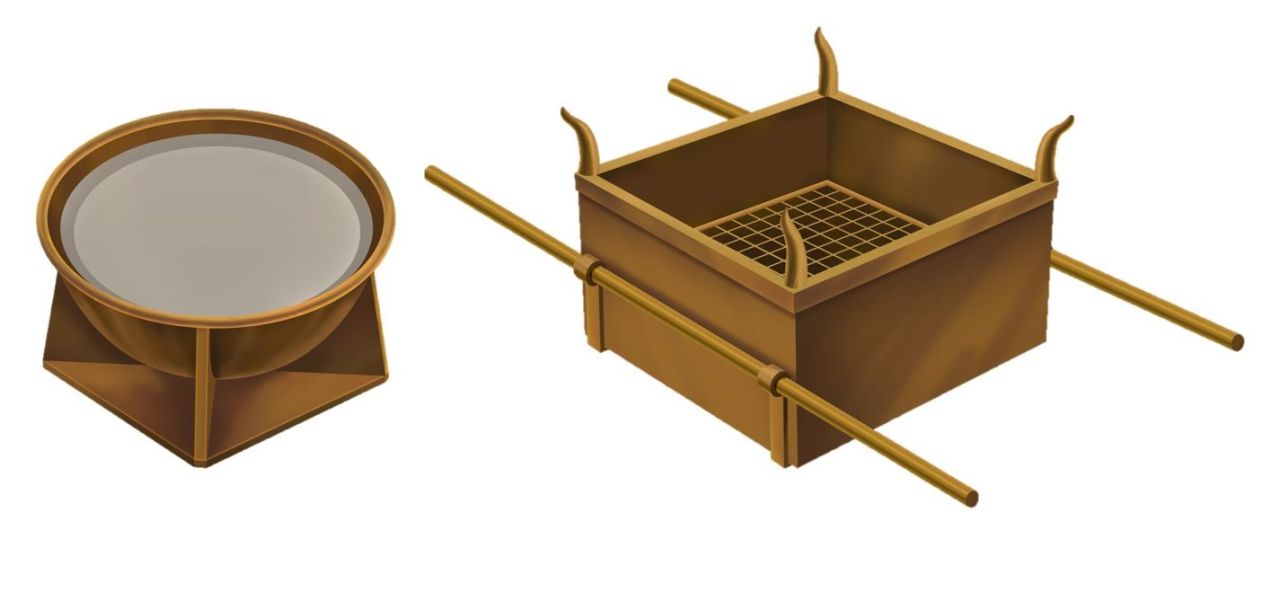

It is a large space that appears when you enter through the entrance to the tabernacle (east gate). The courtyard of the tabernacle was fenced with 60 posts and 300 cubits long curtains of finely twisted linen. Since the posts were five cubits tall (about 2.25 m), people couldn’t see what was carried out inside except through the gate of the tabernacle.
- Altar of Burnt Offering: It is an altar made of bronze for offering sacrifices to God.[20] The priests had to bring the fire from the burnt altar in order to go into the Holy Place and to burn incense.[21][22]
- Basin: It is a basin that contains water to wash the hands and feet of the priests. It was between the altar of burnt offering and the entrance to the Tent of Meeting, and the priests washed their hands and feet before entering the sanctuary.[23]
Tabernacle and History of Israel


When Moses received the stone tablets of the Ten Commandments on Mount Sinai, God showed him the heavenly sanctuary.[24][25] When Moses came down from the mountain, he delivered God’s word to the people and said that they needed various offerings such as gold, silver, bronze, and carved wood for the construction of the tabernacle, and that wise men were needed to make the tabernacle and articles.[26] Among the Israelites, all who were willing brought offerings for the building of the tabernacle.[27] As they kept bringing freewill offerings every day, they were more than enough for building the tabernacle. Moses asked them to stop bringing more. [28] Bezalel and Oholiab, who were filled with the Spirit of God, and every skilled person set up the tabernacle and made all the articles and ornaments in it, including the ark of the covenant and the priestly garments. When the Israelites finished setting up the tabernacle, Moses inspected the work and saw that they had done it just as God had commanded. So Moses blessed them. On the first day of the first month in the second year after the Exodus, Moses set up the tabernacle as God had commanded and brought in the articles, placing the Ten Commandments (the tablet of Testimony) in the ark of the covenant and putting up the curtain at the entrance to the courtyard. Then, the cloud covered the Tent of Meeting, and the glory of God filled the tabernacle. The cloud of God was over the tabernacle by day, and fire was in the cloud by night.[29] Since then, the cloud of the LORD was over the tabernacle by day, and fire was in the cloud by night, in the sight of all the house of Israel during all their travels.
When the tabernacle was built, God called Moses from the Tent of Meeting (tabernacle)[30] and taught him the regulations in detail about the sacrifice to offer to God in the sanctuary. According to God’s word, Moses appointed Aaron and his sons as priests. After finishing the sacrifice, Moses and Aaron went into the Tent of Meeting and came out to bless the people; and the glory of God appeared to all the people. Fire came out from the presence of God and consumed the burnt offering and the fat portions on the altar.
Later, Aaron’s two sons, Nadab and Abihu, offered unauthorized fire before the LORD, contrary to His command.[21][22]Then, fire came out from the presence of the LORD and consumed them, and they died before the LORD.[31] After their death, God commanded Aaron to avoid death by not coming at any time into the Most Holy Place in front of the atonement cover on the ark (Lev 16:1–2).[32] He also told him that when entering the sanctuary area, Aaron had to make atonement for himself and his household and then put the incense on the fire in the Most Holy Place, so that he would not die.
After the tabernacle was built, Israel’s twelve tribes split up into 4 groups of 3 and positioned themselves to the north, south, east, and west of the tabernacle: the tribes of Judah, Issachar, and Zebulun encamped on the east side; the tribes of Reuben, Simeon, and Gad on the south side; the tribes of Ephraim, Manasseh, and Benjamin on the west side; the tribes of Dan, Asher, and Naphtali on the north side; the tribe of Levi around the tabernacle. The tribe of Levi was in charge of serving in the tabernacle, and in return received a tenth of the income of each tribe as an inheritance.[33][34] The Israelites were encamped or set out from their designated camps, each with their own clan and family. Whenever the cloud lifted from above the tabernacle, the Israelites set out and wherever the cloud settled, they encamped.[35] Whenever the cloud stayed above the tabernacle, whether for two days, a month, or a year, the Israelites did not set out during that time.
The tabernacle, which was made in the time of Moses, was built in Shiloh after they entered the land of Canaan, and the ark of the covenant of God was enshrined in the tabernacle.[36] In the time of Solomon, Jerusalem temple was built to be fixed on Mount Moriah, and they moved the sanctuary to the temple.
Role and Meaning of the Sanctuary
The Ten Commandments, the feasts, and the sanctuary are closely connected like a single inseparable organization. The sanctuary was needed to safely keep the Ten Commandments, the words of the covenant of God; the feasts were needed as a manner of serving God in the sanctuary; and the feasts cleansed people through sin offerings and allowed them to go to the sanctuary where the Ten Commandments (the tree of life) were stored and receive life.
Where God Dwells
The most important reason why the sanctuary was regarded as the holy place is because God dwelled there. The sanctuary was called the LORD’s house as the dwelling place of God.[4][37][38] It was also a symbol of God’s dwelling with His people.[39][40] The tabernacle was also called the Tent of Meeting[41][42][43][44] because they met God there.
Where the Ten Commandments Were Kept
The Ten Commandments, which are God’s commandments, were kept in the ark of the covenant; the inside of the Most Holy Place. God put the Ten Commandments in the ark of the covenant, and put the cover with two cherubim, meaning two angels, on them (the atonement cover). The fact that the two cherubim, who were guarding the tree of life in the Garden of Eden, were on the ark of the covenant, shows that the tree of life was located there.
The cherubim guarding the tree of life in Eden had a flaming sword to prevent sinners from accessing the tree of life.[45] Likewise, the two cherubim who guarded the ark of the covenant in the Most Holy Place had a flaming sword, so those who went up to the ark of the covenant against the regulations were put to death. Uzzah was killed on the spot when he accidentally touched the ark of the covenant,[46] and Aaron’s two sons broke God’s regulations and were put to death by fire from the ark of the covenant.[47] In other words, the Ten Commandments were given in place of the tree of life, and so Jesus gave us the teaching, “If you want to enter life, obey the commandments.”[48]
Where the Forgiveness of Sins Occurs
In the sanctuary where God dwelled, the forgiveness of sins was fulfilled. Sinners could not receive the Ten Commandments, which God gave instead of the tree of life. As it is written, “Without the shedding of blood there is no forgiveness” (Heb 9:22),[49]the blood of the sacrifice of a sin offering was needed for the forgiveness of sins. Since the time of Abel, the tradition of blood sacrifice had been handed down by word of mouth, and it was codified in the time of Moses.
In the Old Testament times, the priests sacrificed animals and shed their blood for the forgiveness of sins of the people in the sanctuary according to the The Law of Moses. The sins of the people were temporarily transferred to the sanctuary through the sacrifices on the Sabbath and the feasts, and the sins were finally handed over to a scapegoat on the Day of Atonement. This is a shadow of how the sins of the saints will be temporarily transferred to Christ and then to Satan (the devil) through the feast in the New Testament times. The scapegoat died while wandering around in a solitary place, and the sins of the people were completely forgiven.
Earthly Sanctuary and Heavenly Sanctuary
The earthly sanctuary that Moses built is a copy and shadow of the heavenly sanctuary.[25] Just as people had to go to the earthly sanctuary to receive the fruit of the tree of life after being cleansed through the blood of sacrifice of the sin offering, in the New Testament times we must be cleansed through the blood of Christ, who is the Lamb, in order to go to the tree of life in the heavenly sanctuary.[50][51][52] We come to life by keeping the feasts that symbolize the blood of Christ.
See also
- Most Holy Place
- Temple
- Ark of the Covenant
- Jerusalem
- New Jerusalem
- Sacrifices in the Old Testament
- The Feasts of God
- Day of Atonement
External links
References
- ↑ "sanctuary". Britannica.
- ↑ "4720. Miqdash or miqqedash". Bible Hub.
- ↑ "6944. qodesh". Bible Hub.
- ↑ 4.0 4.1 "Exodus 25:8".
- ↑ "Jeremiah 51:51".
- ↑ "Numbers 9:15".
- ↑ "Exodus 27:9–18".
- ↑ "Exodus 26:22".
- ↑ "Numbers 3:38".
- ↑ "Exodus 25:23–30".
- ↑ "Leviticus 24:8–9".
- ↑ "Exodus 25:31–40".
- ↑ "Exodus 27:20–21".
- ↑ "Exodus 30:1-10".
- ↑ "Leviticus 16:6–34".
- ↑ "Hebrews 9:1–7".
- ↑ "Exodus 26:31–33".
- ↑ "Exodus 25:10–16".
- ↑ "Exodus 25:17–21".
- ↑ "Exodus 27:1–8".
- ↑ 21.0 21.1 "Numbers 16:42–46".
- ↑ 22.0 22.1 "Leviticus 16:12".
- ↑ "Exodus 30:17–21".
- ↑ "Exodus 25:1–9".
- ↑ 25.0 25.1 "Hebrews 8:5".
- ↑ "Exodus 35:4–19".
- ↑ "Exodus 35:20–29".
- ↑ "Exodus 35:30–36:7".
- ↑ "Numbers 9:15".
- ↑ "Leviticus 1:1".
- ↑ "Leviticus 10:1–2".
- ↑ "Leviticus 16:1–2".
- ↑ "Numbers 3:5–8".
- ↑ "Numbers 18:21".
- ↑ "Numbers 2:1–34".
- ↑ "Joshua 18:1".
- ↑ "Psalms 122:1".
- ↑ "Psalms 134:1".
- ↑ "Psalms 114:2".
- ↑ "Habakkuk 2:20".
- ↑ "Exodus 25:22".
- ↑ "Exodus 31:7".
- ↑ "Exodus 33:7".
- ↑ "Numbers 11:26".
- ↑ "Genesis 3:24".
- ↑ "2 Samuel 6:6-7".
- ↑ "Leviticus 10:1–2".
- ↑ "Matthew 19:17".
- ↑ "Hebrews 9:22".
- ↑ "Hebrews 10:19–20".
- ↑ "Revelation 22:14".
- ↑ "Revelation 7:14".