Foot-Washing Ceremony: Difference between revisions
Created page with "{{그림|세족예식.jpg |정렬=오른쪽섬네일 |너비=300px|타이틀=Jesus set an example of the Foot-Washing Ceremony before the Passover Holy Supper.}} '''The Foot-Washing Ceremony''' is a rite in which members wash one another’s feet before participating in the Passover Holy Supper. On the evening of the fourteenth day of the first month by the sacred year, Jesus Christ Himself washed the feet of His disciples before giving them the Passover bread an..." |
No edit summary |
||
| (2 intermediate revisions by the same user not shown) | |||
| Line 1: | Line 1: | ||
{{그림|세족예식.jpg |정렬=오른쪽섬네일 |너비=300px|타이틀=Jesus set an example of the Foot-Washing Ceremony before the Passover Holy Supper.}} | <!-- interlanguage:start -->[[ko:세족예식]]<!-- interlanguage:end -->{{그림|세족예식.jpg |정렬=오른쪽섬네일 |너비=300px|타이틀=Jesus set an example of the Foot-Washing Ceremony before the Passover Holy Supper.}} | ||
'''The Foot-Washing Ceremony''' is a rite in which members wash one another’s feet before participating in the [[Passover]] Holy Supper. On the evening of the fourteenth day of the first month by the sacred year, [[Jesus Christ]] Himself washed the feet of His disciples before giving them the Passover bread and wine. He solemnly declared that unless one followed His example, they could have no part with Him, and He instructed His disciples to wash one another’s feet just as He had washed theirs. | '''The Foot-Washing Ceremony''' is a rite in which members wash one another’s feet before participating in the [[Passover]] Holy Supper. On the evening of the fourteenth day of the first month by the sacred year, [[Jesus Christ]] Himself washed the feet of His disciples before giving them the Passover bread and wine. He solemnly declared that unless one followed His example, they could have no part with Him, and He instructed His disciples to wash one another’s feet just as He had washed theirs. | ||
| Line 7: | Line 7: | ||
The Foot-Washing Ceremony originated from the actions of Jesus. On the fourteenth day of the first month by the sacred year, Jesus sent Peter and [[John (Apostle)|John]] to prepare the Passover. That evening, as He reclined at the table with the twelve disciples in the upper room of Mark’s house, Jesus rose, removed His outer garment, wrapped a towel around His waist, poured water into a basin, and washed the feet of each disciple one by one, drying them with the towel. | The Foot-Washing Ceremony originated from the actions of Jesus. On the fourteenth day of the first month by the sacred year, Jesus sent Peter and [[John (Apostle)|John]] to prepare the Passover. That evening, as He reclined at the table with the twelve disciples in the upper room of Mark’s house, Jesus rose, removed His outer garment, wrapped a towel around His waist, poured water into a basin, and washed the feet of each disciple one by one, drying them with the towel. | ||
In the dry and dusty climate of the Middle East, wearing sandals meant that one’s feet became dirty easily. For this reason, washing the feet of a householder upon his return, or the feet of guests who visited, was a task normally performed by a servant.<ref>{{Cite web|url=https://www.biblegateway.com/passage/?search=1+Samuel%2025%3A40-41&version=NIV|title=1 Samuel 25:40-41|quote= }}</ref> Out of reverence, Peter protested that Jesus should never wash his feet, believing it improper for the One of highest honor to place Himself in the position of a servant. | In the dry and dusty climate of the Middle East, wearing sandals meant that one’s feet became dirty easily. For this reason, washing the feet of a householder upon his return, or the feet of guests who visited, was a task normally performed by a servant.<ref>{{Cite web|url=https://www.biblegateway.com/passage/?search=1+Samuel%2025%3A40-41&version=NIV|title=1 Samuel 25:40-41|quote= }}</ref> Out of reverence, Peter protested that Jesus should never wash his feet, believing it improper for the One of the highest honor to place Himself in the position of a servant. | ||
But Jesus firmly told him that unless He washed Peter’s feet, he would have no part with Him. To have “no part” with Jesus—the Savior—meant being unable to receive salvation. Shocked by this, Peter asked Jesus to wash not only his feet but also his hands and head. Jesus then explained that those who had already received baptism needed only to wash their feet. | But Jesus firmly told him that unless He washed Peter’s feet, he would have no part with Him. To have “no part” with Jesus—the Savior—meant being unable to receive salvation. Shocked by this, Peter asked Jesus to wash not only his feet but also his hands and head. Jesus then explained that those who had already received baptism needed only to wash their feet. | ||
Latest revision as of 11:01, 15 January 2026
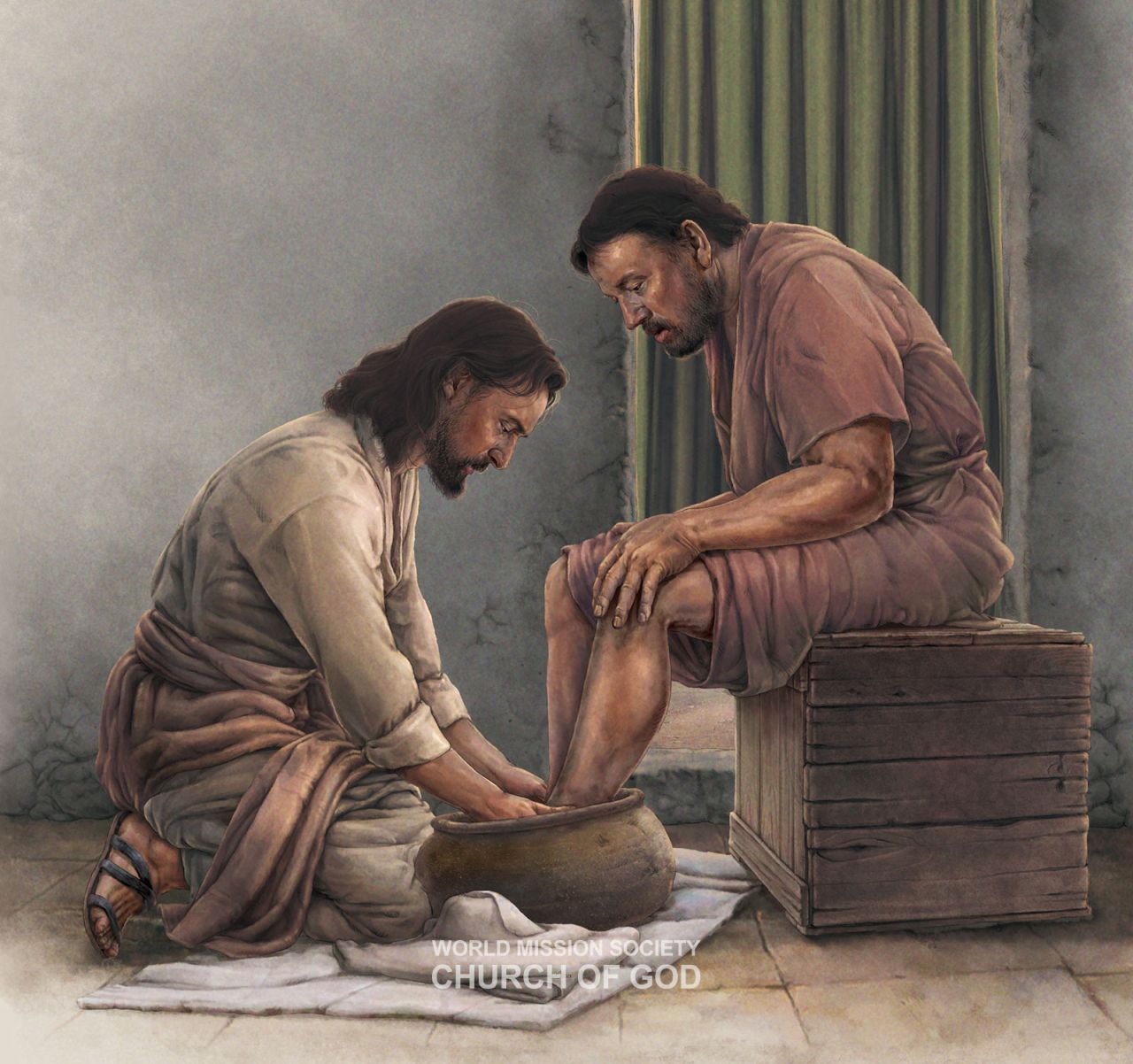

The Foot-Washing Ceremony is a rite in which members wash one another’s feet before participating in the Passover Holy Supper. On the evening of the fourteenth day of the first month by the sacred year, Jesus Christ Himself washed the feet of His disciples before giving them the Passover bread and wine. He solemnly declared that unless one followed His example, they could have no part with Him, and He instructed His disciples to wash one another’s feet just as He had washed theirs.
Through the Foot-Washing Ceremony, Jesus revealed both the humility of lowering Himself as a servant and His profound love for His disciples. Within this ceremony is contained the love of God, who served humanity and sacrificed Himself even to the point of death for their salvation.
Origin of the Foot-Washing Ceremony
The Foot-Washing Ceremony originated from the actions of Jesus. On the fourteenth day of the first month by the sacred year, Jesus sent Peter and John to prepare the Passover. That evening, as He reclined at the table with the twelve disciples in the upper room of Mark’s house, Jesus rose, removed His outer garment, wrapped a towel around His waist, poured water into a basin, and washed the feet of each disciple one by one, drying them with the towel.
In the dry and dusty climate of the Middle East, wearing sandals meant that one’s feet became dirty easily. For this reason, washing the feet of a householder upon his return, or the feet of guests who visited, was a task normally performed by a servant.[1] Out of reverence, Peter protested that Jesus should never wash his feet, believing it improper for the One of the highest honor to place Himself in the position of a servant.
But Jesus firmly told him that unless He washed Peter’s feet, he would have no part with Him. To have “no part” with Jesus—the Savior—meant being unable to receive salvation. Shocked by this, Peter asked Jesus to wash not only his feet but also his hands and head. Jesus then explained that those who had already received baptism needed only to wash their feet.
So he got up from the meal, took off his outer clothing, and wrapped a towel around his waist. After that, he poured water into a basin and began to wash his disciples’ feet, drying them with the towel that was wrapped around him. He came to Simon Peter, who said to him, “Lord, are you going to wash my feet?” Jesus replied, “You do not realize now what I am doing, but later you will understand.” “No,” said Peter, “you shall never wash my feet.” Jesus answered, “Unless I wash you, you have no part with me.” “Then, Lord,” Simon Peter replied, “not just my feet but my hands and my head as well!” Jesus answered, “Those who have had a bath need only to wash their feet; their whole body is clean. . . . Now that I, your Lord and Teacher, have washed your feet, you also should wash one another’s feet. I have set you an example that you should do as I have done for you.”
Since Jesus said that He set an example in the Foot-Washing Ceremony so that His disciples would follow it, those who participate in the Passover Holy Supper should first perform the Foot-Washing Ceremony in accordance with His example.
Significance of the Foot-Washing Ceremony
Preparation for Entering the Spiritual Temple
When God instructed Moses to build the tabernacle, He commanded that a bronze basin—a round vessel for holding water—be placed between the tent of meeting and the altar. The priests were required to wash their hands and feet with water from this basin whenever they entered the tabernacle to minister or approached the altar to offer sacrifices. If they entered without washing, they were put to death.[2] In the Temple built during Solomon’s reign, this regulation continued, and a massive bronze basin called the “Sea,” measuring about five meters in diameter and two and a half meters in height, was installed for the priests to wash in.[3]
This Old Testament regulation—that the priests must wash before entering the tabernacle or the Temple—served as a shadow of the New Testament requirement that God’s people must be spiritually cleansed before coming to Christ, who is the reality of the Temple.[4][5] Just as the priests washed before entering the Temple, God’s people in the New Testament age must be cleansed before approaching Christ through the Passover Holy Supper. Jesus taught that those who had already been cleansed through baptism needed only to wash their feet, and He set the example by establishing the Foot-Washing Ceremony to be performed before the Passover Holy Supper.[6]
Example of Christ’s Love and Service
Before keeping the Passover, Jesus—knowing that the time of His suffering and death on the cross was near—performed the Foot-Washing Ceremony out of deep love for His disciples.[7] He earnestly desired to celebrate the Passover with them before His crucifixion,[8] and He Himself washed their feet so that they might participate in the holy bread and wine of His flesh and blood during the Passover Holy Supper. Contained within the Foot-Washing Ceremony is the love of Jesus, who humbled Himself like a servant and sacrificed Himself even to the point of death to grant humanity the forgiveness of sins and eternal life.[9] It also reveals the will of God, who desires that God’s people, following the example of Jesus who served His disciples, will serve and care for one another.[10][11]
See also
Related videos
- How to Keep the Passover