The Last Supper: Difference between revisions
| Line 13: | Line 13: | ||
==The Last Supper by Leonardo da Vinci== | ==The Last Supper by Leonardo da Vinci== | ||
Leonardo da Vinci painted this mural on the wall of the dining hall at the Santa Maria delle Grazie in Milan, Italy, for about two years from 1495. This work is regarded as a masterpiece of the Renaissance for his creativity, beauty, and excellent way of dealing with the sublime subject. The Austrian-born British art historian Ernst Hans Josef Gombrich said of Leonardo da Vinci’s The Last Supper as “one of the great miracles wrought by human genius.”<ref>The Story of Art Paperback, E.H. Gombrich, ''Phaidon Press''; 16th edition, April 9, 1995, pg. 217</ref> Besides, many scholars and critics appreciate the artistry of this work, and many visual artists, including Andy Warhol, acknowledge its value, transcending time, to the point where they created works based on it.<ref>Leonardo da Vinci, the Last Supper, A Cosmic Drama and an Act of Redemption, The painting's influence through the centuries, ''Temple Lodge Publishing'', 2005, pp. 86-87</ref> This work was inscribed on the UNESCO World Heritage List.<ref>{{Cite web |url=https://whc.unesco.org/en/list/93/ |title=Church and Dominican Convent of Santa Maria delle Grazie with "The Last Supper" by Leonardo da Vinci |website=UNESCO |publisher= |date= |year= |author= |page= |series= |isbn= |quote= }}</ref> | Leonardo da Vinci painted this mural on the wall of the dining hall at the Santa Maria delle Grazie in Milan, Italy, for about two years from 1495. This work is regarded as a masterpiece of the Renaissance for his creativity, beauty, and excellent way of dealing with the sublime subject. The Austrian-born British art historian Ernst Hans Josef Gombrich said of Leonardo da Vinci’s The Last Supper as “one of the great miracles wrought by human genius.”<ref>The Story of Art Paperback, E.H. Gombrich, ''Phaidon Press''; 16th edition, April 9, 1995, pg. 217</ref> Besides, many scholars and critics appreciate the artistry of this work, and many visual artists, including Andy Warhol, acknowledge its value, transcending time, to the point where they created works based on it.<ref>Leonardo da Vinci, the Last Supper, A Cosmic Drama and an Act of Redemption, The painting's influence through the centuries, ''Temple Lodge Publishing'', 2005, pp. 86-87</ref> This work was inscribed on the UNESCO World Heritage List.<ref>{{Cite web |url=https://whc.unesco.org/en/list/93/ |title=Church and Dominican Convent of Santa Maria delle Grazie with "The Last Supper" by Leonardo da Vinci |website=UNESCO |publisher= |date= |year= |author= |page= |series= |isbn= |quote= }}</ref> | ||
[[file:Leonardo da Vinci (1452-1519) - The Last Supper (1495-1498).jpg |thumb | 가운데 | 500px |''The Last Supper'' by Leonardo da Vinci (1452–1519)]] | [[file:Leonardo da Vinci (1452-1519) - The Last Supper (1495-1498).jpg |thumb | 가운데 | 500px |''The Last Supper'' by Leonardo da Vinci (1452–1519)]] | ||
===Theme and Scene=== | ===Theme and Scene=== | ||
The theme of this work is “the last supper” that Jesus shared with His twelve disciples the day before His death on the cross. The scene allegedly describes the reaction of the disciples when Jesus said that one of the disciples would betray Him.<ref name="저물 때">{{Cite web |url=https://www.studylight.org/study-desk.html?q1=Matthew+26%3A20-22&q2=&ss=0&t1=eng_n84&t2=eng_kjv&t3=eng_nas&ns=0&sr=1&ot=bhs&nt=wh&hv1=1&b=verse&d=3 |title=Matthew 26:20–22 |publisher= |quote=}}</ref><ref>The Story of Leonardo Da Vinci 500 Years After His Death, Antone R. E. Pierucci, ''Atlantic Publishing''</ref> In the [[Gospel of John]] of the Bible, it is recorded that the disciples looked at one another and wondered who would betray Him.<ref>{{Cite web |url=https://www.studylight.org/study-desk.html?q1=John+13%3A21-22&q2=&ss=0&t1=eng_n84&t2=eng_kjv&t3=eng_nas&ns=0&sr=1&ot=bhs&nt=wh&hv1=1&b=verse&d=3 |title=John 13:21–22 |publisher= |quote= }}</ref> This is the moment Leonardo da Vinci wanted to draw. There are various facial expressions and gestures of Jesus and His disciples in this painting. | The theme of this work is “the last supper” that Jesus shared with His twelve disciples the day before His death on the cross. The scene allegedly describes the reaction of the disciples when Jesus said that one of the disciples would betray Him.<ref name="저물 때">{{Cite web |url=https://www.studylight.org/study-desk.html?q1=Matthew+26%3A20-22&q2=&ss=0&t1=eng_n84&t2=eng_kjv&t3=eng_nas&ns=0&sr=1&ot=bhs&nt=wh&hv1=1&b=verse&d=3 |title=Matthew 26:20–22 |publisher= |quote=}}</ref><ref>The Story of Leonardo Da Vinci 500 Years After His Death, Antone R. E. Pierucci, ''Atlantic Publishing''</ref> In the [[Gospel of John]] of the Bible, it is recorded that the disciples looked at one another and wondered who would betray Him.<ref>{{Cite web |url=https://www.studylight.org/study-desk.html?q1=John+13%3A21-22&q2=&ss=0&t1=eng_n84&t2=eng_kjv&t3=eng_nas&ns=0&sr=1&ot=bhs&nt=wh&hv1=1&b=verse&d=3 |title=John 13:21–22 |publisher= |quote= }}</ref> This is the moment Leonardo da Vinci wanted to draw. There are various facial expressions and gestures of Jesus and His disciples in this painting. | ||
Revision as of 14:51, 6 February 2023
The Last Supper refers to the last supper that Jesus Christ had with His disciples on the night before He died on the cross. The biblical name for this supper is the Holy Supper of the Passover. It is well known through a mural painted by Leonardo da Vinci, an Italian painter in the Renaissance period.[1] The Four Gospels of the Bible, which record the scene of The Last Supper, that is, the Passover show that the covenant of Christ for the salvation of mankind lies behind the artistic value of a world-famous painting. It is because Jesus established the new covenant, the law of life, to give the forgiveness of sins and eternal life to all mankind at His last Holy Supper of the Passover.

Material for the Masterpiece
The Last Supper is a historical material often used in Western religious art, and you can see murals based on it in early Christian catacombs, too.[2] It depicts Jesus having supper with His twelve disciples the day before His suffering on the cross.
In the past, painters drew on order, rather than simply painting what they wanted. Art works at that time were focused on historical paintings or religious paintings because the clients were mostly aristocrats and priests. In particular, the commissioners and artists wanted to reflect on the meaning of salvation and at the same time express the tension and emotion contained in the last supper, such as Jesus' last meal before death and the disciple's betrayal, through painting.[3]
Jesus’ last supper has been painted by numerous painters. Last Supper by Giotto di Bondone, a pioneer of Renaissance painting,[4] Triptych of the Last Supper by Dirk Bouts, which shows the characteristics of the Northern Renaissance,[5] and The Last Supper by the Spanish painter Juan Dejuanes, etc. Among them,[6] The Last Supper by Leonardo da Vinci is the most famous.
- The Last Supper
-
 Dirk Bouts, c. 1415–1475, St. Peter’s Church, Leuven, Belgium
 -
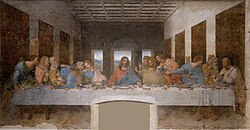 Leonardo da Vinci, 1452–1519, Santa Maria delle Grazie, Milan, Italy
 -
 Valentin de Boulogne, 1591–1632, National Gallery of Ancient Art, Rome


The Last Supper by Leonardo da Vinci
Leonardo da Vinci painted this mural on the wall of the dining hall at the Santa Maria delle Grazie in Milan, Italy, for about two years from 1495. This work is regarded as a masterpiece of the Renaissance for his creativity, beauty, and excellent way of dealing with the sublime subject. The Austrian-born British art historian Ernst Hans Josef Gombrich said of Leonardo da Vinci’s The Last Supper as “one of the great miracles wrought by human genius.”[7] Besides, many scholars and critics appreciate the artistry of this work, and many visual artists, including Andy Warhol, acknowledge its value, transcending time, to the point where they created works based on it.[8] This work was inscribed on the UNESCO World Heritage List.[9]
_-_The_Last_Supper_(1495-1498).jpg)
Theme and Scene
The theme of this work is “the last supper” that Jesus shared with His twelve disciples the day before His death on the cross. The scene allegedly describes the reaction of the disciples when Jesus said that one of the disciples would betray Him.[10][11] In the Gospel of John of the Bible, it is recorded that the disciples looked at one another and wondered who would betray Him.[12] This is the moment Leonardo da Vinci wanted to draw. There are various facial expressions and gestures of Jesus and His disciples in this painting.
“I tell you the truth, one of you is going to betray me.” His disciples stared at one another, at a loss to know which of them he meant. . . . Simon Peter motioned to this disciple and said, “Ask him which one he means.” Leaning back against Jesus, he asked him, “Lord, who is it?”
According to the explanation of UNESCO World Heritage Convention, four groups of three figures were painted on either side of Christ.
The first group starting from the far left of Jesus is Bartholomew, James (son of Alphaeus), and Andrew, who seem shocked by Jesus’ words. The second group is Peter, Jude, and John. Peter, who is impetuous, is leaning toward John, whispering something, and John is unintentionally pushing Judas forward. Judas is emphasized without being separated from the others. The third group in the middle, leaning toward Jesus and looking startled, is Thomas, James (John’s brother), and Philip, who seem to be zealous to confirm their loyalty to Jesus. The fourth group on the far right is Matthew, Thaddaeus, and Simon. They are not looking at Jesus because of the heated debate among themselves.
Some symbolic elements are also found in The Last Supper. The knife in Peter’s hand implies that he will later use it to sever the ear of a soldier attempting to arrest Jesus, and the purse in Judas’ hand symbolizes his betrayal of Jesus for thirty silver coins.[13][14] The bread and wine on the table are not just food for a supper, but they symbolize the flesh and blood that Jesus will shed on the cross the next day.[15]
Composition and Drawing Technique
In the paintings that dealt with the same subject in Florence in the fifteenth century, the disciples are placed on each side of Jesus and Judas separately on the other side. In da Vinci's painting, Judas is not isolated, but sits in the crowd of the disciples.[16]
Additionally, he utilized linear perspective to create the illusion of depth on a flat surface, which is one of the characteristics of Renaissance art. Perspective is expressed around the vanishing point located at Jesus’ head, which makes it look as if the wall in the picture is connected to the actual wall, and as if the last supper is being held at the end of the hall.
It is also notable that there is no halo around Jesus and His disciples unlike the paintings drawn previously, dealing with the same subject. Da Vinci surrounded Jesus with bright light coming from the three windows behind Him. He used light to create a three-dimensional effect on the characters, and vividly depicted details such as wrinkles on clothes and plates on the table.
“ There was nothing in this work that resembled older representations of the same theme. In these traditional versions, the apostles were seen sitting quietly at the table in a row—only Judas being segregated from the rest—while Christ was calmly dispensing the Sacrament. The new picture was very different from any of these paintings. “ — The Story of Art, E. H. Gombrich
Da Vinci also chose not to use the pre-existing method of drawing techniques. To make a perfect masterpiece, he worked in tempera, which is a technique to paint with pigments bound in egg yolk, not in fresco, which is a technique with which the painting cannot be fixed once done. The tempera technique had the advantage of being able to describe in detail and expressing bright colors, but it had the disadvantage of easily peeling off when used on murals. As a result, mold and cracks formed in da Vinci’s The Last Supper, and part of the painting fell off due to moisture in the dining room.
It is said that the painting had already deteriorated in the early 16th century,[17] and it lost its true appearance through the floods and wars.[18] As the Italian government began to restore the painting in the late 1970s, the restored painting was released to the public in 1999.[19] Although the viewing time is limited to 15 minutes to each person in order to prevent damage to the work, many people visit Milan to see this masterpiece.[20]
The Passover, the Biblical Name for The Last Supper
The biblical name for The Last Supper is The Passover.[15][21] The word supper in the English dictionary refers to a main meal eaten in the evening; an event in which people come together to eat in the evening.[22] As the word supper shows, the Passover is celebrated on the evening of the 14th day of the sacred calendar.[23] So Jesus, too, waited for this day to celebrate the Passover with His twelve disciples at twilight.[10][15]
So the disciples did as Jesus had directed them and prepared the Passover. When evening came, Jesus was reclining at the table with the Twelve. . . . While they were eating, Jesus took bread, gave thanks and broke it, and gave it to his disciples, saying, “Take and eat; this is my body.” Then he took the cup, gave thanks and offered it to them, saying, “Drink from it, all of you. This is my blood of the covenant, which is poured out for many for the forgiveness of sins.”
Some people misunderstand that the Passover of the Bible is the day when Jesus was resurrected. However, the Passover in the Bible is celebrated the night before Jesus suffered,[24] and the Holy Supper is celebrated in commemoration of Jesus’ death, not of His resurrection.[25]
Passover Ceremony
Jesus knew that Judas Iscariot would betray Him, that His disciples would flee, and that He would die in great pain and agony. In the face of a horrific death, Jesus had the last supper, the Passover of the new covenant, prepared and held it in order to fulfill all the prophecies of the Bible.
The Passover consisted of the feet-washing ceremony and the Holy Supper. The feet-washing ceremony was a ritual where the saints followed the example of Christ who washed the feet of His disciples before taking the bread and wine of the Passover.[26] After the feet-washing ceremony, the Holy Supper of the Passover was held for the disciples to participate in Jesus’ holy flesh and precious blood.

| Class. | Content |
| Preparation | Jesus sends Peter and John to prepare a room where they can eat the Passover. The disciples prepare the Passover as Jesus directed them.[27][28][29] |
| Feet-Washing Ceremony | On the evening of the Passover, the disciples gather in the upper room, which is said to belong to Mark, and Jesus Himself washes their feet.[30] After washing all His disciples’ feet, He tells them to do it just as He set an example.[26] |
| Holy Supper of the Passover | Jesus establishes the new covenant with the promise of the forgiveness of sins and eternal life by letting His disciples eat and drink the Passover bread and wine, which represent His flesh and blood.[31][32][33] |
Blessings Contained in the Passover
What Jesus earnestly wanted to do before the end of His life was to keep the Passover with His disciples.[15] 그By doing that, Jesus fulfilled His purpose of coming to this earth.[34][35] Jesus came to save mankind. For mankind, who is destined to die because of their sins, salvation means obtaining eternal life.[36][31]When Jesus was teaching in the synagogue in Capernaum, He clearly said that no one has life unless they eat and drink His flesh and blood.[37] The Passover is the way to eat and drink the flesh and blood of Jesus, who is eternal life itself. Jesus directly commanded His disciples to prepare the Passover,[27] and told them to eat and drink the bread and wine representing His flesh and blood at the supper.[31] Since He came to save mankind, He eagerly desired to keep the Passover of the new covenant that contains the pomise of the forgiveness of sins and eternal life.
Jesus said to them, “I tell you the truth, unless you eat the flesh of the Son of Man and drink his blood, you have no life in you. Whoever eats my flesh and drinks my blood has eternal life, and I will raise him up at the last day.”
Jesus’s Last Will, the New Covenant
At the Passover Supper, Jesus proclaimed the Passover wine as “the new covenant” in His blood. He also told His disciples to keep the Passover in remembrance of Him, which means God’s people must keep it until the end without forgetting it.[33] Since the new covenant was proclaimed the night before Jesus’ death, it is Jesus’ last will. A will takes effect only when somebody has died.[38] The Passover of the new covenant, which is Jesus’ will, too, took effect as Jesus died. Even after Jesus’ sacrifice on the cross, the early Church continued to celebrate the Passover and commemorated His death.[25] In order to commemorate Jesus’ love and sacrifice and preach the truth of salvation, the apostles and the members of the early Church kept the new covenant with all their heart, and did not lose faith even in the face of tribulation and persecution.[39]
Get rid of the old yeast that you may be a new batch without yeast--as you really are. For Christ, our Passover lamb, has been sacrificed. Therefore let us keep the Festival, . . .
See also
- Passover
- God in the Flesh (Incarnation)
- Messiah
- Jesus Christ
- Life of Jesus
- Major Achievements of Jesus Christ
- Teachings of Jesus Christ
- Suffering on the Cross
Related Videos
- [FactPlus] Jesus’ Last Will
References
- ↑ "Last Supper, The". Encyclopedia.com.
- ↑ "The Last Supper Interpreted by da Vinci and Other Artists". LIBERTY VOICE. April 17, 2014.
- ↑ Last Supper painting by Leonardo da Vinci, Britannica
- ↑ "Last Supper". The History of Art.
- ↑ Robert Suckale, Early Renaissance, Masterpieces of Western Art: A History of Art in 900 Individual Studies from the Gothic to the Present Day, TASCHEN; Reprint. edition, pg. 130, September 1, 2002
- ↑ Stephen Farthing, 1001 paintings you must see before you die, London : Cassell Illustrated, 2006
- ↑ The Story of Art Paperback, E.H. Gombrich, Phaidon Press; 16th edition, April 9, 1995, pg. 217
- ↑ Leonardo da Vinci, the Last Supper, A Cosmic Drama and an Act of Redemption, The painting's influence through the centuries, Temple Lodge Publishing, 2005, pp. 86-87
- ↑ "Church and Dominican Convent of Santa Maria delle Grazie with "The Last Supper" by Leonardo da Vinci". UNESCO.
- ↑ 10.0 10.1 "Matthew 26:20–22".
- ↑ The Story of Leonardo Da Vinci 500 Years After His Death, Antone R. E. Pierucci, Atlantic Publishing
- ↑ "John 13:21–22".
- ↑ "Last Supper". Britannica.
- ↑ "The Last Supper". Khan Academy.
- ↑ 15.0 15.1 15.2 15.3 "Luke 22:15–20".
- ↑ "THE LAST SUPPER". La Salle University Digital Commons.
- ↑ "Leonardo's Last Supper restored: A wreck, but an authentic wreck". The Art Newspaper. November 1, 1998.
- ↑ "The Day We Almost Lost Da Vinci's 'The Last Supper' Forever!". Rearview Mirror. August 15, 2014.
- ↑ "The da Vinci puzzle: Restoring The Last Supper". BBC News. 1999.
- ↑ "My 15 minutes with one of the world's most famous paintings, 'The Last Supper'". The Star. August 27, 2022.
- ↑ "Leonardo da Vinci". HISTORY.COM.
- ↑ "supper". Cambridge Dictionary.
- ↑ "Leviticus 23:5".
- ↑ "Luke 22:15".
- ↑ 25.0 25.1 "1 Corinthians 11:23–26".
- ↑ 26.0 26.1 "John 13:14–15".
- ↑ 27.0 27.1 "Matthew 26:17–19".
- ↑ "Mark 14:12–16".
- ↑ "Luke 22:7–13".
- ↑ "John 13:1–5".
- ↑ 31.0 31.1 31.2 "Matthew 26:26–28".
- ↑ "Mark 14:22–24".
- ↑ 33.0 33.1 "Luke 22:19–20".
- ↑ "Luke 19:10".
- ↑ "John 10:10".
- ↑ "Romans 6:23".
- ↑ "John 6:53–54".
- ↑ "Hebrews 9:15–17".
- ↑ "Hebrews 11:33–38".