The Heart-to-Heart Project: Difference between revisions
| Line 7: | Line 7: | ||
From the onset of the pandemic, the medical workers put their efforts into examinations and treatments day and night despite the shortage of manpower and rest, wearing protective clothing and equipment. In February 2021, more than 3,000 confirmed cases were reported in just fifteen days in Daegu, Korea. Subsequently, medical workers had to work without rest for more than 12 hours a day and each nurse had to take care of about 20 patients, which was twice the amount of his or her typical caseload. In New York, thousands of retired medical workers were reinstated and medical students graduated early to be sent into the field due to a shortage of manpower.<ref>{{Cite web |url=https://www.hsph.harvard.edu/news/hsph-in-the-news/coronavirus-news-march-2020/ |title=Coronavirus news – March 2020 |website=HARVARD T.H. CHAN, School of Public Health |publisher= |date=March 27, 2020 |quote= }}</ref> Field workers wore protective gear to prevent the spread of the virus, while taking care of patients or taking samples. In Korea, they had to wear Level D protective clothing that covered them from head to toe, or four layers of coveralls, a face mask, gloves, and a face shield for six hours a day regardless of weather conditions.<ref>{{Cite web |url=https://www.epa.gov/emergency-response/personal-protective-equipment#:~:text=resistant%20outer%20boots.-,Level%20D%20protection,-is%20the%20minimum |title=Personal Protective Equipment |website=EPA |publisher=|date= |quote= }}</ref><br>Amid concerns over the emotional [https://www.who.int/news/item/28-05-2019-burn-out-an-occupational-phenomenon-international-classification-of-diseases burnout] of medical workers,<ref>{{Cite web |url=https://en.yna.co.kr/view/AEN20200611007500315 |title=(Yonhap Feature) Medical workers exhausted by stifling protective suits as heat waves arrive |website=YONHAP NEWS AGENCY |publisher= |date=June 11, 2020 |quote= }}</ref><ref>{{Cite web |url=https://www.forbes.com/sites/nazbeheshti/2021/04/15/the-pandemic-has-created-a-new-kind-of-burnout-which-makes-well-being-more-critical-than-ever/?sh=1ccbf4c32f01 |title=The Pandemic Has Created A New Kind Of Burnout, Which Makes Well-Being More Critical Than Ever |website=Forbes |publisher=|date=April 15, 2021 |quote= }}</ref> ASEZ WAO launched the Heart-to-Heart Project to comfort and encourage those who were responding to the prolonged pandemic. The members from all over the world expressed their sincere respect, gratitude, and support to the medical workers who dedicated themselves to citizens’ safety and to helping bring society back to normal. | From the onset of the pandemic, the medical workers put their efforts into examinations and treatments day and night despite the shortage of manpower and rest, wearing protective clothing and equipment. In February 2021, more than 3,000 confirmed cases were reported in just fifteen days in Daegu, Korea. Subsequently, medical workers had to work without rest for more than 12 hours a day and each nurse had to take care of about 20 patients, which was twice the amount of his or her typical caseload. In New York, thousands of retired medical workers were reinstated and medical students graduated early to be sent into the field due to a shortage of manpower.<ref>{{Cite web |url=https://www.hsph.harvard.edu/news/hsph-in-the-news/coronavirus-news-march-2020/ |title=Coronavirus news – March 2020 |website=HARVARD T.H. CHAN, School of Public Health |publisher= |date=March 27, 2020 |quote= }}</ref> Field workers wore protective gear to prevent the spread of the virus, while taking care of patients or taking samples. In Korea, they had to wear Level D protective clothing that covered them from head to toe, or four layers of coveralls, a face mask, gloves, and a face shield for six hours a day regardless of weather conditions.<ref>{{Cite web |url=https://www.epa.gov/emergency-response/personal-protective-equipment#:~:text=resistant%20outer%20boots.-,Level%20D%20protection,-is%20the%20minimum |title=Personal Protective Equipment |website=EPA |publisher=|date= |quote= }}</ref><br>Amid concerns over the emotional [https://www.who.int/news/item/28-05-2019-burn-out-an-occupational-phenomenon-international-classification-of-diseases burnout] of medical workers,<ref>{{Cite web |url=https://en.yna.co.kr/view/AEN20200611007500315 |title=(Yonhap Feature) Medical workers exhausted by stifling protective suits as heat waves arrive |website=YONHAP NEWS AGENCY |publisher= |date=June 11, 2020 |quote= }}</ref><ref>{{Cite web |url=https://www.forbes.com/sites/nazbeheshti/2021/04/15/the-pandemic-has-created-a-new-kind-of-burnout-which-makes-well-being-more-critical-than-ever/?sh=1ccbf4c32f01 |title=The Pandemic Has Created A New Kind Of Burnout, Which Makes Well-Being More Critical Than Ever |website=Forbes |publisher=|date=April 15, 2021 |quote= }}</ref> ASEZ WAO launched the Heart-to-Heart Project to comfort and encourage those who were responding to the prolonged pandemic. The members from all over the world expressed their sincere respect, gratitude, and support to the medical workers who dedicated themselves to citizens’ safety and to helping bring society back to normal. | ||
==About the | ==About the Project== | ||
{{그림|ASEZ WAO Heart to Heart 1.jpg|정렬=오른쪽섬네일|너비=300px|타이틀=ASEZ WAO members carrying encouragement gifts in Hackensack, NJ, U.S.}} | {{그림|ASEZ WAO Heart to Heart 1.jpg|정렬=오른쪽섬네일|너비=300px|타이틀=ASEZ WAO members carrying encouragement gifts in Hackensack, NJ, U.S.}} | ||
The Heart-to-Heart Project is a way to express gratitude to those who are working hard to cope with COVID-19. ASEZ WAO members prepare encouragement gifts containing snacks, face masks, and handwritten letters to encourage those working to support pandemic prevention. They deliver packages to hospitals, government offices, fire stations, and other places where frontline workers are. Through virtual meetings, members plan the event and help prepare gifts after work and on their days off. When they deliver the gifts, they wear face masks and gloves, following the COVID-19 prevention rules. | The Heart-to-Heart Project is a way to express gratitude to those who are working hard to cope with COVID-19. ASEZ WAO members prepare encouragement gifts containing snacks, face masks, and handwritten letters to encourage those working to support pandemic prevention. They deliver packages to hospitals, government offices, fire stations, and other places where frontline workers are. Through virtual meetings, members plan the event and help prepare gifts after work and on their days off. When they deliver the gifts, they wear face masks and gloves, following the COVID-19 prevention rules. | ||
Revision as of 14:15, 23 March 2023
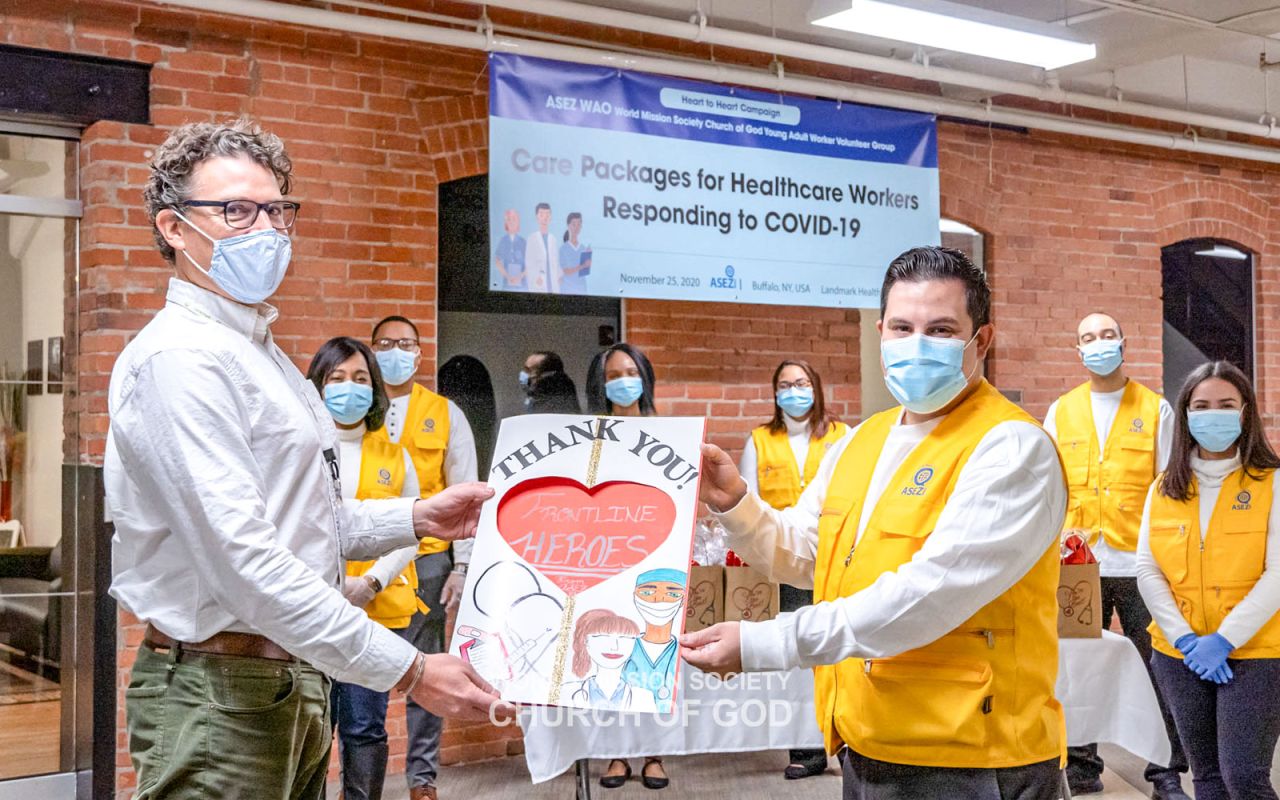

The Heart-to-Heart Project is one of ASEZ WAO’s major activities to combat COVID-19. The purpose of this project was to deliver a message of thanks and support to the medical staff and officials working hard on the frontline against the COVID-19 pandemic. ASEZ WAO carried out this project 256 times in 13 countries from November 2020 to October 2021. As of now, they have delivered about 17,800 gifts of thanks and encouragement.
| |
Humanitarian Campaigns
(Campaigns For Us) • Response to COVID-19 Campaign Environmental Campaigns
(Campaigns For EARTH) • Response to Climate Change Campaign • Reducing Plastic Use Campaign • Terrestrial Ecosystem Protection Campaign • Marine Ecosystem Protection Campaign | |
| ASEZ WAO is an international volunteer group consisting of young adult workers from 7,800 Church of God locations in 175 countries. |

The Purpose of Heart-to-Heart Project
As COVID-19 spread throughout the world, medical workers at the forefront of the pandemic experienced many hardships. Roughly six months after the World Health Organization [WHO] declared COVID-19 a pandemic,[1] one million deaths had already been confirmed (33.3 million confirmed cases).[2] Despite active prevention efforts from government officials, the virus has continued to spread over the past few years.
From the onset of the pandemic, the medical workers put their efforts into examinations and treatments day and night despite the shortage of manpower and rest, wearing protective clothing and equipment. In February 2021, more than 3,000 confirmed cases were reported in just fifteen days in Daegu, Korea. Subsequently, medical workers had to work without rest for more than 12 hours a day and each nurse had to take care of about 20 patients, which was twice the amount of his or her typical caseload. In New York, thousands of retired medical workers were reinstated and medical students graduated early to be sent into the field due to a shortage of manpower.[3] Field workers wore protective gear to prevent the spread of the virus, while taking care of patients or taking samples. In Korea, they had to wear Level D protective clothing that covered them from head to toe, or four layers of coveralls, a face mask, gloves, and a face shield for six hours a day regardless of weather conditions.[4]
Amid concerns over the emotional burnout of medical workers,[5][6] ASEZ WAO launched the Heart-to-Heart Project to comfort and encourage those who were responding to the prolonged pandemic. The members from all over the world expressed their sincere respect, gratitude, and support to the medical workers who dedicated themselves to citizens’ safety and to helping bring society back to normal.
About the Project
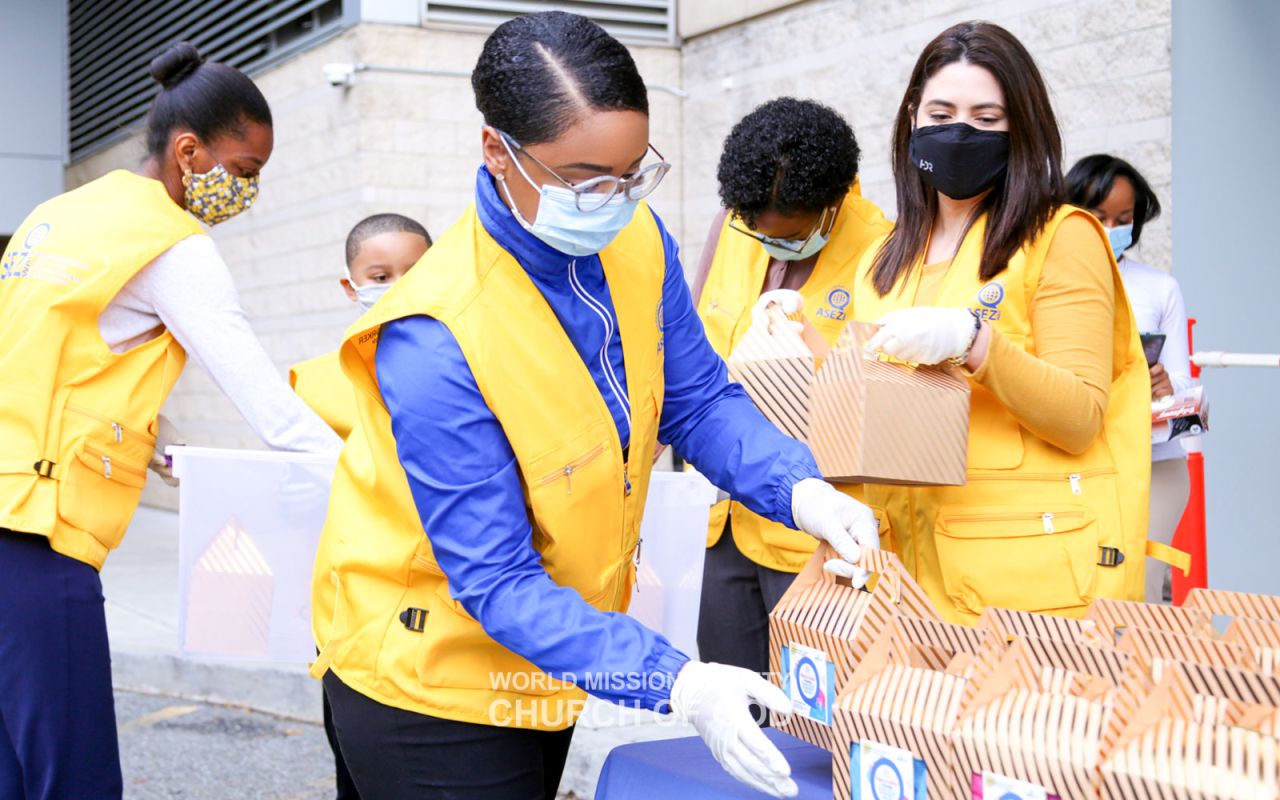

The Heart-to-Heart Project is a way to express gratitude to those who are working hard to cope with COVID-19. ASEZ WAO members prepare encouragement gifts containing snacks, face masks, and handwritten letters to encourage those working to support pandemic prevention. They deliver packages to hospitals, government offices, fire stations, and other places where frontline workers are. Through virtual meetings, members plan the event and help prepare gifts after work and on their days off. When they deliver the gifts, they wear face masks and gloves, following the COVID-19 prevention rules.
Current Activity Status
The Heart-to-Heart Project held at Inamdar Multispeciality Hospital in India


Since midyear 2020, the Heart-to-Heart Project has been carried out throughout the world, starting with ASEZ WAO’s regular volunteering. ASEZ WAO delivered a cheerful message to more than 9,400 people through the campaign which was held for two months in 13 countries including the U.S., the U.K., India, Japan, Malaysia, Peru, Argentina, and Korea.[7] When vaccinations were given during the first half of 2021, people faced a new phase in responding to COVID-19. ASEZ WAO delivered 6,300 encouragement gifts to 92 institutes such as hospitals, public health centers, vaccination centers, and government offices to encourage medical workers.[8] Since then, using regional and national networks, ASEZ WAO has been continuing the Heart-to-Heart Project wherever people need encouragement.
In an atmosphere where volunteer service has decreased sharply since COVID-19,[9] ASEZ WAO delivers sincere comfort through the Heart-to-Heart Project. Receiving the encouraging gifts containing handwritten letters that were written with sincere love, the medical workers expressed their joy and gratitude. After reading the members’ handwritten letters, the health center workers in Sokcho, Korea, expressed their gratitude. They said, “What we needed was nothing but cheering.” An official from the Patient Transfer Center in Manchester, U.K., said, “We love this job, but we had a difficult time for the past few months. ASEZ WAO’s activities make us feel that we are recognized. I’d like to give thanks for your meaningful activities.”[10][11][12]
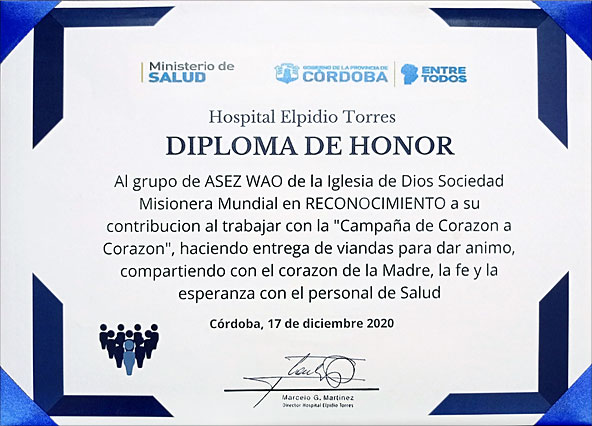
The Director of Inamdar Multispeciality Hospital in Pune, Maharashtra, India, presented an award to ASEZ WAO. He said, “The nursing staff who carry out dangerous tasks at the forefront take an active part in this pandemic situation. I’m glad to see you express your gratitude to each person working in the field, and not just to one person or representative.” Marcelo Martinez, the Director of the Elpidio Torres Hospital in Argentina, presented a citation to ASEZ WAO and complimented them for their contribution to spreading hope with the heart of a mother through the Heart-to-Heart Project.[13][14][15]
See also
- Green Workplace (Workplace Eco-Friendly) Project
- The Mother’s Forest Project
- The No More GPGP Project (Reducing Plastic Use)
References
- ↑ "WHO Declares COVID-19 a Pandemic". PubMed.gov. March 2020.
- ↑ "As the COVID-19 death toll passes 1 million, how does it compare to other major killers?". WORLD ECONOMIC FORUM. September 29, 2020.
- ↑ "Coronavirus news – March 2020". HARVARD T.H. CHAN, School of Public Health. March 27, 2020.
- ↑ "Personal Protective Equipment". EPA.
- ↑ "(Yonhap Feature) Medical workers exhausted by stifling protective suits as heat waves arrive". YONHAP NEWS AGENCY. June 11, 2020.
- ↑ "The Pandemic Has Created A New Kind Of Burnout, Which Makes Well-Being More Critical Than Ever". Forbes. April 15, 2021.
- ↑ ""I cried all night because of verbal abuse and fatigue." COVID-19 Medical Staff Experience Burnout". The JoongAng. August 28, 2020.
- ↑ "A Message of Thanks from Heart to Heart". ASEZ WAO Official Website. December 3, 2020.
- ↑ "Young Adult Worker Volunteer Group [ASEZ WAO] Carried Out Volunteer Services in the First Half of 2021". WATV.org. June 6, 2021.
- ↑ "A Sudden Decrease for Volunteer Activities Due to COVID-19, Replaces with Untact Volunteer Activites". The Kyunghyang. October 13, 2021.
- ↑ Warm Support to Overcome COVID-19, Making Brighter Future in Global Community, February 1, 2021, Woman DongA
- ↑ “World Mission Society Church of God gave Ambulance staff in Trafford gift boxes,” NEWS4TRAFFORD, Dec. 3. 2020.
- ↑ "ASEZ WAO Carried Out Regular Volunteer Services". WATV.org. December 18, 2020.
- ↑ "BEST AWARD CERTIFICATE, 2020 AWARD, Inamdar Multispeciality Hospital". WATV AWARD. November 12, 2020.
- ↑ "DIPLOMA of Honor, Elpidio Torres Hospital". WATV AWARD. December 17, 2020.