Elohim: Difference between revisions
No edit summary |
No edit summary |
||
| Line 21: | Line 21: | ||
When we look into the Bible, God did not say, “Let me make man in my image, in my likeness,” but repeatedly said, “us” and “our.” If there is only one God, He would have said, “Let me,” rather than “Let us.” The plural usage of God has raised questions among Christians who have called God “the Father” and believed that God is only one. | When we look into the Bible, God did not say, “Let me make man in my image, in my likeness,” but repeatedly said, “us” and “our.” If there is only one God, He would have said, “Let me,” rather than “Let us.” The plural usage of God has raised questions among Christians who have called God “the Father” and believed that God is only one. | ||
{{quote |The CLIMAX of Genesis 1 and the heart of its mystery comes in the description of the creation of adam, the Hebrew term meaning “human being” or “humanity.” God had said, “Let there be light.” But now, God does not say, “Let there be man.” Instead he says, “Let us make man (adam) in our image after our likeness” (Genesis 1:26). . . . This passage has long been a puzzle for interpreters of the Bible.|Mysteries of the Bible, Reader’s Digest Association, Inc., 1988, p. 21}} | {{quote |The CLIMAX of Genesis 1 and the heart of its mystery comes in the description of the creation of adam, the Hebrew term meaning “human being” or “humanity.” God had said, “Let there be light.” But now, God does not say, “Let there be man.” Instead he says, “Let us make man (adam) in our image after our likeness” (Genesis 1:26). . . . This passage has long been a puzzle for interpreters of the Bible.|Mysteries of the Bible, Reader’s Digest Association, Inc., 1988, p. 21}} | ||
Theologians have differing opinions on this matter. Some say that “us” means God Himself and the angels, while others say that it is the Trinity. Some believe the plural term is used to express God’s majesty, and others claim that it was influenced by the surrounding polytheistic people at the time the Bible was written.<br/>If “us” refers to God and the angels, mankind should serve the angels since they too are their creators. When we look into the Bible, however, it describes angels as the spirits who serve those who will be saved,<ref>{{Cite web |url=https://www.biblegateway.com/passage/?search=Hebrews+1%3A14+&version=NIV |title=Hebrews 1:14 |publisher= |quote= }}</ref> and that they will be judged by the saints.<ref>{{Cite web |url=https://www.biblegateway.com/passage/?search=1+Corinthians+6%3A3&version=NIV |title=1 Corinthians 6:3 |publisher= }}</ref> In addition, the [[Trinity]] means that the Father, the Son, and the Holy Spirit are one God the Father; therefore, it cannot be plural. Also, because the first of the Ten Commandments is, “You shall have no other gods before me,”<ref>{{Cite web |url=https://www.biblegateway.com/passage/?search=Exodus+20%3A3&version=NIV |title=Exodus 20:3 |publisher= |quote= }}</ref> it is an illogical claim that the word ''God'' was written in plural terms due to the influence of the polytheistic people. | Theologians have differing opinions on this matter. Some say that “us” means God Himself and the angels, while others say that it is the Trinity. Some believe the plural term is used to express God’s majesty, and others claim that it was influenced by the surrounding polytheistic people at the time the Bible was written.<br/>If “us” refers to God and the angels, mankind should serve the angels since they too are their creators. When we look into the Bible, however, it describes angels as the spirits who serve those who will be saved,<ref>{{Cite web |url=https://www.biblegateway.com/passage/?search=Hebrews+1%3A14+&version=NIV |title=Hebrews 1:14 |publisher= |quote= }}</ref> and that they will be judged by the saints.<ref>{{Cite web |url=https://www.biblegateway.com/passage/?search=1+Corinthians+6%3A3&version=NIV |title=1 Corinthians 6:3 |publisher= }}</ref> In addition, the [[Trinity]] means that the Father, the Son, and the Holy Spirit are one God the Father; therefore, it cannot be plural. Also, because the first of the [[The Ten Commandments|Ten Commandments]] is, “You shall have no other gods before me,”<ref>{{Cite web |url=https://www.biblegateway.com/passage/?search=Exodus+20%3A3&version=NIV |title=Exodus 20:3 |publisher= |quote= }}</ref> it is an illogical claim that the word ''God'' was written in plural terms due to the influence of the polytheistic people. | ||
== Elohim Is God the Father and God the Mother == | == Elohim Is God the Father and God the Mother == | ||
Revision as of 08:55, 19 December 2024
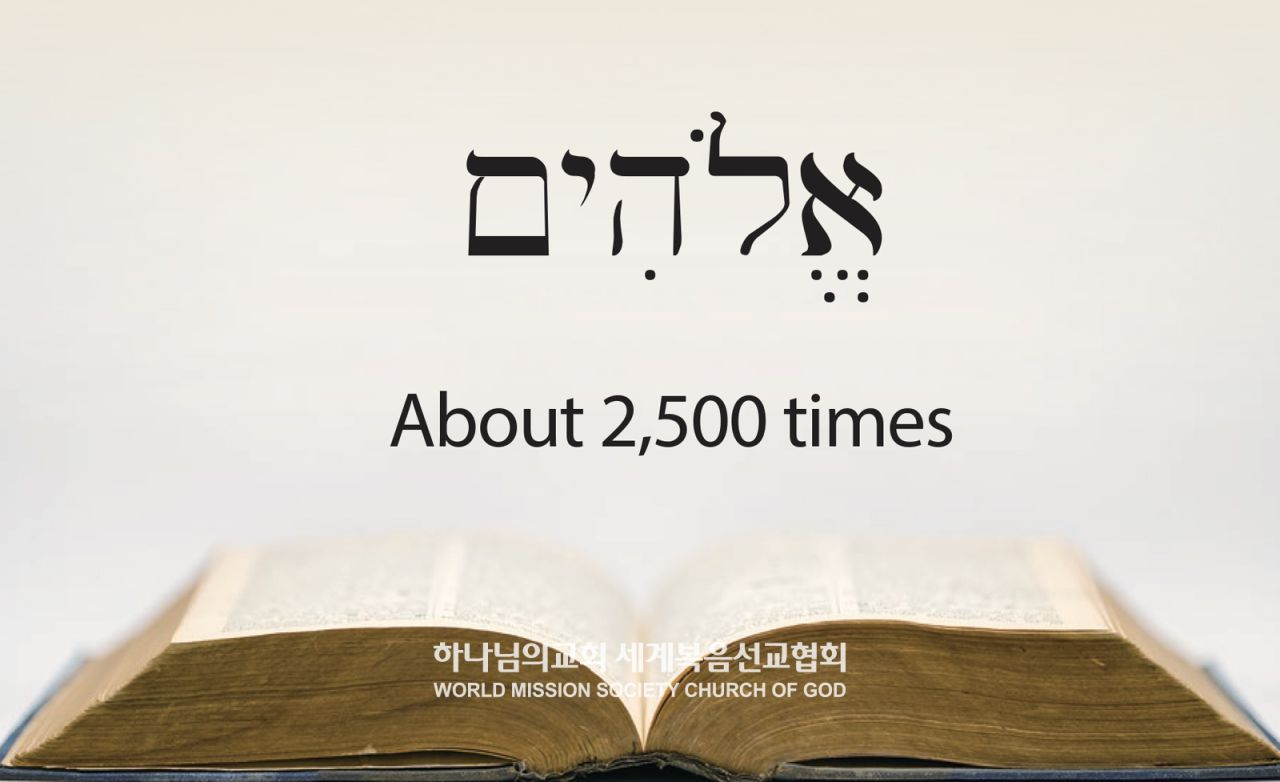

Elohim (אֱלֹהִים) is the most used Hebrew word for God in the Old Testament, and is a plural noun. The literal translation of the word means Gods, which refers to God the Father and God the Mother. From the Creation of the heavens and the earth to the last days when the new heaven and new earth will come, God Elohim leads the work of salvation together.
The Meaning of Elohim
In Hebrew, the singular term meaning God is El and Eloah. When the suffix -im (ים) is added to Eloah, it becomes the plural term Elohim, which means Gods.
Among the three words for God, Elohim is the most commonly used and is written about 2,500 times throughout the Old Testament. The word Elohim appears from the first chapter of the Bible. In Genesis 1:1, it says, “In the beginning God created the heavens and the earth.” In the Hebrew translation of this verse, the term that is used for “God” is Elohim.
בְּרֵאשִׁ֖ית בָּרָ֣א אֱלֹהִ֑ים אֵ֥ת הַשָּׁמַ֖יִם וְאֵ֥ת הָאָֽרֶץ׃
| 410. אל [êl] el | 433. אֱלוֹהַּ [ělôwahh] eloah | 430. אֱלֹהִים [ělôhîym] elohim |
|---|---|---|
| ale; short. from 352; strength; as adj, mighty; espec. the Almighty (but used also of any deity); God {213x}, god {16x} | el-oʹ-ah; rarely (short.) prob. prol. (emphat.) from 410; a deity or the Deity:―God {52x}, god {5x}. | el-o-heem´; plur. of 433; gods in the ordinary sense; but spec. used (in the plur. thus, espec. with the art.) of the supreme God |
※The New Strong’s Expanded Dictionary of Bible Words, James Strong, Thomas Nelson, Inc., 2001. 410., 433., and 430., is a number that James Strong, an American theologian at the end of the 19th century, added to words so that people could easily study the Bible in the original language. It is commonly called “Strong Code.”
God Refers to Himself as “Us”
In addition to the plural noun Elohim, God also uses the first-person plural pronoun, “us.”
Then God said, "Let us make man in our image, in our likeness"
When we look into the Bible, God did not say, “Let me make man in my image, in my likeness,” but repeatedly said, “us” and “our.” If there is only one God, He would have said, “Let me,” rather than “Let us.” The plural usage of God has raised questions among Christians who have called God “the Father” and believed that God is only one.
“ The CLIMAX of Genesis 1 and the heart of its mystery comes in the description of the creation of adam, the Hebrew term meaning “human being” or “humanity.” God had said, “Let there be light.” But now, God does not say, “Let there be man.” Instead he says, “Let us make man (adam) in our image after our likeness” (Genesis 1:26). . . . This passage has long been a puzzle for interpreters of the Bible. “ — Mysteries of the Bible, Reader’s Digest Association, Inc., 1988, p. 21
Theologians have differing opinions on this matter. Some say that “us” means God Himself and the angels, while others say that it is the Trinity. Some believe the plural term is used to express God’s majesty, and others claim that it was influenced by the surrounding polytheistic people at the time the Bible was written.
If “us” refers to God and the angels, mankind should serve the angels since they too are their creators. When we look into the Bible, however, it describes angels as the spirits who serve those who will be saved,[1] and that they will be judged by the saints.[2] In addition, the Trinity means that the Father, the Son, and the Holy Spirit are one God the Father; therefore, it cannot be plural. Also, because the first of the Ten Commandments is, “You shall have no other gods before me,”[3] it is an illogical claim that the word God was written in plural terms due to the influence of the polytheistic people.
Elohim Is God the Father and God the Mother
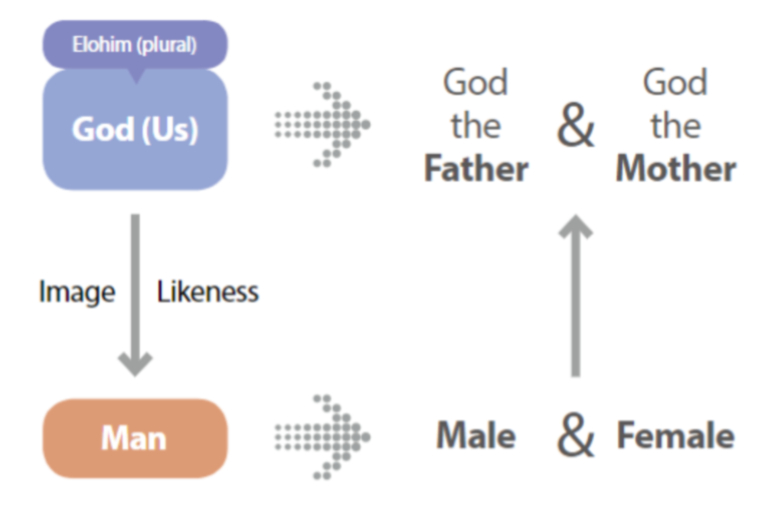

The question about the plural terms, “Elohim” and “us,” in Genesis 1:26, can be easily solved through the next verse.
So God created man in his own image, in the image of God he created him; male and female he created them.
Male and female were created in the image of God. Through the creation of mankind, we come to know an important fact about God: God exists as two images, the male image and the female image. By looking at the copy, we can understand the original. If male and female were made in the image of God, who is the original, this means that God's image contains a male image and a female image. Jesus taught us about the male image of God when He said that we should pray to “Our Father in heaven.”
“This, then, is how you should pray: ‘Our Father in heaven . . .’ ”
The title father can only be given to a man who has a child; however, it is a mother who conceives and gives birth to a child. The only way a child can exist and a man can receive the title father is when there is a mother. If there is a father, it means that there is a mother as well. Because Jesus taught us to call God the "Father," this means that God the Mother has to exist.
But the Jerusalem that is above is free, and she is our mother.
For God’s children who will be saved, not only God the Father but also God the Mother exists. God Elohim, the Creator who made male and female, saying, “Let us make man in our image,” are God the Father and God the Mother.
God Elohim Reflected in Adam and Eve
Adam and Eve were created in the image and likeness of God and were established as rulers over all living things on the earth.[4] This contains God’s will to reveal the Saviors of mankind.[5]
Adam was the first man created in the image of God. The Bible tells us there is the first man Adam, and the last Adam, which is Christ.
Adam, who was a pattern of the one to come.
“The first man Adam became a living being”; the last Adam, a life-giving spirit.
As Adam represents Christ, God the Father, his wife, Eve (Hawwāh), represents God the Mother. The name Eve means life, and she was called the “mother of all the living.” This cannot be looked at in a literal sense because Eve did not give physical life to all people.[6] This is a prophecy that God’s children will receive eternal life from God the Mother represented as the last Eve.
Sometimes, the Bible describes God as one.[7][8] The reason for this can be seen through Adam and Eve. It was Eve who was tempted by the serpent and ate from the tree of the knowledge of good and evil first.[9] If we look into the Bible, however, it describes the sin as “Adam’s sin”[10] or the “trespass of the one man.”[11] This means that Adam and Eve are considered one body, and Adam is the representative of the two.[12] The two are considered one because Eve was created from one of Adam’s ribs. Even though Adam and Eve are two separate individuals, they are also described as one person Adam. When the Bible says that Adam sinned alone, in actuality it means that Adam and Eve sinned together. Adam and Eve are copies who were created in the image and likeness of God. If Adam and Eve are considered one body, God Elohim, who is the original, can also be seen in the same way. God Elohim is God the Father and God the Mother, but They can be described as one God. Through this, we can understand that God the Father did not work alone, but was always working together with God the Mother.
God Elohim and the Water of Life
In the Bible, we can see God Elohim working together in many situations in addition to Their work of creation. For example, They stopped arrogant people from building the Tower of Babel and said, “Let us go down.”[13] They also called the prophet Isaiah and said, “Who will go for Us?”[14] In the last days, They continue to work together by coming to this earth[15] as the Spirit and the Bride to give the water of life to the people in the world.
The Spirit and the bride say, “Come!” And let him who hears say, “Come!” Whoever is thirsty, let him come; and whoever wishes, let him take the free gift of the water of life.
According to the Trinity, the Holy Spirit is God the Father. When the angel said that he would show Apostle John the bride, the wife of the Lamb, he showed him the holy city, Jerusalem, coming down out of heaven.[16] The Heavenly Jerusalem represents God the Mother.[17] To receive the water of life, we must come to God the Father and God the Mother, who are Elohim.[18] From the beginning until the end, God Elohim continues to work together to bring salvation to mankind.
See also
- El (Hebrew)
- Eloah
- God the Mother
- Bride of the Lamb
- Heavenly Family
- History of Abraham’s Family
- World Mission Society Church of God
Related videos
- The Mystery of the Bible, God Elohim
References
- ↑ "Hebrews 1:14".
- ↑ "1 Corinthians 6:3".
- ↑ "Exodus 20:3".
- ↑ "Genesis 1:28".
- ↑ "Revelation 4:11".
- ↑ "Genesis 3:20".
- ↑ "1 Timothy 2:5".
- ↑ "1 Timothy 6:15".
- ↑ "Genesis 3:6".
- ↑ "Romans 5:14".
- ↑ "Romans 5:15".
- ↑ "Genesis 2:22-24".
- ↑ "Genesis 11:1-9".
- ↑ "Isaiah 6:8".
- ↑ "Amos 8:11".
- ↑ "Revelation 21:9-10".
- ↑ "Galatians 4:26".
- ↑ "The Elohim Gods". WATV.org.