Diferencia entre revisiones de «La última cena»
Sin resumen de edición |
Sin resumen de edición |
||
| Línea 2: | Línea 2: | ||
[[archivo:최후의 만찬 유월절.jpg |miniatura | px | En la Santa Comunión de la Pascua, conocida como la última cena, Jesús estableció el nuevo pacto que tiene la promesa del perdón de pecados y la vida eterna.]] | [[archivo:최후의 만찬 유월절.jpg |miniatura | px | En la Santa Comunión de la Pascua, conocida como la última cena, Jesús estableció el nuevo pacto que tiene la promesa del perdón de pecados y la vida eterna.]] | ||
==Material para la obra maestra== | ==Material para la obra maestra== | ||
''La última cena'' es un material histórico utilizado a menudo en el arte religioso occidental, y también se pueden ver murales basados en ella en las catacumbas de los primeros cristianos.<ref>{{cita web |url=https://guardianlv.com/2014/04/the-last-supper-interpreted-by-da-vinci-and-other-artists/ |título=The Last Supper Interpreted by da Vinci and Other Artists |sitioweb=LIBERTY VOICE |editorial= |fecha=17 de abril de 2014 |año= |autor= |página= |serie= |isbn= |cita= }}</ref>Representa a Jesús cenando con sus doce discípulos el día anterior a su [[La cruz y el sufrimiento|sufrimiento en la cruz]].<br> En el pasado, los artistas pintaban por encargo, en lugar de pintar simplemente lo que querían. Las obras de arte de la época se centraban en pinturas históricas o religiosas, porque los clientes eran en su mayoría aristócratas y sacerdotes. En concreto, los mecenas y artistas querían reflexionar sobre el significado de la salvación y, al mismo tiempo, expresar a través de la pintura la tensión y emoción contenidas en la última cena, como la última comida de Jesús antes de morir y la traición del discípulo.<ref>[https://www.britannica.com/topic/Last-Supper-fresco-by-Leonardo-da-Vinci Last Supper painting by Leonardo da Vinci], ''Britannica''</ref><br>La última cena de Jesús ha sido pintada por numerosos pintores. ''La última cena'' de Giotto di Bondone, pionero de la pintura renacentista,<ref>{{cita web |url=https://www.thehistoryofart.org/giotto/last-supper/ |título=Last Supper |sitioweb=The History of Art |editorial= |autor= |página= |serie= |isbn= |cita= }}</ref> ''Tríptico de la última cena'' de Dirk Bouts, que muestra las características del Renacimiento nórdico,<ref>Robert Suckale, Early Renaissance, Masterpieces of Western Art: A History of Art in 900 Individual Studies from the Gothic to the Present Day, TASCHEN; | ''La última cena'' es un material histórico utilizado a menudo en el arte religioso occidental, y también se pueden ver murales basados en ella en las catacumbas de los primeros cristianos.<ref>{{cita web |url=https://guardianlv.com/2014/04/the-last-supper-interpreted-by-da-vinci-and-other-artists/ |título=The Last Supper Interpreted by da Vinci and Other Artists |sitioweb=LIBERTY VOICE |editorial= |fecha=17 de abril de 2014 |año= |autor= |página= |serie= |isbn= |cita= }}</ref>Representa a Jesús cenando con sus doce discípulos el día anterior a su [[La cruz y el sufrimiento|sufrimiento en la cruz]].<br> En el pasado, los artistas pintaban por encargo, en lugar de pintar simplemente lo que querían. Las obras de arte de la época se centraban en pinturas históricas o religiosas, porque los clientes eran en su mayoría aristócratas y sacerdotes. En concreto, los mecenas y artistas querían reflexionar sobre el significado de la salvación y, al mismo tiempo, expresar a través de la pintura la tensión y emoción contenidas en la última cena, como la última comida de Jesús antes de morir y la traición del discípulo.<ref>[https://www.britannica.com/topic/Last-Supper-fresco-by-Leonardo-da-Vinci Last Supper painting by Leonardo da Vinci], ''Britannica''</ref><br>La última cena de Jesús ha sido pintada por numerosos pintores. ''La última cena'' de Giotto di Bondone, pionero de la pintura renacentista,<ref>{{cita web |url=https://www.thehistoryofart.org/giotto/last-supper/ |título=Last Supper |sitioweb=The History of Art |editorial= |autor= |página= |serie= |isbn= |cita= }}</ref> ''Tríptico de la última cena'' de Dirk Bouts, que muestra las características del Renacimiento nórdico,<ref>Robert Suckale, ''Early Renaissance, Masterpieces of Western Art: A History of Art in 900 Individual Studies from the Gothic to the Present Day'', TASCHEN; reimpresión, p. 130, 1 de septiembre de 2002</ref> ''La última cena'' del pintor español Juan de Juanes, etc. Entre ellas,<ref>Stephen Farthing, ''1001 paintings you must see before you die'', London : Cassell Illustrated, 2006</ref> ''La última cena'' de Leonardo da Vinci es la más famosa. | ||
<div style="text-align:center; width:auto; margin-left:auto; margin-right:auto;"> | <div style="text-align:center; width:auto; margin-left:auto; margin-right:auto;"> | ||
<gallery ;="" gallery="" widths="240" heights="200" caption="''' | <gallery ;="" gallery="" widths="240" heights="200" caption="'''La última cena'''"> | ||
file:Dieric Bouts - Altarpiece of the Holy Sacrament - WGA03002.jpg|Dirk Bouts, c. 1415–1475, | file:Dieric Bouts - Altarpiece of the Holy Sacrament - WGA03002.jpg|Dirk Bouts, c. 1415–1475, Iglesia de San Pedro de Lovaina, Bélgica | ||
file:Leonardo da Vinci (1452-1519) - The Last Supper (1495-1498).jpg|Leonardo da Vinci, 1452–1519, Santa Maria delle Grazie, | file:Leonardo da Vinci (1452-1519) - The Last Supper (1495-1498).jpg|Leonardo da Vinci, 1452–1519,Santa Maria delle Grazie, Milán, Italia | ||
file:Valentin de Boulogne, Last Supper.jpg|Valentin de Boulogne, 1591–1632, | file:Valentin de Boulogne, Last Supper.jpg|Valentin de Boulogne, 1591–1632, Galería Nacional de Arte Antiguo, Roma | ||
</gallery> | </gallery> | ||
</div> | </div> | ||
== | ==''La última cena'' de Leonardo da Vinci== | ||
Leonardo da Vinci | Leonardo da Vinci pintó este mural en la pared del comedor de Santa María delle Grazie, Milán, Italia; se tardó unos dos años, desde 1495. Esta obra es considerada una obra maestra del Renacimiento por su creatividad, belleza y su excelente forma de tratar el tema sublime. El historiador de arte británico, de origen austriaco, Ernst Hans Josef Gombrich, se expresó así de La última cena de Leonardo da Vinci: “Uno de los más grandes milagros forjados por el genio humano”.<ref>E.H. Gombrich, ''The Story of Art Paperback'', Phaidon Press; 16.a edición, 9 de abril de 1995, p. 217</ref> Además, muchos académicos y críticos aprecian el arte de esta obra, y numerosos artistas visuales, como Andy Warhol, reconocen su valor, transcendiendo el tiempo, hasta el punto de crear obras basadas en ella.<ref>''Leonardo da Vinci, the Last Supper, A Cosmic Drama and an Act of Redemption, The painting’s influence through the centuries'', Temple Lodge Publishing, 2005, pp. 86-87</ref> Esta obra fue inscrita en la Lista del Patrimonio Mundial de la Unesco.<ref>{{cita web |url=https://whc.unesco.org/en/list/93/ |título=Church and Dominican Convent of Santa Maria delle Grazie with "The Last Supper" by Leonardo da Vinci |sitioweb=''UNESCO'' |editorial= |fecha= |año= |autor= |página= |serie= |isbn= |cita= }}</ref> | ||
[[archivo:Leonardo da Vinci (1452-1519) - The Last Supper (1495-1498).jpg |miniatura | center | 500px |'' | [[archivo:Leonardo da Vinci (1452-1519) - The Last Supper (1495-1498).jpg |miniatura | center | 500px |''La última cena'' de Leonardo da Vinci (1452-1519)]] | ||
=== | ===Tema y escena=== | ||
El tema de esta obra es la “última cena” que Jesús compartió con sus doce discípulos el día anterior a su muerte en la cruz. La escena al parecer describe la reacción de los discípulos cuando Jesús dijo que uno de ellos lo traicionaría.<ref name="저물 때">{{cita web |url=https://www.studylight.org/study-desk.html?q1=Matthew+26%3A20-22&q2=&ss=0&t1=eng_n84&t2=eng_kjv&t3=eng_nas&ns=0&sr=1&ot=bhs&nt=wh&hv1=1&b=verse&d=3 |título=Mateo 26:20–22 |editorial= |cita=}}</ref><ref>Antone R. E. Pierucci, ''The Story of Leonardo Da Vinci 500 Years After His Death'', Atlantic Publishing</ref> En el [[Evangelio de Juan]] de la Biblia, está escrito que los discípulos se miraron unos a otros y se preguntaron quién lo traicionaría.<ref>{{cita web |url=https://www.studylight.org/study-desk.html?q1=John+13%3A21-22&q2=&ss=0&t1=eng_n84&t2=eng_kjv&t3=eng_nas&ns=0&sr=1&ot=bhs&nt=wh&hv1=1&b=verse&d=3 |título=Juan 13:21–22 |editorial= |cita= }}</ref> Este es el momento que Leonardo da Vinci quiso pintar. Hay varias expresiones faciales y gestos de Jesús y sus discípulos en esa pintura. | |||
{{quote5 |내용= | {{quote5 |내용=“De cierto, de cierto os digo, que uno de vosotros me va a entregar. Entonces los discípulos se miraban unos a otros, dudando de quién hablaba. […] A éste, pues, hizo señas Simón Pedro, para que preguntase quién era aquel de quien hablaba. Él entonces, recostado cerca del pecho de Jesús, le dijo: Señor, ¿quién es?” |출처=[https://www.studylight.org/study-desk.html?q1=John+13%3A21-25&q2=&ss=0&t1=eng_n84&t2=eng_kjv&t3=eng_nas&ns=0&sr=1&ot=bhs&nt=wh&hv1=1&b=verse&d=3 Juan 13:21–25]}} | ||
Según la explicación de la [https://whc.unesco.org/ Convención del Patrimonio Mundial de la Unesco], se pintaron cuatro grupos de tres figuras a cada lado de Cristo. <br>El primer grupo, que comienza desde el extremo izquierdo de Jesús, es Bartolomé, Jacobo (hijo de Alfeo) y Andrés, quienes se veían sorprendidos por las palabras de Jesús. El segundo grupo es Pedro, Judas y Juan. Pedro, impetuoso, se inclina hacia Juan, susurrando algo, y Juan sin querer empuja a Judas hacia adelante. Se destaca a Judas sin separarlo de los demás. El tercer grupo en el centro, inclinado hacia Jesús y con cara de asombro, está formado por Tomás, Jacobo (hermano de Juan) y Felipe, quienes parecen deseosos de confirmar su lealtad a Jesús. El cuarto grupo en el extremo derecho es Mateo, Tadeo y Simón. Ellos no miran a Jesús debido al acalorado debate entre sí. <br>También se encuentran algunos elementos simbólicos en La última cena. El cuchillo en la mano de Pedro implica su posterior uso para cortar la oreja de un soldado en su intento de arrestar a Jesús, y la bolsa en la mano de Judas simboliza su traición a Jesús por treinta monedas de plata.<ref>{{cita web |url=https://www.britannica.com/topic/Last-Supper-fresco-by-Leonardo-da-Vinci#:~:text=simple%20composition.-,Subject,-The%20subject%20of |título=Last Supper |sitioweb=Britannica |editorial= |fecha= |año= |autor= |página= |serie= |isbn= |cita= }}</ref><ref>{{cita web |url=https://www.khanacademy.org/humanities/ap-art-history/early-europe-and-colonial-americas/renaissance-art-europe-ap/a/leonardo-last-supper |título=The Last Supper |sitioweb=Khan Academy |editorial= |fecha= |año= |autor= |página= |serie= |isbn= |cita= }}</ref>El pan y el vino sobre la mesa no son solo la comida para la cena, simbolizan la carne y la sangre que Jesús desgarrará y derramará en la cruz al día siguiente.<ref name="원하였노라">{{cita web|url=https://www.studylight.org/study-desk.html?q1=Luke+22%3A15-20&q2=&ss=0&t1=eng_n84&t2=eng_kjv&t3=eng_nas&ns=0&sr=1&ot=bhs&nt=wh&hv1=1&b=verse&d=3|título=Lucas 22:15–20|cita=}}</ref> | |||
=== | ===Técnica de composición y dibujo=== | ||
En los cuadros consagrados al mismo tema en Florencia en el siglo {{작은 대문자|xv}}, los discípulos se sitúan a cada lado de Jesús y Judas, por separado, al otro lado. En el cuadro de Da Vinci, Judas no está aislado, sino sentado entre los discípulos.<ref>{{cita web |url=https://digitalcommons.lasalle.edu/last_supper_iconography/2/ |título=THE LAST SUPPER |sitioweb=La Salle University Digital Commons |editorial= |año= |autor= |serie= |isbn= |cita= }}</ref><br>Además, utilizó la perspectiva lineal para crear la ilusión de profundidad sobre una superficie plana, una de las características del arte renacentista. La perspectiva se expresa en torno al [https://www.nationalgallery.org.uk/paintings/glossary/vanishing-point#:~:text=The%20vanishing%20point%20in%20paintings,all%20receding%20parallel%20lines%20meet. punto de fuga ] ubicado en la cabeza de Jesús, en virtud del cual parece que la pared del cuadro estuviera conectada con la pared real, y como si la última cena se estuviera celebrando al final del salón. | |||
También llama la atención la ausencia de aureola alrededor de Jesús y sus discípulos, a diferencia de las pinturas anteriores relativas al mismo tema. Da Vinci rodeó a Jesús con una luz brillante procedente de las tres ventanas detrás de Él. Utilizó la luz para crear un efecto tridimensional en los personajes, y representó vívidamente detalles como las arrugas de la ropa y los platos sobre la mesa.{{quote |No había nada en esta obra que se pareciera a representaciones más antiguas del mismo tema. En estas versiones tradicionales, los apóstoles se veían sentados tranquilamente en la mesa en fila, y solo Judas estaba separado del resto, mientras que Cristo estaba distribuyendo el Sacramento. El nuevo cuadro era muy diferente de cualquiera de estas pinturas.|작가=''The Story of Art''(La historia del arte), E. H. Gombrich}} | |||
Da Vinci | Da Vinci también optó por no utilizar el método preexistente de técnicas de dibujo. Para crear una obra maestra perfecta, trabajó al [https://www.britannica.com/art/tempera-painting temple], técnica para pintar con pigmentos aglutinados en yema de huevo, no al fresco, cuya técnica no permite fijar la pintura una vez terminada. La técnica del temple tenía la ventaja de poder describir en detalle y expresar colores vivos, pero presentaba el inconveniente de desprenderse fácilmente cuando se utilizaba en murales. Como consecuencia, se formaron moho y grietas en ''La última cena'' de Leonardo da Vinci, y parte del cuadro se desprendió debido a la humedad del comedor..<br>Se dice que el cuadro ya se había deteriorado a principios del siglo {{작은 대문자|xvi}}<ref>{{cita web |url=https://www.theartnewspaper.com/1998/11/01/leonardos-last-supper-restored-a-wreck-but-an-authentic-wreck |título=Leonardo's Last Supper restored: A wreck, but an authentic wreck |sitioweb=The Art Newspaper |editorial= |fecha=November 1, 1998 |año= |autor= |página= |serie= |isbn= |cita= }}</ref> and it lost its true appearance through the floods and wars.<ref>{{cita web |url=https://the-rearview-mirror.com/2014/08/15/the-day-we-almost-lost-da-vincis-the-last-supper-forever/ |título=The Day We Almost Lost Da Vinci’s ‘The Last Supper’ Forever! |sitioweb=Rearview Mirror |editorial= |fecha=August 15, 2014 |año= |autor= |página= |serie= |isbn= |cita= }}</ref> As the Italian government began to restore the painting in the late 1970s, the restored painting was released to the public in 1999.<ref>{{cita web |url=https://www.bbc.com/news/av/magazine-36466835 |título=The da Vinci puzzle: Restoring The Last Supper |sitioweb=BBC News |editorial= |fecha=1999 |año= |autor= |página= |serie= |isbn= |cita=}}</ref> Although the viewing time is limited to 15 minutes to each person in order to prevent damage to the work, many people visit Milan to see this masterpiece.<ref>{{cita web |url=https://www.thestar.com.my/lifestyle/travel/2022/08/27/15-minutes-with-one-of-the-world039s-most-famous-paintings |título=My 15 minutes with one of the world's most famous paintings, 'The Last Supper' |sitioweb=The Star |editorial= |fecha=August 27, 2022 |año= |autor= |página= |serie= |isbn= |cita=}}</ref> | ||
==The Passover, the Biblical Name for ''The Last Supper''== | ==The Passover, the Biblical Name for ''The Last Supper''== | ||
Revisión del 12:12 18 jul 2023
La última cena se refiere a la última cena que Jesucristo tuvo con sus discípulos la noche antes de morir en la cruz. El nombre bíblico de esta cena es la Santa Comunión de la Pascua. Es muy conocida por un mural pintado por Leonardo da Vinci, pintor italiano de la época del Renacimiento.[1] Los cuatro Evangelios de la Biblia, que registran la escena de La última cena, es decir, la Pascua, muestran que el pacto de Cristo para la salvación de la humanidad subyace tras el valor artístico de la pintura más famosa del mundo. Es porque Jesús estableció el nuevo pacto, la ley de vida, para dar el perdón de pecados y la vida eterna a toda la humanidad en su última cena de la Pascua.

Material para la obra maestra
La última cena es un material histórico utilizado a menudo en el arte religioso occidental, y también se pueden ver murales basados en ella en las catacumbas de los primeros cristianos.[2]Representa a Jesús cenando con sus doce discípulos el día anterior a su sufrimiento en la cruz.
En el pasado, los artistas pintaban por encargo, en lugar de pintar simplemente lo que querían. Las obras de arte de la época se centraban en pinturas históricas o religiosas, porque los clientes eran en su mayoría aristócratas y sacerdotes. En concreto, los mecenas y artistas querían reflexionar sobre el significado de la salvación y, al mismo tiempo, expresar a través de la pintura la tensión y emoción contenidas en la última cena, como la última comida de Jesús antes de morir y la traición del discípulo.[3]
La última cena de Jesús ha sido pintada por numerosos pintores. La última cena de Giotto di Bondone, pionero de la pintura renacentista,[4] Tríptico de la última cena de Dirk Bouts, que muestra las características del Renacimiento nórdico,[5] La última cena del pintor español Juan de Juanes, etc. Entre ellas,[6] La última cena de Leonardo da Vinci es la más famosa.
- La última cena
-
 Dirk Bouts, c. 1415–1475, Iglesia de San Pedro de Lovaina, Bélgica
 -
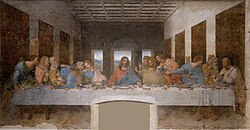 Leonardo da Vinci, 1452–1519,Santa Maria delle Grazie, Milán, Italia
 -
 Valentin de Boulogne, 1591–1632, Galería Nacional de Arte Antiguo, Roma


La última cena de Leonardo da Vinci
Leonardo da Vinci pintó este mural en la pared del comedor de Santa María delle Grazie, Milán, Italia; se tardó unos dos años, desde 1495. Esta obra es considerada una obra maestra del Renacimiento por su creatividad, belleza y su excelente forma de tratar el tema sublime. El historiador de arte británico, de origen austriaco, Ernst Hans Josef Gombrich, se expresó así de La última cena de Leonardo da Vinci: “Uno de los más grandes milagros forjados por el genio humano”.[7] Además, muchos académicos y críticos aprecian el arte de esta obra, y numerosos artistas visuales, como Andy Warhol, reconocen su valor, transcendiendo el tiempo, hasta el punto de crear obras basadas en ella.[8] Esta obra fue inscrita en la Lista del Patrimonio Mundial de la Unesco.[9]
_-_The_Last_Supper_(1495-1498).jpg)
Tema y escena
El tema de esta obra es la “última cena” que Jesús compartió con sus doce discípulos el día anterior a su muerte en la cruz. La escena al parecer describe la reacción de los discípulos cuando Jesús dijo que uno de ellos lo traicionaría.[10][11] En el Evangelio de Juan de la Biblia, está escrito que los discípulos se miraron unos a otros y se preguntaron quién lo traicionaría.[12] Este es el momento que Leonardo da Vinci quiso pintar. Hay varias expresiones faciales y gestos de Jesús y sus discípulos en esa pintura.
“De cierto, de cierto os digo, que uno de vosotros me va a entregar. Entonces los discípulos se miraban unos a otros, dudando de quién hablaba. […] A éste, pues, hizo señas Simón Pedro, para que preguntase quién era aquel de quien hablaba. Él entonces, recostado cerca del pecho de Jesús, le dijo: Señor, ¿quién es?”
Según la explicación de la Convención del Patrimonio Mundial de la Unesco, se pintaron cuatro grupos de tres figuras a cada lado de Cristo.
El primer grupo, que comienza desde el extremo izquierdo de Jesús, es Bartolomé, Jacobo (hijo de Alfeo) y Andrés, quienes se veían sorprendidos por las palabras de Jesús. El segundo grupo es Pedro, Judas y Juan. Pedro, impetuoso, se inclina hacia Juan, susurrando algo, y Juan sin querer empuja a Judas hacia adelante. Se destaca a Judas sin separarlo de los demás. El tercer grupo en el centro, inclinado hacia Jesús y con cara de asombro, está formado por Tomás, Jacobo (hermano de Juan) y Felipe, quienes parecen deseosos de confirmar su lealtad a Jesús. El cuarto grupo en el extremo derecho es Mateo, Tadeo y Simón. Ellos no miran a Jesús debido al acalorado debate entre sí.
También se encuentran algunos elementos simbólicos en La última cena. El cuchillo en la mano de Pedro implica su posterior uso para cortar la oreja de un soldado en su intento de arrestar a Jesús, y la bolsa en la mano de Judas simboliza su traición a Jesús por treinta monedas de plata.[13][14]El pan y el vino sobre la mesa no son solo la comida para la cena, simbolizan la carne y la sangre que Jesús desgarrará y derramará en la cruz al día siguiente.[15]
Técnica de composición y dibujo
En los cuadros consagrados al mismo tema en Florencia en el siglo xv, los discípulos se sitúan a cada lado de Jesús y Judas, por separado, al otro lado. En el cuadro de Da Vinci, Judas no está aislado, sino sentado entre los discípulos.[16]
Además, utilizó la perspectiva lineal para crear la ilusión de profundidad sobre una superficie plana, una de las características del arte renacentista. La perspectiva se expresa en torno al punto de fuga ubicado en la cabeza de Jesús, en virtud del cual parece que la pared del cuadro estuviera conectada con la pared real, y como si la última cena se estuviera celebrando al final del salón.
También llama la atención la ausencia de aureola alrededor de Jesús y sus discípulos, a diferencia de las pinturas anteriores relativas al mismo tema. Da Vinci rodeó a Jesús con una luz brillante procedente de las tres ventanas detrás de Él. Utilizó la luz para crear un efecto tridimensional en los personajes, y representó vívidamente detalles como las arrugas de la ropa y los platos sobre la mesa.
“ No había nada en esta obra que se pareciera a representaciones más antiguas del mismo tema. En estas versiones tradicionales, los apóstoles se veían sentados tranquilamente en la mesa en fila, y solo Judas estaba separado del resto, mientras que Cristo estaba distribuyendo el Sacramento. El nuevo cuadro era muy diferente de cualquiera de estas pinturas. “ — The Story of Art(La historia del arte), E. H. Gombrich
Da Vinci también optó por no utilizar el método preexistente de técnicas de dibujo. Para crear una obra maestra perfecta, trabajó al temple, técnica para pintar con pigmentos aglutinados en yema de huevo, no al fresco, cuya técnica no permite fijar la pintura una vez terminada. La técnica del temple tenía la ventaja de poder describir en detalle y expresar colores vivos, pero presentaba el inconveniente de desprenderse fácilmente cuando se utilizaba en murales. Como consecuencia, se formaron moho y grietas en La última cena de Leonardo da Vinci, y parte del cuadro se desprendió debido a la humedad del comedor..
Se dice que el cuadro ya se había deteriorado a principios del siglo xvi[17] and it lost its true appearance through the floods and wars.[18] As the Italian government began to restore the painting in the late 1970s, the restored painting was released to the public in 1999.[19] Although the viewing time is limited to 15 minutes to each person in order to prevent damage to the work, many people visit Milan to see this masterpiece.[20]
The Passover, the Biblical Name for The Last Supper
The biblical name for The Last Supper is The Passover.[15][21] The word supper in the English dictionary refers to a main meal eaten in the evening; an event in which people come together to eat in the evening.[22] As the word supper shows, the Passover is celebrated on the evening of the 14th day of the sacred calendar.[23] So Jesus, too, waited for this day to celebrate the Passover with His twelve disciples at twilight.[10][15]
So the disciples did as Jesus had directed them and prepared the Passover. When evening came, Jesus was reclining at the table with the Twelve. . . . While they were eating, Jesus took bread, gave thanks and broke it, and gave it to his disciples, saying, “Take and eat; this is my body.” Then he took the cup, gave thanks and offered it to them, saying, “Drink from it, all of you. This is my blood of the covenant, which is poured out for many for the forgiveness of sins.”
Some people misunderstand that the Passover of the Bible is the day when Jesus was resurrected. However, the Passover in the Bible is celebrated the night before Jesus suffered,[24] and the Holy Supper is celebrated in commemoration of Jesus’ death, not of His resurrection.[25]
Passover Ceremony
Jesus knew that Judas Iscariot would betray Him, that His disciples would flee, and that He would die in great pain and agony. In the face of a horrific death, Jesus had the last supper, the Passover of the new covenant, prepared and held it in order to fulfill all the prophecies of the Bible.
The Passover consisted of the feet-washing ceremony and the Holy Supper. The feet-washing ceremony was a ritual where the saints followed the example of Christ who washed the feet of His disciples before taking the bread and wine of the Passover.[26] After the feet-washing ceremony, the Holy Supper of the Passover was held for the disciples to participate in Jesus’ holy flesh and precious blood.

| Class. | Content |
| Preparation | Jesus sends Peter and John to prepare a room where they can eat the Passover. The disciples prepare the Passover as Jesus directed them.[27][28][29] |
| Feet-Washing Ceremony | On the evening of the Passover, the disciples gather in the upper room, which is said to belong to Mark, and Jesus Himself washes their feet.[30] After washing all His disciples’ feet, He tells them to do it just as He set an example.[26] |
| Holy Supper of the Passover | Jesus establishes the new covenant with the promise of the forgiveness of sins and eternal life by letting His disciples eat and drink the Passover bread and wine, which represent His flesh and blood.[31][32][33] |
Blessings Contained in the Passover
What Jesus earnestly wanted to do before the end of His life was to keep the Passover with His disciples.[15] By doing that, Jesus fulfilled His purpose of coming to this earth.[34][35] Jesus came to save mankind. For mankind, who is destined to die because of their sins, salvation means obtaining eternal life.[36][31]When Jesus was teaching in the synagogue in Capernaum, He clearly said that no one has life unless they eat and drink His flesh and blood.[37] The Passover is the way to eat and drink the flesh and blood of Jesus, who is eternal life Himself. Jesus directly commanded His disciples to prepare the Passover,[27] and told them to eat and drink the bread and wine representing His flesh and blood at the supper.[31] Since He came to save mankind, He eagerly desired to keep the Passover of the new covenant that contains the promise of the forgiveness of sins and eternal life.
Jesus said to them, “I tell you the truth, unless you eat the flesh of the Son of Man and drink his blood, you have no life in you. Whoever eats my flesh and drinks my blood has eternal life, and I will raise him up at the last day.”
Jesus’s Last Will, the New Covenant
At the Passover Supper, Jesus proclaimed the Passover wine as “the new covenant” in His blood. He also told His disciples to keep the Passover in remembrance of Him, which means God’s people must keep it until the end without forgetting it.[33] Since the new covenant was proclaimed the night before Jesus’ death, it is Jesus’ last will. A will takes effect only when somebody has died.[38] The Passover of the new covenant, which is Jesus’ will, too, took effect as Jesus died. Even after Jesus’ sacrifice on the cross, the early Church continued to celebrate the Passover and commemorated His death.[25] In order to commemorate Jesus’ love and sacrifice and preach the truth of salvation, the apostles and the members of the early Church kept the new covenant with all their heart, and did not lose faith even in the face of tribulation and persecution.[39]
Get rid of the old yeast that you may be a new batch without yeast--as you really are. For Christ, our Passover lamb, has been sacrificed. Therefore let us keep the Festival, . . .
Véase también
- La Pascua
- Dios en la carne
- El Mesías
- Jesucristo
- La vida de Jesús
- Las principales obras de Jesucristo
- Enseñanzas de Jesucristo
- El sufrimiento en la cruz
Vídeos relacionados
- [FactPlus] El último testamento de Jesús
Referencias
- ↑ «Last Supper, The». Encyclopedia.com.
- ↑ «The Last Supper Interpreted by da Vinci and Other Artists». LIBERTY VOICE. 17 de abril de 2014.
- ↑ Last Supper painting by Leonardo da Vinci, Britannica
- ↑ «Last Supper». The History of Art.
- ↑ Robert Suckale, Early Renaissance, Masterpieces of Western Art: A History of Art in 900 Individual Studies from the Gothic to the Present Day, TASCHEN; reimpresión, p. 130, 1 de septiembre de 2002
- ↑ Stephen Farthing, 1001 paintings you must see before you die, London : Cassell Illustrated, 2006
- ↑ E.H. Gombrich, The Story of Art Paperback, Phaidon Press; 16.a edición, 9 de abril de 1995, p. 217
- ↑ Leonardo da Vinci, the Last Supper, A Cosmic Drama and an Act of Redemption, The painting’s influence through the centuries, Temple Lodge Publishing, 2005, pp. 86-87
- ↑ «Church and Dominican Convent of Santa Maria delle Grazie with "The Last Supper" by Leonardo da Vinci». UNESCO.
- ↑ 10,0 10,1 «Mateo 26:20–22».
- ↑ Antone R. E. Pierucci, The Story of Leonardo Da Vinci 500 Years After His Death, Atlantic Publishing
- ↑ «Juan 13:21–22».
- ↑ «Last Supper». Britannica.
- ↑ «The Last Supper». Khan Academy.
- ↑ 15,0 15,1 15,2 15,3 «Lucas 22:15–20».
- ↑ «THE LAST SUPPER». La Salle University Digital Commons.
- ↑ «Leonardo's Last Supper restored: A wreck, but an authentic wreck». The Art Newspaper. November 1, 1998.
- ↑ «The Day We Almost Lost Da Vinci’s ‘The Last Supper’ Forever!». Rearview Mirror. August 15, 2014.
- ↑ «The da Vinci puzzle: Restoring The Last Supper». BBC News. 1999.
- ↑ «My 15 minutes with one of the world's most famous paintings, 'The Last Supper'». The Star. August 27, 2022.
- ↑ «Leonardo da Vinci». HISTORY.COM.
- ↑ «supper». Cambridge Dictionary.
- ↑ «Leviticus 23:5».
- ↑ «Luke 22:15».
- ↑ 25,0 25,1 «1 Corinthians 11:23–26».
- ↑ 26,0 26,1 «John 13:14–15».
- ↑ 27,0 27,1 «Matthew 26:17–19».
- ↑ «Mark 14:12–16».
- ↑ «Luke 22:7–13».
- ↑ «John 13:1–5».
- ↑ 31,0 31,1 31,2 «Matthew 26:26–28».
- ↑ «Mark 14:22–24».
- ↑ 33,0 33,1 «Luke 22:19–20».
- ↑ «Luke 19:10».
- ↑ «John 10:10».
- ↑ «Romans 6:23».
- ↑ «John 6:53–54».
- ↑ «Hebrews 9:15–17».
- ↑ «Hebrews 11:33–38».