Passover: Difference between revisions
No edit summary |
No edit summary Tag: Manual revert |
||
| (11 intermediate revisions by 3 users not shown) | |||
| Line 1: | Line 1: | ||
{{절기 | <!-- interlanguage:start -->[[ko:유월절]][[vi:Lễ Vượt Qua]][[es:Pascua]][[ne:निस्तार-चाड]][[pt:Páscoa]]<!-- interlanguage:end -->{{절기 | ||
|above =Passover | |above =Passover | ||
|image = [[file:Bible primer, Old Testament, for use in the primary department of Sunday schools (1919) (14782080995).jpg|250px|thumb|Center|The Israelites put the blood of the Passover lamb.]] | |image = [[file:Bible primer, Old Testament, for use in the primary department of Sunday schools (1919) (14782080995).jpg|250px|thumb|Center|The Israelites put the blood of the Passover lamb.]] | ||
| Line 12: | Line 12: | ||
The '''Passover''' is the first of the Seven Feasts in Three Times recorded in the [[Bible]]. It is observed on the evening of the 14th day of the first month by the sacred calendar, and it corresponds to the period between March and April in [https://www.britannica.com/topic/Gregorian-calendar the Gregorian calendar] (solar calendar). The Seven Feasts are classified into three times: the [[The Feast of Unleavened Bread|Feast of Unleavened Bread]], the [[Feast of Weeks]], and the [[Feast of Tabernacles]]. The Passover belongs to the first time of feasts—the Feast of Unleavened Bread. | The '''Passover''' is the first of the Seven Feasts in Three Times recorded in the [[Bible]]. It is observed on the evening of the 14th day of the first month by the sacred calendar, and it corresponds to the period between March and April in [https://www.britannica.com/topic/Gregorian-calendar the Gregorian calendar] (solar calendar). The Seven Feasts are classified into three times: the [[The Feast of Unleavened Bread|Feast of Unleavened Bread]], the [[Feast of Weeks]], and the [[Feast of Tabernacles]]. The Passover belongs to the first time of feasts—the Feast of Unleavened Bread. | ||
The Passover is the core truth of the [[New Covenant|new covenant]] which God established to save all humanity. On the evening of the 14th day of the first month by the sacred calendar, [[Jesus Christ]] established the new covenant by keeping the Passover with His disciples with bread and wine representing His flesh and blood. Just as in the times of the Old Testament, when the Israelites were freed from Egypt by keeping the Passover and entered the land of Canaan, in the times of the New Testament, God's people are given eternal life and freed from the sinful world by keeping the [[The New Covenant Passover|Passover of the new covenant]], and enter the [[Heaven|kingdom of heaven]]. | The Passover is the core truth of the [[New Covenant|new covenant]] which God established to save all humanity. On the evening of the 14th day of the first month by the sacred calendar, [[Jesus Christ]] established the new covenant by keeping the Passover with His disciples with bread and wine representing His flesh and blood. Just as in the times of the Old Testament, when the Israelites were freed from Egypt by keeping the Passover and entered the land of Canaan, in the times of the New Testament, God's people are given eternal life and freed from the sinful world by keeping the [[The New Covenant Passover|Passover of the new covenant]], and enter the [[Kingdom of Heaven|kingdom of heaven]]. | ||
==Origin and Meaning of the Passover== | ==Origin and Meaning of the Passover== | ||
| Line 19: | Line 19: | ||
===Passover in Each Language=== | ===Passover in Each Language=== | ||
The Passover mentioned in the book of [[Exodus]] is as follows in each language. | The Passover mentioned in the book of [[The Exodus|Exodus]] is as follows in each language. | ||
{| class="wikitable" | {| class="wikitable" | ||
!'''Language''' | !'''Language''' | ||
| Line 148: | Line 148: | ||
===Kingdom of Heaven=== | ===Kingdom of Heaven=== | ||
[[file:하나님의교회 유월절.jpg|thumb|World Mission Society Church of God keeps the Passover of the new covenant.]] | [[file:하나님의교회 유월절.jpg|thumb|World Mission Society Church of God keeps the Passover of the new covenant.]] | ||
The Israelites’ 40-year long journey in the desert showed what would happen in the New Testament times.<ref>{{Cite web|url=https://www.biblegateway.com/passage/?search=1+Corinthians+10%3A1-11&version=NIV|title=1 Corinthians 10:1–11|quote=}}</ref> The history of the Israelites keeping the Passover and being liberated from Egypt and entering Canaan after forty years in the desert was a prophecy that God’s people of the New Testament would keep the Passover, be set free from the sinful world, and enter the [[Heaven|kingdom of heaven]], the spiritual Canaan.<ref>{{Cite web|url=https://www.biblegateway.com/passage/?search=Hebrews+3%3A15-19&version=NIV|title=Hebrews 3:15-19|quote=}}</ref><ref>{{Cite web|url=https://www.biblegateway.com/passage/?search=Hebrews+4%3A6-11&version=NIV|title=Hebrews 4:6–11|quote=}}</ref> <br>There is no record of the Israelites keeping the Passover after they kept it a second time in the Desert of Sinai, until just before they entered Canaan. In the same way, in the New Testament times, the Passover was not celebrated for nearly 1,600 years after the Council of Nicaea was held in AD 325. The fact that the Israelites celebrated the Passover just before entering Canaan was a prophecy showing that the new covenant Passover, which had not been kept for a long time, would be restored just before God’s people enter heaven, the heavenly Canaan.<ref>{{Cite web|url=https://www.biblegateway.com/passage/?search=Isaiah+25%3A6-9&version=NIV|title=Isaiah 25:6–9|quote=}}</ref> Just as the Israelites entered Canaan only after keeping the Passover, people can enter the kingdom of heaven, the spiritual Canaan, only after keep the new covenant. | The Israelites’ 40-year long journey in the desert showed what would happen in the New Testament times.<ref>{{Cite web|url=https://www.biblegateway.com/passage/?search=1+Corinthians+10%3A1-11&version=NIV|title=1 Corinthians 10:1–11|quote=}}</ref> The history of the Israelites keeping the Passover and being liberated from Egypt and entering Canaan after forty years in the desert was a prophecy that God’s people of the New Testament would keep the Passover, be set free from the sinful world, and enter the [[Kingdom of Heaven|kingdom of heaven]], the spiritual Canaan.<ref>{{Cite web|url=https://www.biblegateway.com/passage/?search=Hebrews+3%3A15-19&version=NIV|title=Hebrews 3:15-19|quote=}}</ref><ref>{{Cite web|url=https://www.biblegateway.com/passage/?search=Hebrews+4%3A6-11&version=NIV|title=Hebrews 4:6–11|quote=}}</ref> <br>There is no record of the Israelites keeping the Passover after they kept it a second time in the Desert of Sinai, until just before they entered Canaan. In the same way, in the New Testament times, the Passover was not celebrated for nearly 1,600 years after the Council of Nicaea was held in AD 325. The fact that the Israelites celebrated the Passover just before entering Canaan was a prophecy showing that the new covenant Passover, which had not been kept for a long time, would be restored just before God’s people enter heaven, the heavenly Canaan.<ref>{{Cite web|url=https://www.biblegateway.com/passage/?search=Isaiah+25%3A6-9&version=NIV|title=Isaiah 25:6–9|quote=}}</ref> Just as the Israelites entered Canaan only after keeping the Passover, people can enter the kingdom of heaven, the spiritual Canaan, only after keep the new covenant. | ||
===Forgiveness of Sins=== | ===Forgiveness of Sins=== | ||
| Line 173: | Line 173: | ||
*[[Seal of God]] | *[[Seal of God]] | ||
*[[The Feast of Unleavened Bread|Feast of Unleavened Bread]] | *[[The Feast of Unleavened Bread|Feast of Unleavened Bread]] | ||
*[[ | *[[Feast of Firstfruits]] | ||
*[[Feast of Weeks]] | *[[Feast of Weeks]] | ||
*[[Feast of Trumpets]] | *[[Feast of Trumpets]] | ||
Latest revision as of 14:10, 23 April 2026
| Passover | |
|---|---|
_(14782080995).jpg) | |
| Name | 逾越節, Passover |
| Date | Evening on the 14th day of the first month by the sacred calendar |
| Origin | Liberation from Egypt |
| Ritual in the Old Testament | Sprinkle lamb’s blood and roast meat over fire |
| Ritual in the New Testament | Eat and drink bread and wine which represents Jesus’ flesh and blood, after the Foot-Washing Ceremony. |
| Fulfillment of prophecy | Set free from the sinful world. |
| Blessing | forgiveness of sins, eternal life, protection from disasters, fulfillment of the first commandment |
The Passover is the first of the Seven Feasts in Three Times recorded in the Bible. It is observed on the evening of the 14th day of the first month by the sacred calendar, and it corresponds to the period between March and April in the Gregorian calendar (solar calendar). The Seven Feasts are classified into three times: the Feast of Unleavened Bread, the Feast of Weeks, and the Feast of Tabernacles. The Passover belongs to the first time of feasts—the Feast of Unleavened Bread.
The Passover is the core truth of the new covenant which God established to save all humanity. On the evening of the 14th day of the first month by the sacred calendar, Jesus Christ established the new covenant by keeping the Passover with His disciples with bread and wine representing His flesh and blood. Just as in the times of the Old Testament, when the Israelites were freed from Egypt by keeping the Passover and entered the land of Canaan, in the times of the New Testament, God's people are given eternal life and freed from the sinful world by keeping the Passover of the new covenant, and enter the kingdom of heaven.
Origin and Meaning of the Passover
Origin and Meaning
The Passover originated from the history of the Israelites, who had been slaves in Egypt; they were protected from plagues and set free by keeping the Passover. The name of the Passover, which means “the feast that makes disasters pass over,” originated from this history. In Hebrew, the word Passover is Pesach (פֶּסַח).[1] It is derived from the verb pasach (פָּסַח)[2] meaning “to pass” or “to jump.” In Greek, it is called Pascha (πασχα). In both of these languages, which were used to write the Bible, the word Passover means that “(disasters) pass over.”
Passover in Each Language
The Passover mentioned in the book of Exodus is as follows in each language.
| Language | Translation |
|---|---|
| Hebrew | Pesach(פֶּסַח) |
| Greek | Pascha(πασχα) |
| Korean | 유월절 (or 과월절 in some translations) |
| English | Passover |
| Spanish | Pascua |
| Dutch | het Joodse Paasfeest |
| Norwegian | påske |
| German | Pạssah•fest |
| Latin | Pascha |
| Russian | еврейская пасха |
| Romanian | Pesah |
| Mongolian | Дээгүүр өнгөрөх баяр |
| Swahili | Pasaka ya Kiyahudi |
| Swedish | påskhögtid |
| Ukrainian | Песах |
| Italian | pasqua ebraica |
| Indonesian | Paskah |
| Japanese | 過越祭(すぎこしさい) |
| Chinese (Simplified) | 逾越节 |
| Czech | pesach |
| Turkish | Fısıh Bayramı, Hamursuz Bayramı |
| Persian | فصح[fesh] |
| Portuguese | páscoa |
| Polish | Pascha(święto w judaizmie) |
| French | Pâque |
| Finnish | pääsiäinen |
| Hungarian | Páska |
The Passover of the Old Testament
Ritual
At twilight on the 14th day of the first month by the sacred calendar, the Israelites slaughtered year-old lambs and ated the roasted meat over fire along with unleavened bread and bitter herbs. The meat couldn’t be left till morning. Furthermore, the bones of the Passover lambs were not to be broken.[3][4][5]
The History of the Passover of the Old Testament
- Exodus

The Passover was kept for the first time around the 15th century B.C. in the time of Moses. God inflicted ten plagues on Egypt to free the Israelites who had been slaves in Egypt for about 400 years. Before the tenth plague came upon the land, the plague that struck down every firstborn, God allowed the Israelites to keep the Passover.
“[I]t is the LORD’s Passover. On that same night I will pass through Egypt and strike down every firstborn—both men and animals—and I will bring judgment on all the gods of Egypt. I am the LORD. The blood will be a sign for you on the houses where you are; and when I see the blood, I will pass over you. No destructive plague will touch you when I strike Egypt. This is a day you are to commemorate; for the generations to come you shall celebrate it as a festival to the LORD—a lasting ordinance.”
On the evening of the 14th day of the first month of the sacred calendar, the Israelites slaughtered year-old lambs without defect, put the blood of the lambs on the sides and tops of the doorframes of the houses, and roasted the meat over the fire and ate it with the unleavened bread and bitter herbs.[6] On the night of the Passover, a plague that killed the firstborns in every Egyptian household came upon the land. There was a loud wailing in Egypt as all the firstborns were struck down from the firstborn of Pharaoh to the firstborn of all the livestock.[7] However, not even one firstborn of the Israelite households was killed; they were protected from the plague by keeping the Passover as God had promised them. The next day, the Israelites came out of Egypt and set out for Canaan, the Promised Land, in joy of freedom and liberation.
- In the Desert
After coming out of Egypt, the Israelites completed building the tabernacle on the first day of the first month of the following year,[8] and celebrated the Passover a second time in the desert of Sinai on the 14th day of that month.[9] God said that those who could not keep the Passover because they were ceremonially unclean on account of a dead body or because they were on a long journey, should celebrate the Passover on the evening of the 14th day of the second month in accordance with all its rules and regulations. God warned that they must keep the Passover, and that those who did not keep the Passover would be cut off from the people.[10]
However, the Bible has no record of the Israelites keeping the Passover for 38 years after they came out of Egypt and kept it in the second year. At the end of their journey in the desert, when they crossed the Jordan and reached the city of Jericho, God commanded them to conduct circumcision. This was because all the men twenty years of age or older, who came out of Egypt, died in the desert (except for Joshua and Caleb[11]) and in addition, those who were born in the desert, were not circumcised.[12] Therefore, since only those who were circumcised could keep the Passover, the fact that they had not been circumcised means that they had not kept the Passover.[13] After circumcision was conducted, the Israelites kept the Passover on the plains of Jericho, and entered the land of Canaan that very year.[14]
- Time of King Hezekiah
Throughout the history of the Israelites, God’s power has been revealed through the Passover. Let us look to the time of Hezekiah, about 800 years after the time of Moses. Hezekiah was the thirteenth king of the southern Kingdom of Judah. In those days, Israel had been divided into the southern Kingdom of Judah and the northern Kingdom of Israel.
As soon as King Hezekiah was enthroned, he made the decision to keep the Passover, with the hope that his nation would be at peace and protected by God’s grace. Hezekiah sent his couriers throughout the two kingdoms of Judah and Israel to deliver the news to come to Jerusalem to celebrate the Passover. However, most of the Israelites in the north, because they had not kept the Passover for about 250 years since the time when Israel was divided into two kingdoms, ridiculed the couriers and their message. In the end, only the people of the southern Kingdom of Judah kept the Passover with the Israelites in the north who humbled themselves and came to Jerusalem to keep it.[15] After keeping the Passover, the people removed all the idols from inside the temple and also broke down the altars that were being used to sacrifice and worship other gods, not even knowing they were committing idolatry.[16]
Three years later, Assyria, a powerful nation at the time, invaded and besieged Israel in the north and surrounded Samaria, the capital city of Israel, eventually capturing it after three years. Northern Israel, which did not celebrate the Passover, was completely destroyed around 721 BC.[17] The Bible explains that the fundamental cause of the destruction of Northern Israel was because they violated God’s covenant.[18]
In the fourteenth year of Hezekiah, the Assyrian army also invaded Judah in the south, conquered many cities, and narrowed their siege on Jerusalem. God promised salvation to Judah in the south, which celebrated the Passover, and sent an angel to fight against the Assyrian soldiers. As a result, over 185,000 Assyrian soldiers were killed overnight and the Assyrian army retreated.[19] According to the promise contained in the Passover, Judah in the south was protected from disasters and escaped its destruction.
- Time of King Josiah
After Hezekiah, the southern Kingdom of Judah stopped celebrating the Passover and once again set up the very idols Hezekiah had destroyed. Josiah, the sixteenth king of Judah, the great-grandson of Hezekiah, read the Book of the Law, which was found while the temple was being repaired in his eighteenth year, and came to realize the Passover.[20] Josiah and the people decided to celebrate the Passover, and removed the idols they had served in the temple of God.[21] After the Passover, they destroyed all the idols in Israel and Judah. Not since the days of the judges, nor throughout the days of the kings of Israel and the kings of Judah, had any such Passover been observed. So Josiah was written in the Bible as a king who completely obeyed all the laws of God with all his heart, soul, and strength.[22]
The Passover of the New Testament
Ritual
On the evening of the 14th day of the first month by the sacred calendar, the Foot-Washing Ceremony is conducted first.[23] It is then followed by the ceremony of eating and drinking bread and wine, which represent the flesh and blood of Jesus, who is the reality of the Passover lamb.[24]
The New Covenant Passover of Jesus Christ
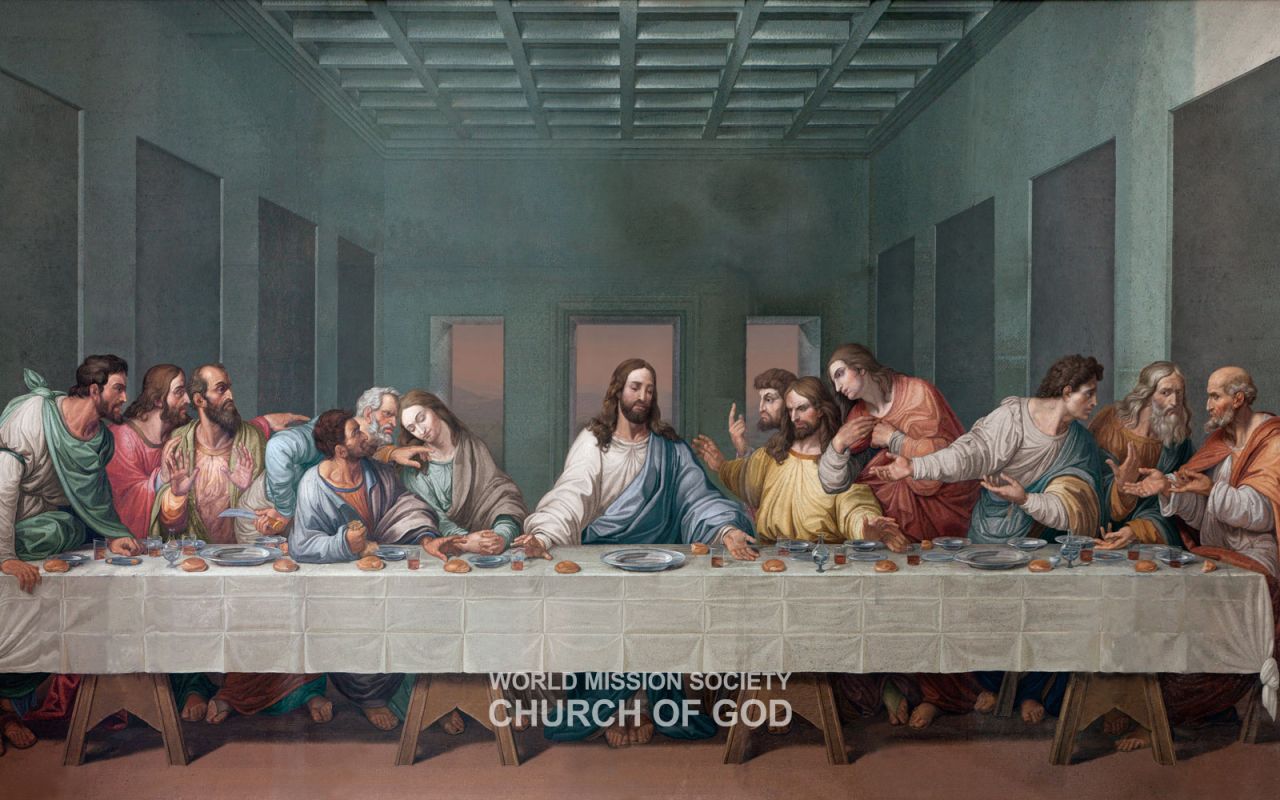

The history of the deliverance of the Israelites from Egypt after keeping the Passover was a prophecy that Jesus Christ would establish the Passover of the new covenant and free people from this sinful world. Jesus Christ sent Peter and John to prepare for the Passover on the 14th day of the first month by the sacred calendar when it was customary to sacrifice the Passover lamb.[25] That evening, Jesus Christ washed His disciples’ feet in Mark’s upper room[23] and celebrated the Passover together. Jesus Christ proclaimed the new covenant, saying that the Passover bread is His flesh and that the Passover wine is His blood, which was poured out for many for the forgiveness of sins.[24]
When the hour came, Jesus and His disciples reclined at the table. Jesus said to them, “I have eagerly desired to eat this Passover with you before I suffer. . . .” And he took bread, gave thanks and broke it, and gave it to them, saying, “This is my body given for you; do this in remembrance of me.” In the same way, after the supper he took the cup, saying, “This cup is the new covenant in my blood, which is poured out for you.”
Taking the cup of the Passover wine, Jesus said that it is the new covenant in His blood, and also said that He had eagerly desired to eat the Passover. This means that the core of the new covenant is the Passover. On the day after the Passover, Jesus died on the cross as the reality of the Passover lamb. The Roman soldiers broke the legs of the two robbers, who were hung on the cross on each side of Jesus, but they did not break Jesus’ bones. Instead, they pierced His side with a spear. This fulfilled the prophecy that the bones of the Passover lambs must not be broken.[26]
The Early Church Kept the Passover of the New Covenant
The Israelites celebrated the Passover a second time in the desert of Sinai in the year after the Exodus. This became a prophecy showing that the apostles and the saints of the early Church would keep the new covenant Passover on the evening of the 14th day of the first month by the sacred calendar every year after the Jesus’ ascension. Apostle Paul emphasized that we should keep the Passover because Christ was sacrificed as the reality of the Passover lamb.[27] He also said that we must commemorate Jesus’ sacrifice whenever we eat the bread and drink the wine on the night of the Passover, the night He was betrayed, and keep the Passover until the Lord comes.
For I received from the Lord what I also passed on to you: The Lord Jesus, on the night he was betrayed [Passover night], took bread, and when he had given thanks, he broke it and said, “This is my body, which is for you; do this in remembrance of me.” . . . “This cup is the new covenant in my blood; do this, whenever you drink it, in remembrance of me. For whenever you eat this bread and drink this cup, you proclaim the Lord’s death until he comes.”
Blessings of the Passover
Kingdom of Heaven

The Israelites’ 40-year long journey in the desert showed what would happen in the New Testament times.[28] The history of the Israelites keeping the Passover and being liberated from Egypt and entering Canaan after forty years in the desert was a prophecy that God’s people of the New Testament would keep the Passover, be set free from the sinful world, and enter the kingdom of heaven, the spiritual Canaan.[29][30]
There is no record of the Israelites keeping the Passover after they kept it a second time in the Desert of Sinai, until just before they entered Canaan. In the same way, in the New Testament times, the Passover was not celebrated for nearly 1,600 years after the Council of Nicaea was held in AD 325. The fact that the Israelites celebrated the Passover just before entering Canaan was a prophecy showing that the new covenant Passover, which had not been kept for a long time, would be restored just before God’s people enter heaven, the heavenly Canaan.[31] Just as the Israelites entered Canaan only after keeping the Passover, people can enter the kingdom of heaven, the spiritual Canaan, only after keep the new covenant.
Forgiveness of Sins
The Bible teaches that all people die because of their sins.[32] Since they cannot avoid death, they live as slaves to sin all their lives.[33] The only way to be freed from sin is to be clothed with the grace of Christ’s precious blood shed on the cross.[34] Jesus Christ said that the Passover wine is His blood shed for many for the forgiveness of sins. Therefore, we must keep the new covenant Passover to receive the forgiveness of sins through the blood of Christ. Just as the Israelites in the Old Testament times kept the Passover and were freed from Egypt, people in the New Testament times keep the new covenant Passover and are freed from this sinful world.[35]
Eternal Life
When our sins, which are cause of death, are taken away, we can live forever. Therefore, if we receive the forgiveness of sins, we can have eternal life. This is why Jesus Christ said that we will receive eternal life if we eat His flesh and drink His blood through the Passover of the new covenant.
Jesus said to them, “I tell you the truth, unless you eat the flesh of the Son of Man and drink his blood, you have no life in you. Whoever eats my flesh and drinks my blood has eternal life, and I will raise him up at the last day.”
The reason God gave us eternal life through the Passover of the new covenant is because the kingdom of heaven is a place where there is no death.[36] No one can enter heaven with a mortal body. This is why God gives His people eternal life through the new covenant Passover.

Disasters Pass Over
The Passover is a sign of God’s power that lets disasters pass over. The Bible records how God’s people, who kept the Passover, were protected from disasters. When the Israelites kept the Passover at the time of the Exodus, they were protected from the plague which struck down every firstborn.[37] When King Hezekiah and the people of Judah kept the Passover, they were protected from the Assyrian attack;[15][19] and in the New Testament times, those who keep the new covenant Passover are protected from the last plagues. When someone eats the flesh of Jesus Christ and drinks His blood through the Passover, they can remain in God.[38] God has promised that He will protect those who belong to Him from disasters.[39]
Fulfillment of the First Commandment
The first of the Ten Commandments, “You shall have no other gods before Me,” contains two commands: “Do not to serve other gods,” and “Serve only God.” The Passover is a special truth that enables us to destroy other gods and worship only God; because the Passover was established as the day to punish all other gods since the time of the Exodus.[37] If all the other gods are judged on the Passover, it means only God remains. If we realize the Passover and celebrate it, we can worship only God, not other gods. For example, God destroyed the gods of Egypt on the night of the Passover in the time of Moses. In the time of Hezekiah and of Josiah, too, the Israelites were able to serve only God by removing idols after keeping the Passover. Even in the New Testament times, we can fully keep the first commandment if we keep the Passover of the new covenant.
See also
- New Covenant
- New Covenant Passover
- Disaster & Passover
- Seal of God
- Feast of Unleavened Bread
- Feast of Firstfruits
- Feast of Weeks
- Feast of Trumpets
- Day of Atonement
- Feast of Tabernacles
Related videos
- Sermon: The Passover Holy Supper God Commanded Us to Keep
- Goal of Faith & the Passover
References
- ↑ 6453. pesach, Bible Hub
- ↑ 6452. pasach, Bible Hub
- ↑ "Deuteronomy 16:1–7".
- ↑ "Numbers 9:11–12".
- ↑ "Exodus 12:42–47".
- ↑ "Exodus 12:5–11".
- ↑ "Exodus 12:29–30".
- ↑ "Exodus 40:17".
- ↑ "Numbers 9:1–5".
- ↑ "Numbers 9:9–13".
- ↑ "Numbers 14:29–30".
- ↑ "Joshua 5:2–5".
- ↑ "Exodus 12:48".
- ↑ "Joshua 5:10–12".
- ↑ 15.0 15.1 "2 Chronicles 30:1–12".
- ↑ "2 Chronicles 31:1".
- ↑ Introduction to 1–2 Kings, ESV
- ↑ "2 Kings 18:9–12".
- ↑ 19.0 19.1 "2 Kings 19:30–35".
- ↑ "2 Kings 22:3–11".
- ↑ "2 Kings 23:3–4".
- ↑ "2 Kings 23:21–25".
- ↑ 23.0 23.1 "John 13:4–15".
- ↑ 24.0 24.1 "Matthew 26:19–28".
- ↑ "Luke 22:7–8".
- ↑ "John 19:32–36".
- ↑ "1 Corinthians 5:7–8".
- ↑ "1 Corinthians 10:1–11".
- ↑ "Hebrews 3:15-19".
- ↑ "Hebrews 4:6–11".
- ↑ "Isaiah 25:6–9".
- ↑ "Romans 6:23".
- ↑ "John 8:34".
- ↑ "Ephesians 1:7".
- ↑ "Romans 8:1–2".
- ↑ "Revelation 21:1–4".
- ↑ 37.0 37.1 "Exodus 12:11–13".
- ↑ "John 6:56".
- ↑ "Isaiah 43:1–2".