Sanctuary (Tabernacle)


_%EB%AA%A8%ED%98%95.jpg)
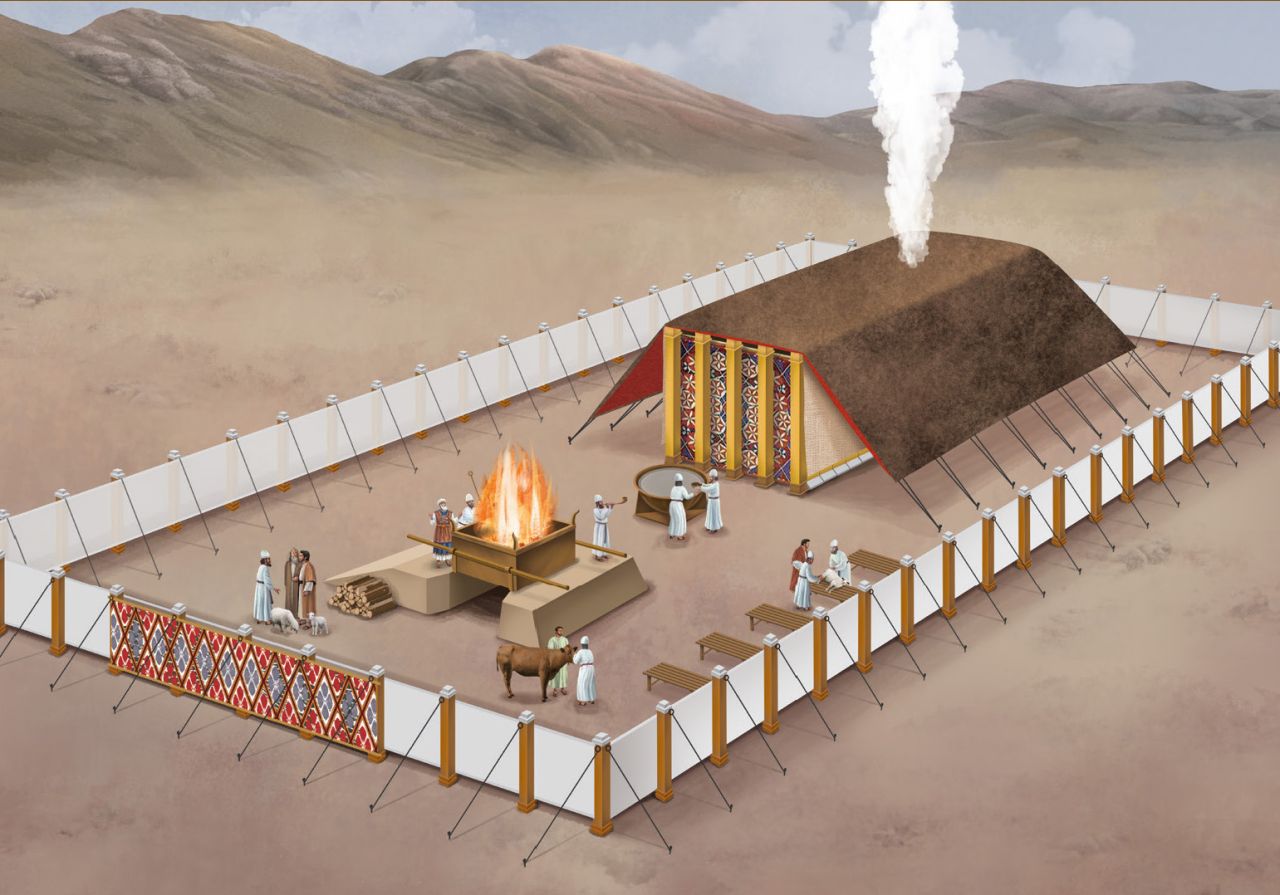
A sanctuary is a holy place[1] where God dwells among His people. The sanctuary housed the tablets of the Ten Commandments, that is, the words of God’s covenant, and was the place where the Israelites received forgiveness of sins. At its center were the outer room and the inner room. Because this central structure was a portable tent, it was called the tabernacle. Later, when a permanent structure was built, it was called the temple.
Terminology
In the Old Testament, the Hebrew words translated as sanctuary include miqdash (מִקְדָּשׁ)[2] and qodesh (קֹדֶשׁ),[3] which carry the meaning of holiness or something sacred. The sanctuary was described as the place where God dwelt among His people[4] and as the house of God.[5]
In a narrow sense, the term sanctuary can refer to the outer room; in a broader sense, it can include both the outer room and the inner room, which is called the Most Holy Place. In an even broader sense, it can refer to the entire structure containing these two rooms—the tabernacle, or later, the temple.
The central part of the sanctuary was a tent divided into the Holy Place and the Most Holy Place. This tent, made with finely twisted linen, was called the tabernacle. It was also called the Tent of Meeting, emphasizing that it was the place where God met with His people. Since it housed the ark of testimony (ark of the covenant), it was also referred to as the Tent of Testimony or the tabernacle of testimony. Although the terms tabernacle and Tent of Meeting originally referred to the tent at the center of the sanctuary, they were sometimes used more broadly to refer to the entire sanctuary, including the courtyard.[6]
Structure

The sanctuary built by Moses was a rectangular, portable sanctuary measuring 100 cubits long and 50 cubits wide.[7] Like a modern-day tent, it could be dismantled and reassembled. This was necessary because the Israelites were living in the wilderness and could not build a permanent structure in one location.
The tabernacle, or the Tent of Meeting, was the most important structure within the sanctuary. Although it appeared to be a single structure from the outside, its interior was divided by a curtain into two sections: the front room, the Holy Place, and the inner room, the Most Holy Place. The tabernacle was set up in a prescribed orientation: the rear, where the Most Holy Place was located, faced west, while the front, where the entrance was located, faced east.[8][9]
Later, the portable tabernacle was replaced by a permanent temple, but its basic layout and orientation remained the same.
Now the first covenant had regulations for worship and also an earthly sanctuary. A tabernacle was set up. In its first room were the lampstand, the table and the consecrated bread; this was called the Holy Place. Behind the second curtain was a room called the Most Holy Place, which had the golden altar of incense and the gold-covered ark of the covenant. This ark contained the gold jar of manna, Aaron's staff that had budded, and the stone tablets of the covenant.
Outer Room
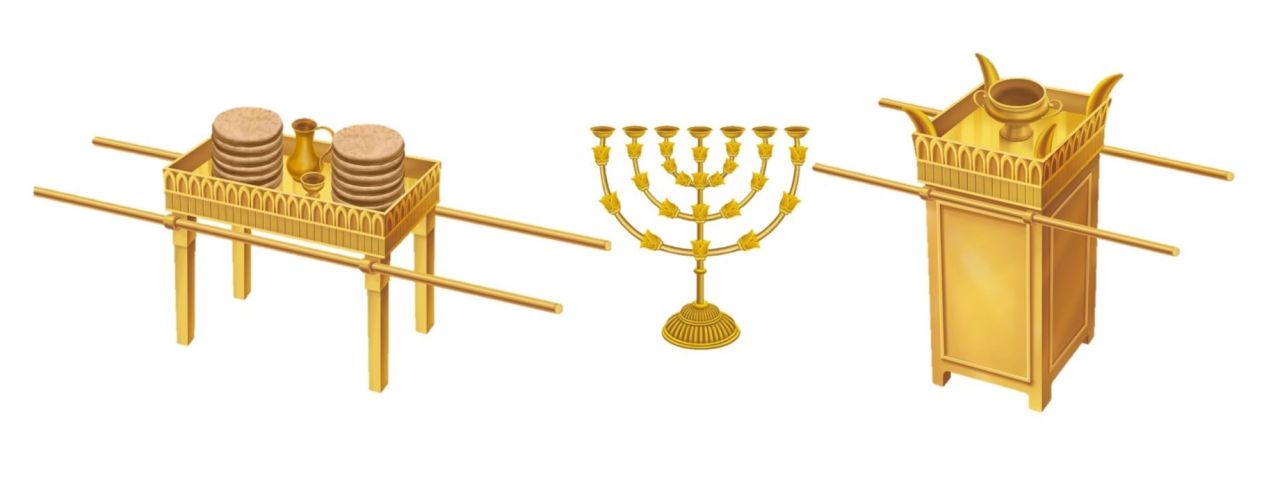

The outer room was also called the outer sanctuary. It was the area extending from the entrance of the tabernacle (the tent of meeting), that is, the entrance to the outer room, to the curtain. It contained the table for the bread of the Presence, the gold lampstand, and the altar of incense.
- Table for the Bread of the Presence: The table was made of acacia wood and measured 2 cubits long, 1 cubit wide, and 1.5 cubits high. It was overlaid with pure gold and had a gold molding around it. The bread of the Presence was always placed on the table, along with dishes, spoons, pitchers, and bowls of pure gold. The bread of the Presence was baked with fine flour without yeast and arranged on the table in 2 rows of 6 loaves, for a total of 12 loaves. Every Sabbath, the loaves were replaced with fresh ones. The loaves that were removed were eaten by the high priest and his descendants in the courtyard of the tabernacle.[10][11]
- Golden Lampstand: The lampstand had 3 branches extending from each side, making 7 branches in all, with cups shaped like almond flowers at their ends. Its shaft, cups, flowers, and buds were all made of gold and formed as one piece. Its wick trimmers and trays were also made of pure gold.[12] The 7 lamps gave light toward the front. They were fueled with clear oil made from pressed olives. The lamps were extinguished in the morning and kept burning throughout the night.[13]
- Altar of Incense: The altar was made of acacia wood and measured 1 cubit long, 1 cubit wide, and 2 cubits high. It had horns on its 4 upper corners and was overlaid with pure gold, with a gold molding around it. The high priest burned fragrant incense on it every morning and evening.[14]
Inner Room (Most Holy Place)

.jpg)
It was the inner space behind the curtain and had a cubical structure, with equal length, width, and height. The inner room was called the Most Holy Place, meaning “the most holy place,” because it contained the ark of the covenant, in which the Ten Commandments were kept. No one could enter the Most Holy Place freely. Only the anointed high priest could enter it once a year, on the Day of Atonement, with the blood of the sin offering.[15][16]
- Curtain: The curtain separated the Holy Place from the Most Holy Place and had cherubim embroidered on it. To enter the Most Holy Place from the Holy Place, one had to pass through the curtain.[17]
- Ark of the Covenant: The ark of the covenant, the most important of the furnishings of the tabernacle, was a chest made of acacia wood, measuring 2.5 cubits long, 1.5 cubits wide, and 1.5 cubits high. It was overlaid with pure gold and had a gold molding around it. Four gold rings were attached to it, and poles overlaid with gold were inserted into the rings so that the ark could be carried. The tablets of the covenant, the stone tablets of the Ten Commandments, were placed inside the ark.[18]
- Atonement Cover: The cover of the ark of the covenant was called the “atonement cover.” God said that He would meet with Moses between the two cherubim above the atonement cover. These cherubim represented the cherubim that guarded the way to the tree of life in the Garden of Eden. It was here that the forgiveness of sins was granted and God’s grace was bestowed. The atonement cover was also called the “mercy seat,” meaning the place where mercy is bestowed.[19]
Courtyard of the Sanctuary
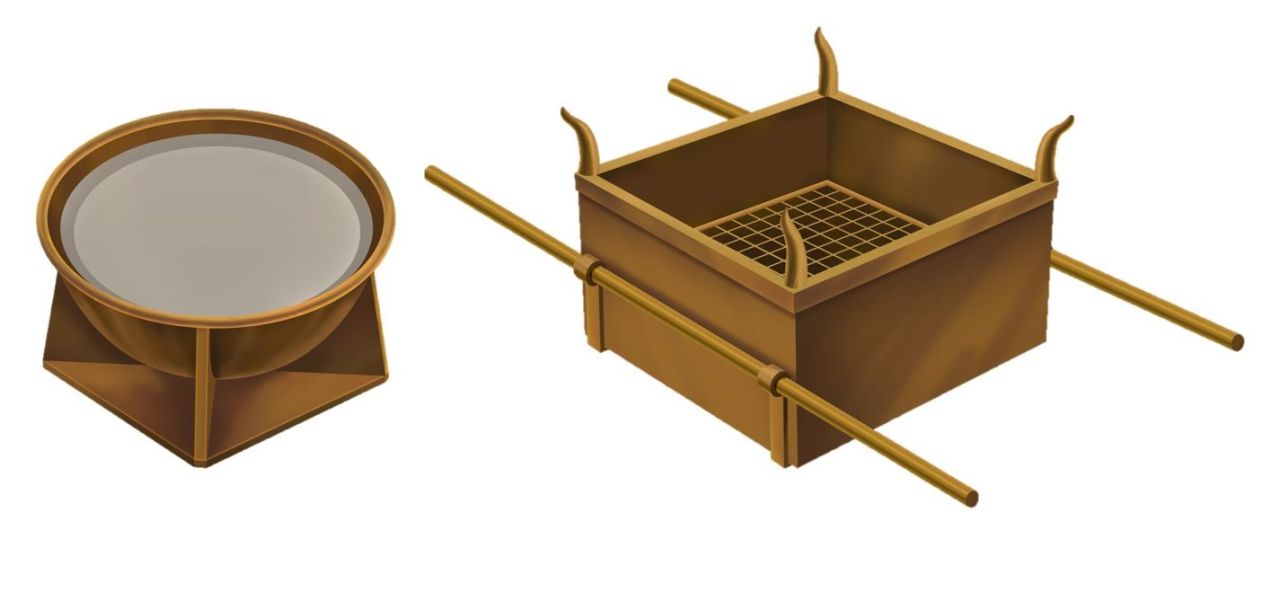

The courtyard was a large open area just inside the entrance to the sanctuary on the east side. It was enclosed by 60 posts and 300 cubits of finely twisted linen curtains. Since the posts were 5 cubits high (about 2.25 m), no one could see what was taking place inside without entering through the entrance to the sanctuary.
- Altar of Burnt Offering: It was an altar made of bronze for offering sacrifices to God.[20] The priests had to take fire from the altar of burnt offering with them when they entered the tabernacle to burn incense.[21][22]
- Basin: It was a basin containing water for washing the hands and feet. It stood between the altar of burnt offering and the entrance to the tabernacle (the entrance to the outer room), and the priests washed their hands and feet before entering the sanctuary.[23]
Sanctuary and History of Israel


When Moses received the stone tablets of the Ten Commandments on Mount Sinai, God showed him the tabernacle in heaven.[24][25] When Moses came down from the mountain, he delivered God’s word to the people and told them that various offerings, such as gold, silver, bronze, and acacia wood, were needed for the construction of the tabernacle,[26] and that skilled people were needed to make the tabernacle and its furnishings. All the Israelites who were willing gladly brought the necessary offerings.[27] As they continued to bring offerings day after day, there was more than enough for the work of building the tabernacle, so Moses told them to stop bringing more.[28]
Bezalel and Oholiab, who were filled with the Spirit of God, along with other skilled workers, constructed the tabernacle and made all its furnishings and decorations, including the ark of the covenant, as well as the priestly garments. When the work of building the tabernacle was completed, Moses inspected everything and saw that it had been done just as God had commanded. So Moses blessed them.
On the first day of the first month in the second year after the Exodus, Moses set up the tabernacle as God had commanded and put all its furnishings in place. He placed the tablets of the Ten Commandments in the ark of the covenant and put up the curtain at the entrance to the courtyard. Then the cloud covered the Tent of Meeting, and the glory of God filled the tabernacle. By day, God’s cloud was over the tabernacle, and by night, fire was in the cloud. From then on, a pillar of cloud was over the sanctuary by day and a pillar of fire by night,[29] guiding the Israelites throughout their journey.
When the tabernacle had been set up, God called Moses from the Tent of Meeting[30] and gave him detailed regulations concerning the sacrifices to be offered to God in the sanctuary. According to God’s word, Moses appointed Aaron and his sons as priests. After offering the sacrifices, Moses and Aaron entered the Tent of Meeting. When they came out and blessed the people, the glory of God appeared to all the people. Fire came out from the presence of God and consumed the burnt offering and the fat portions on the altar.
Later, Aaron’s two sons, Nadab and Abihu, put fire in their censers that was different from the fire from the altar of burnt offering that God had commanded them to use, and offered incense.[21][22] Then fire came out from the presence of the LORD and consumed them, and they died before the LORD.[31] After their death, God told Aaron not to enter the Most Holy Place behind the curtain, before the atonement cover on the ark, whenever he chose, or he would die.[32] He also instructed him that when he entered, he had to make atonement for himself and his household and then offer incense in the Most Holy Place so that he would not die.
Later, the twelve tribes of Israel camped around the tabernacle in four groups of three tribes each. The tribes of Judah, Issachar, and Zebulun camped on the east side; Reuben, Simeon, and Gad on the south; Ephraim, Manasseh, and Benjamin on the west; and Dan, Asher, and Naphtali on the north. The tribe of Levi was positioned around the tabernacle at the center. The Levites were responsible for serving at the tabernacle and received a tenth of the Israelites’ produce as their inheritance.[33][34] The Israelites camped and set out according to their clans and families. Whenever the cloud lifted from above the tabernacle, they set out, and wherever the cloud settled, they camped.[35] As long as the cloud remained over the tabernacle, whether for two days, a month, or a year, they did not set out.
After the Israelites entered the land of Canaan, the tabernacle made in the time of Moses was set up at Shiloh, and the ark of the covenant of God was placed inside it.[36] In the time of Solomon, a permanent temple was built in Jerusalem on Mount Moriah, and the sanctuary was moved to the temple.
Role and Meaning of the Sanctuary
The Ten Commandments, the feasts, and the sanctuary were closely connected as one inseparable system. The sanctuary was needed to safely keep the Ten Commandments, the words of God’s covenant, and the feasts were needed as the ordinances for worshiping God in the sanctuary. The feasts were also the way by which people were cleansed through sin offerings, approached the Ten Commandments, which represented the tree of life, in the sanctuary, and received life.
Where God Dwells
The most important reason the sanctuary was set apart as a holy place was that God dwelled there. As God’s dwelling place, the sanctuary was called the house of the LORD.[4][37][38] It also symbolized God dwelling among His people.[39][40] The tabernacle was also called the Tent of Meeting[41][42][43][44] because it was there that God met with His people.
Where the Ten Commandments Were Kept
The Ten Commandments, God’s commandments, were kept inside the ark of the covenant in the Most Holy Place. God had the Ten Commandments placed in the ark of the covenant and the cover, with two cherubim on it, placed over the ark. This cover was the atonement cover. The two cherubim above the ark of the covenant, corresponding to the cherubim who guarded the tree of life in the Garden of Eden, indicate that the tree of life was represented there.
The cherubim guarding the tree of life in Eden had a flaming sword to prevent sinners from approaching the tree of life.[45] Likewise, the cherubim guarding the ark of the covenant in the Most Holy Place had a flaming sword, and those who approached the ark contrary to God’s regulations were put to death. Uzzah died on the spot when he accidentally touched the ark of the covenant,[46] and Aaron’s two sons violated God’s regulations and were put to death by fire that came out from the presence of the LORD.[47] In other words, the Ten Commandments were given in place of the tree of life. Jesus also taught, “If you want to enter life, keep the commandments.”[48]
Where the Forgiveness of Sins Is Granted
In the sanctuary where God dwelled, the forgiveness of sins was also granted. Sinners could not receive the Ten Commandments, which God had given in place of the tree of life. As it is written, “without the shedding of blood there is no forgiveness” (Heb 9:22),[49] the sacrificial blood of a sin offering was necessary for the forgiveness of sins. The practice of offering sacrifices with the shedding of blood, which had been handed down orally since the time of Abel, was codified in the time of Moses.
In Old Testament times, the priests offered sacrifices involving the shedding of blood in the sanctuary according to the Law of Moses for the forgiveness of the people’s sins. Through the daily burnt offerings and the sacrifices offered on the Sabbath and at the feasts, the people’s sins were temporarily transferred to the sanctuary and were ultimately transferred to the scapegoat on the Day of Atonement. This was a shadow showing that in New Testament times, the sins of God’s people would be temporarily transferred to Christ and then transferred to Satan, the devil, through the feasts. The scapegoat wandered in a solitary place until it died, and the people’s sins were completely forgiven.
The Earthly Sanctuary and the Heavenly Sanctuary
The earthly sanctuary built by Moses was a copy and shadow of the heavenly sanctuary.[25] Just as people had to be cleansed by the sacrificial blood of a sin offering before approaching the tree of life in the earthly sanctuary and receiving life, in New Testament times we must be cleansed by the blood of Christ, the Lamb, in order to approach the tree of life in the heavenly sanctuary.[50][51][52] By keeping the feasts that symbolize the blood of Christ, we are able to approach the tree of life and receive life.
See also
- Most Holy Place
- Temple
- Ark of the Covenant
- Jerusalem
- New Jerusalem
- Sacrifices in the Old Testament
- The Feasts of God
- Day of Atonement
External links
References
- ↑ "sanctuary". Britannica.
- ↑ "4720. Miqdash or miqqedash". Bible Hub.
- ↑ "6944. qodesh". Bible Hub.
- ↑ 4.0 4.1 "Exodus 25:8".
- ↑ "Jeremiah 51:51".
- ↑ "Numbers 9:15".
- ↑ "Exodus 27:9–18".
- ↑ "Exodus 26:22".
- ↑ "Numbers 3:38".
- ↑ "Exodus 25:23–30".
- ↑ "Leviticus 24:8–9".
- ↑ "Exodus 25:31–40".
- ↑ "Exodus 27:20–21".
- ↑ "Exodus 30:1-10".
- ↑ "Leviticus 16:6–34".
- ↑ "Hebrews 9:1–7".
- ↑ "Exodus 26:31–33".
- ↑ "Exodus 25:10–16".
- ↑ "Exodus 25:17–21".
- ↑ "Exodus 27:1–8".
- ↑ 21.0 21.1 "Numbers 16:42–46".
- ↑ 22.0 22.1 "Leviticus 16:12".
- ↑ "Exodus 30:17–21".
- ↑ "Exodus 25:1–9".
- ↑ 25.0 25.1 "Hebrews 8:5".
- ↑ "Exodus 35:4–19".
- ↑ "Exodus 35:20–29".
- ↑ "Exodus 35:30–36:7".
- ↑ "Numbers 9:15".
- ↑ "Leviticus 1:1".
- ↑ "Leviticus 10:1–2".
- ↑ "Leviticus 16:1–2".
- ↑ "Numbers 3:5–8".
- ↑ "Numbers 18:21".
- ↑ "Numbers 2:1–34".
- ↑ "Joshua 18:1".
- ↑ "Psalms 122:1".
- ↑ "Psalms 134:1".
- ↑ "Psalms 114:2".
- ↑ "Habakkuk 2:20".
- ↑ "Exodus 25:22".
- ↑ "Exodus 31:7".
- ↑ "Exodus 33:7".
- ↑ "Numbers 11:26".
- ↑ "Genesis 3:24".
- ↑ "2 Samuel 6:6-7".
- ↑ "Leviticus 10:1–2".
- ↑ "Matthew 19:17".
- ↑ "Hebrews 9:22".
- ↑ "Hebrews 10:19–20".
- ↑ "Revelation 22:14".
- ↑ "Revelation 7:14".