Moses: Difference between revisions
m Text replacement - "[[Life in Desert" to "[[Life in the Desert" |
|||
| Line 12: | Line 12: | ||
}} | }} | ||
'''Moses ('''Hebrew: משֶׁה)<ref>[https://biblehub.com/hebrew/4872.htm 4872. Mosheh], ''Bible Hub''</ref>was a leader who guided the Israelites who were oppressed in Egypt to the land of [[Canaan]] that [[God]] promised to them. He was a son of Amram and Jochebed, Levites. He was raised as a step son of an Egyptian princess. He gave up his comfortable life as the prince of Egypt and suffered with his people.<ref>{{Cite web |url=https://www.biblegateway.com/passage/?search=Hebrews+11%3A24-26&version=NIV |title=Hebrews 11:24–26 |publisher= |quote=}}</ref> He is the writer of the [https://www.britannica.com/topic/Torah Pentateuch] and the prophet who represents the Old Testament times. At the age of eighty, he was called by God to lead the Israelites during the [[The Exodus|Exodus]] and [[Life in Desert|the forty-year journey in the desert]], and he received the [[The Ten Commandments|Ten Commandments]] directly from God. Moses’ work in the [[The Old Testament|Old Testament]] symbolizes the work of [[Jesus Christ]]. | '''Moses ('''Hebrew: משֶׁה)<ref>[https://biblehub.com/hebrew/4872.htm 4872. Mosheh], ''Bible Hub''</ref>was a leader who guided the Israelites who were oppressed in Egypt to the land of [[Canaan]] that [[God]] promised to them. He was a son of Amram and Jochebed, Levites. He was raised as a step son of an Egyptian princess. He gave up his comfortable life as the prince of Egypt and suffered with his people.<ref>{{Cite web |url=https://www.biblegateway.com/passage/?search=Hebrews+11%3A24-26&version=NIV |title=Hebrews 11:24–26 |publisher= |quote=}}</ref> He is the writer of the [https://www.britannica.com/topic/Torah Pentateuch] and the prophet who represents the Old Testament times. At the age of eighty, he was called by God to lead the Israelites during the [[The Exodus|Exodus]] and [[Life in the Desert|the forty-year journey in the desert]], and he received the [[The Ten Commandments|Ten Commandments]] directly from God. Moses’ work in the [[The Old Testament|Old Testament]] symbolizes the work of [[Jesus Christ]]. | ||
==Historical Background == | ==Historical Background == | ||
| Line 111: | Line 111: | ||
God called Moses and asked him to go up to Mount Nebo from the plains of Moab, across from [[Jericho]], to see the land of Canaan. God told Moses that He would die on Mount Nebo without crossing over into the land of Canaan.<ref>{{Cite web |url=https://www.biblegateway.com/passage/?search=Deuteronomy+32%3A49-51&version=NIV |title=Deuteronomy 32:49–51 |publisher= }}</ref> Then, God told him to appoint [[Joshua]] as his successor.<ref>{{Cite web |url=https://www.biblegateway.com/passage/?search=Numbers+27%3A18-20&version=NIV |title=Numbers 27:18–20 |publisher= |quote=}}</ref> According to God’s word, Moses laid his hands on Joshua and appointed him as his successor.<ref>{{Cite web |url=https://www.biblegateway.com/passage/?search=Numbers+27%3A22-23&version=NIV |title=Numbers 27:22–23 |publisher= |quote=}}</ref> | God called Moses and asked him to go up to Mount Nebo from the plains of Moab, across from [[Jericho]], to see the land of Canaan. God told Moses that He would die on Mount Nebo without crossing over into the land of Canaan.<ref>{{Cite web |url=https://www.biblegateway.com/passage/?search=Deuteronomy+32%3A49-51&version=NIV |title=Deuteronomy 32:49–51 |publisher= }}</ref> Then, God told him to appoint [[Joshua]] as his successor.<ref>{{Cite web |url=https://www.biblegateway.com/passage/?search=Numbers+27%3A18-20&version=NIV |title=Numbers 27:18–20 |publisher= |quote=}}</ref> According to God’s word, Moses laid his hands on Joshua and appointed him as his successor.<ref>{{Cite web |url=https://www.biblegateway.com/passage/?search=Numbers+27%3A22-23&version=NIV |title=Numbers 27:22–23 |publisher= |quote=}}</ref> | ||
====Moses’ Last Sermon==== | ====Moses’ Last Sermon==== | ||
On the first day of the eleventh month, 40 years after leaving Egypt, Moses and the Israelites arrived in the east of the [[Jordan]] on the plains of Moab. Moses preached his last sermon to the people there. <ref>{{Cite web |url=https://www.biblegateway.com/passage/?search=Deuteronomy+1%3A1&version=NIV |title=Deuteronomy 1:1 |publisher= |quote=}}</ref> Moses looked back on the past [[Life in Desert|40 years in the desert]]. He told them that man does not live on bread alone but on every word that comes from the mouth of God. Then, he urge them to fear God and keep His commands because God had them walk in the desert so that in the end it might go well with them. Moreover, Moses explained in detail God’s decrees and laws that they must keep all our lives: [[The Ten Commandments|Ten Commandments]], [[The Feasts of God|the feasts]], [[Tithe|tithes]], etc. | On the first day of the eleventh month, 40 years after leaving Egypt, Moses and the Israelites arrived in the east of the [[Jordan]] on the plains of Moab. Moses preached his last sermon to the people there. <ref>{{Cite web |url=https://www.biblegateway.com/passage/?search=Deuteronomy+1%3A1&version=NIV |title=Deuteronomy 1:1 |publisher= |quote=}}</ref> Moses looked back on the past [[Life in the Desert|40 years in the desert]]. He told them that man does not live on bread alone but on every word that comes from the mouth of God. Then, he urge them to fear God and keep His commands because God had them walk in the desert so that in the end it might go well with them. Moreover, Moses explained in detail God’s decrees and laws that they must keep all our lives: [[The Ten Commandments|Ten Commandments]], [[The Feasts of God|the feasts]], [[Tithe|tithes]], etc. | ||
Moses repeatedly said that what God wants the people to do is to serve God with all their heart and soul, and to observe God’s commands and decrees for their own good.{{quote5 |내용= And now, O Israel, what does the LORD your God ask of you but to fear the LORD your God, to walk in all his ways, to love him, to serve the LORD your God with all your heart and with all your soul, and '''to observe the LORD's commands and decrees''' that I am giving you '''today for your own good'''? |출처= [https://www.biblegateway.com/passage/?search=Deuteronomy+10%3A12-13&version=NIV Deuteronomy 10:12–13]}} | Moses repeatedly said that what God wants the people to do is to serve God with all their heart and soul, and to observe God’s commands and decrees for their own good.{{quote5 |내용= And now, O Israel, what does the LORD your God ask of you but to fear the LORD your God, to walk in all his ways, to love him, to serve the LORD your God with all your heart and with all your soul, and '''to observe the LORD's commands and decrees''' that I am giving you '''today for your own good'''? |출처= [https://www.biblegateway.com/passage/?search=Deuteronomy+10%3A12-13&version=NIV Deuteronomy 10:12–13]}} | ||
| Line 197: | Line 197: | ||
== See also == | == See also == | ||
*[[Moses and Jesus]] | *[[Moses and Jesus]] | ||
*[[Life in Desert]] | *[[Life in the Desert]] | ||
*[[Passover]] | *[[Passover]] | ||
*[[Red Sea]] | *[[Red Sea]] | ||
Revision as of 10:05, 31 July 2025
| Moses | |
|---|---|
| Moses | |
 | |
| Family | Father: Amram Mother: Jochebed Brother: Aaron Sister: Miriam Wife: Zipporah Children (sons): Gershom, Eliezer |
| Birthplace | Goshen |
| Burial place | Mount Nebo, Moab |
| Major achievements | Wrote the Pentateuch Led the Israelites at the time of Exodus The miracle of the Red Sea Received the Ten Commandments from God Built the tabernacle and established the priests and the Levites Led the Israelites in the desert for 40 years |
Moses (Hebrew: משֶׁה)[1]was a leader who guided the Israelites who were oppressed in Egypt to the land of Canaan that God promised to them. He was a son of Amram and Jochebed, Levites. He was raised as a step son of an Egyptian princess. He gave up his comfortable life as the prince of Egypt and suffered with his people.[2] He is the writer of the Pentateuch and the prophet who represents the Old Testament times. At the age of eighty, he was called by God to lead the Israelites during the Exodus and the forty-year journey in the desert, and he received the Ten Commandments directly from God. Moses’ work in the Old Testament symbolizes the work of Jesus Christ.
Historical Background
Jacob who lived in Canaan migrated to the land of Goshen in Egypt to escape the famine, being invited by Joseph who became a prime minister of Egypt. At that time, there were 70 members of Jacob’s family who moved to Egypt. In the land of Goshen, which was known to be the most fertile land in Egypt, the Israelites prospered and became powerful.[3] Jacob’s twelve sons became the basis of the twelve tribes of Israel. However, the situation changed when a new king was enthroned because he did not know Joseph, a former prime minister of Egypt. Pharaoh, the king of Egypt, felt a political threat as the number of Israelites increased. Thus, they made the Israelites slaves and let them build the national store cities of Pithom and Ramses to weaken their power. The Israelites carried out hard labor in brick and mortar and with all kinds of work in the fields every day. However, the more they were oppressed, the more the population increased and the worries of Pharaoh and the Egyptians grew.[4] Eventually, Pharaoh ordered to kill all the Hebrew boys when they were born.[5][6]
Moses’ Life and Major Events
Birth and Life in the Palace
.jpg)
After Pharaoh’s command was given throughout Egypt, Jochebed the wife of Amram of the tribe of Levi gave birth to a son. Jochebed raised the child for three months while hiding him. As the child grew older, it was hard to hide him. So she put him in a papyrus basket coated it with tar and pitch. Then, she placed the child in it and put it among the reeds along the bank of the Nile. At that time, the princess of Pharaoh came to bathe and found the box. The princess knew that the child was a Hebrew, but she felt sorry for him and decided to keep the child. After seeing this, Moses’ sister Miriam recommended his mother Jochebed as his nanny to nurse the child to the princess. The princess paid Jochebed a wage and let her nurse the child. After taking the child to the palace and adopt him, the princess gave him the name Moses meaning, “I drew him out of the water.”[7] According to Stephen’s speech at the Council, Moses was educated in all the wisdom of the Egyptians until he was forty years old in the royal palace.[8]
Shepherd Life
- Fleeing to Midian
When Moses turned 40, he decided to take care of his people.[9] One day, he went to the field where his people, the Hebrews, worked. Seeing an Egyptian beating a Hebrew, he became furious and killed the Egyptian. Moses hid the Egyptian body in the sand. The next day, he went out again, and this time he saw two Hebrews fighting. While mediating their fight, Moses found out that what he had killed an Egyptian was exposed. When Pharaoh tried to find Moses to kill him, Moses ran away from Pharaoh and fled to Midian.
Moses happened to help the seven daughters of a Midianite priest called Jethro (also known as Reuel),[10]who were in trouble by a well. There, Moses married Zipporah the daughter of Jethro,[11] gave birth to two sons, and lived as a shepherd herding sheep for forty years.
- Receiving the Mission to Save His People.


As time passed by, a new king ascended to the throne of Egypt, but the Israelites were still suffering from hard labor. God heard their groaning and crying and remembered the covenant He had made with Abraham, Isaac, and Jacob and looked after them.[12]
One day, Moses drove his sheep to Horeb (Mount Sinai),[13] the mountain of God, and found flames of fire from within a bush. When Moses tried to get close to it, God commanded Moses, "Do not come any closer, but Take off your sandals, for the place where you are standing is a holy ground." God told Moses, who was afraid, a plan of delivering the Israelites out of Egypt and lead them to the land of Canaan flowing with milk and honey. He entrusted Moses with the mission to save the Israelites.[14]
Moses thought he was not the one who could be entrusted with the task, but God encouraged him and said He would be with him[15]. Moses asked God to show the Israelites a convincing evidence so that they could trust him. In an instant, God showed him the miracle of the staff of Moses turning into a serpent and the miracle of leprosy on his hand.[16] Although seeing the power of God right before his eyes, Moses hesitated again and said he was not eloquent.[17] God told Moses that He is the Creator who gave man his mouth and said, “I will help.” When Moses asked God once again to entrust the mission to another competent person, God’s anger burned against Moses and said that his brother, Aaron, would speak to the Israelites on his behalf. Then, Moses accepted his mission and said goodbye to Jethro, his father-in-law, and headed for Egypt with his family. Moses was 80 years old at that time.[18]
Exodus and the Life in the desert
Ten Plagues and the Power of the Passover

Moses and Aaron delivered God’s will to Pharaoh, king of Egypt, to free the Israelites, but Pharaoh refused to listen and rather aggravated their labor and abused them even more. God brought the ten plagues upon the Egyptians to show His power.[19]
The ten plagues that came upon Egypt were as follows:
① First plague: Turning water to blood
② Second plague: Frogs
③ Third plague: Gnats
④ Fourth plague: Flies
⑤ Fifth plague: Livestock Pestilence
⑥ Sixth plague: Boils
⑦ Seventh plague: Hail
⑧ Eighth plague: Locusts
⑨ Ninth plague: Darkness
⑩ Tenth plague: Killing of the Firstborn
As Moses and Aaron had foretold, there were nine plagues, but Pharaoh did not let the Israelites go. Finally, God brought down the tenth plague; destroying all the firstborn of Egypt. God taught Moses and Aaron how to escape the tenth plague, so that they could save the lives of the Israelites. The way to escape the last plague was keeping the Passover.
On the night when the Israelites celebrated the Passover, all were slain in the land of Egypt; from the firstborn of Pharaoh to the firstborn of livestock. There was loud wailing in Egypt. However, the Israelites, who kept the Passover according to God’s word, escaped the disaster. Pharaoh finally decided to let the Israelites go.[20]
God commanded the Israelites, who were saved from disasters, to keep the Passover as an everlasting ordinance for generations to come.
It is the LORD's Passover. “On that same night I will pass through Egypt and strike down every firstborn―both men and animals―and I will bring judgment on all the gods of Egypt. I am the LORD. The blood will be a sign for you on the houses where you are; and when I see the blood, I will pass over you. No destructive plague will touch you when I strike Egypt. This is a day you are to commemorate; for the generations to come you shall celebrate it as a festival to the LORD―a lasting ordinance.”
The miracle of the Red Sea


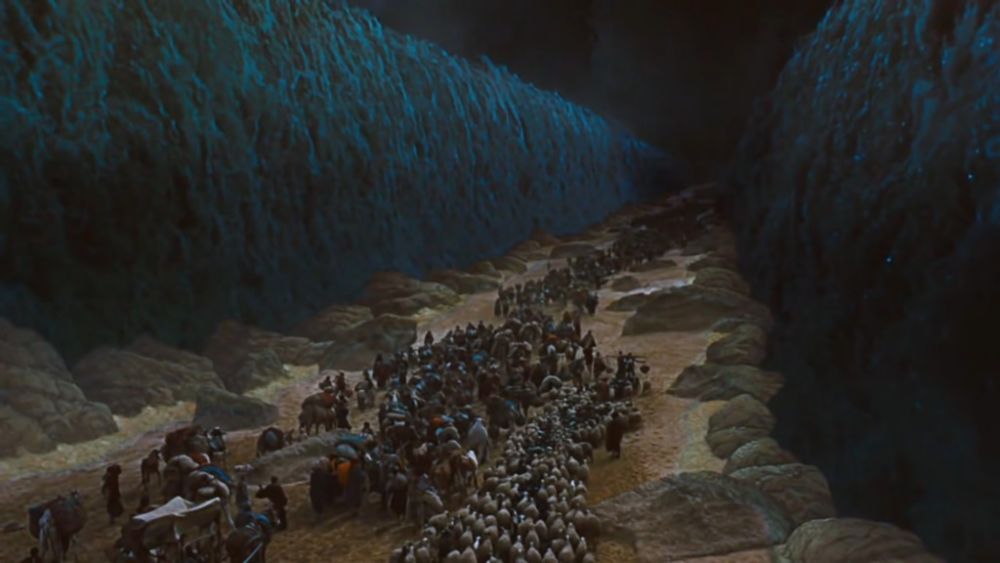

By the power of the Passover, the Israelites came out of Egypt and arrived in front of the Red Sea and encamped there.[21] At that time, Pharaoh changed his mind and pursued the Israelites with six hundred of the best chariots along with all the other chariots of Egypt. The Israelites feared and cried out to God and grumbled against Moses, saying, “It would have been better for us to serve the Egyptians than to die in the desert!"[22] Moses reassured the Israelites that God would fight for them.
According to God’s word, Moses stretched out his staff over the sea.[23] Then, the sea was divided and a dry ground appeared. All that night, God drove the sea back with a strong east wind and turned it into dry land.[24] The waters were divided, and the Israelites went through the sea on dry ground, with a wall of water on their right and on their left. When the Egyptian army came after the Israelites into the sea, God made the wheels of their chariots come off so that they had difficulty driving.[25]
At daybreak, Moses stretched out his hand over the sea by following God's word, and the sea went back to its place; the Egyptians were fleeing toward it, and God swept them into the sea. The Israelites landed safely on the other side of the land. The Israelites, who had witnessed the power of God, feared God and trusted Moses.[26]
- The Miracle That Divided the Red Sea (A scene from the movie, The Ten Commandments)
Battle With the Amalekites

When the Israelites were at Rephidim through the Desert of Sin,[27] the Amalekites attacked Israel. Moses let Joshua lead an army and fight while he took Aaron and Hur up to the top of the mountain. As long as Moses held up his hands, the Israelites were winning, but whenever he lowered his hands, the Amalekites were winning. As Moses grew tired, Aaron and Hur held up his arms on each side until the sunset. Eventually, Joshua’s army won the war.
After the war, Moses gave thanks to God and built an altar, and called it, “Jehovah Nissi,” which means, “Jehovah is my banner.”[28]
Moses Received the First Set of the Ten Commandments
God descended to Mount Sinai and proclaimed the Ten Commandments while the Israelites gathered together.[29] They were afraid that they would die when they heard God’s voice, so they asked Moses to deliver God’s word on His behalf.[30] Moses was the only person who faced God.[31] The people heard God’s voice like the thunder, but Moses heard and understood it correctly.[30] God let the people go back to their tents and called Moses separately. Then, He taught all the laws and regulations, including the seven feast in three times.[32] When Moses delivered God’s word to the people, they replied with one voice that they would obey the word.[33]
God told Moses to go up to Mount Sinai, so that He would give him the tablets of stone with the law and the commandments written on it.[34] From that day on, Moses went up to Mount Sinai and stayed there forty days and nights without eating bread or drinking water.[35][36] God commanded Moses to build a sanctuary (tabernacle) that He would dwell among His people. He showed Moses in detail the structure, size, shape, and materials of the sanctuary, and told him to build it exactly how it was shown.[37] Also, God made the two stone tablets of the covenant, meaning the tablets of the Ten Commandments, and asked to store them in the ark of the covenant inside the Most Holy Place. Then, God said He would meet Moses and give him all His commands for the Israelites from above the cover between the two cherubim (angels) that were over the ark of the Testimony.[38] When God finished speaking to him on Mount Sinai, He gave Moses the two tablets of the Testimony, the tablets of stone (of the Ten Commandments) inscribed by the finger of God.[39]
- Moses receives the Ten Commandments on Mount Sinai (A scene from the movie, The Ten Commandments)
Idolatry With the Golden Calf
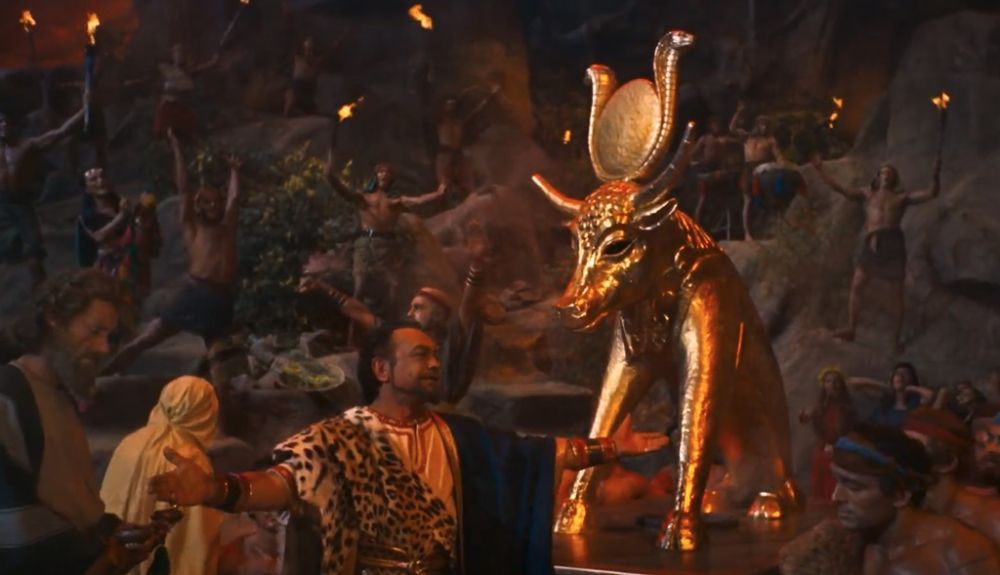


When Moses did not come down from Mount Sinai for forty days, the people came to Aaron and asked him to make a god to lead them because they were not sure what happened to Moses. Aaron made an idol in the shape of a calf by melting the gold earrings brought by the people. The people built an altar in front of it and called the golden calf the god who brought them out of Egypt. Then, they sat down to eat and drink, and got up to indulge in revelry. Moreover, Aaron proclaimed, “Tomorrow there will be a festival to the LORD."[40]
God was angry with the people who became corrupt and worshiped the idol, so He said He would destroy them. When Moses sought the favor of God, God saw his earnestness and did not bring disaster.[41]
As Moses descended from Mount Sinai, he saw the people worshiping an idol in the form of a golden calf. His anger burned and threw the tablets out of his hands, breaking them to pieces at the foot of the mountain. When Moses made a distinction between those who stood on God’s side and those who did not, the Levites stood on God’s side. Moses punished those who worshiped the idol of the golden calf by the tribe of Levi. That day, 3,000 people were killed.[42]
Received the Second Set of the Ten Commandments
Moses went to God and repented of the sins of the Israelites and asked for forgiveness, saying, “Please forgive their sin--but if not, then blot me out of the book you have written." Then, God answered, “Whoever has sinned against me I will blot out of my book.”[43]
God commanded Moses to tell the Israelites to take off their ornaments.[44] Then, He asked Moses to chisel two stone tables like the first ones and come up to Mount Sinai.[45] As Moses followed everything, God came down on Mount Sinai. God said that He would make a covenant with His people. He commanded them as follows: Do not worship any other gods, do not make cast idols, keep the seventh-day Sabbath, celebrate the Feast of Unleavened Bread, the Feast of Weeks, and the Feast of Ingathering every year.[46] Moses was there with God forty days and forty nights without eating bread or drinking water. God recorded the words of the covenant, which were the same as the first time, the Ten Commandments, on the stone tablets.[47] Moses came down with the second set of the Ten Commandments on the 10th day of the seventh month by the sacred calendar. This day become the origin of the Day of Atonement.
Rebellion of Korah and His Followers
_(14792891813).jpg)
Korah of the tribe of Levi, and certain Reubenites—Dathan, Abiram, and On—coveted the Priest title and formed a group to rebel against Moses and Aaron along with 250 leaders. Moses rebuked them for not knowing their place, but it did not work.
Then, God’s glory appeared when Korah and his followers gathered together in opposition to Moses and Aaron. God told Moses and Aaron to move away from the tents of Korah and his followers because He would put an end to them at once. As soon as the rest of them moved away, the ground under them split apart and the earth opened its mouth and swallowed them, with their households and all Korah's men and all their possessions. The 250 leaders were destroyed by the fire that came out from God.
The next day, the Israelite community came out and grumbled against Moses and Aaron, and said they had killed God's people. Then, the plague started among them because they provoked God’s anger. Through this plague, 14,700 people were killed.[48]
Moses’ Mistake

When the Israelites stayed at Kadesh, there was no water to drink. They rushed to Moses and Aaron and complained, “Why did you bring us up out of Egypt to this terrible place?” God said to Moses and Aaron, “Take the staff and gather the assembly together. Speak to that rock before their eyes and it will pour out its water.”
Then, Moses and Aaron called the people together in front of the rock and said, “Listen, you rebels, must we (Moses and Aaron) bring you water out of this rock?" Then, Moses struck the rock twice with his staff. Water gushed out and the community and their livestock drank. However, God said to Moses and Aaron, “You will not bring this community into Canaan I give them,” because they glorified themselves from the incident that came from God’s power. In the end, Moses and Aaron could not enter the land of Canaan.[49]
Venomous Snakes and the Bronze Snake
_(14586328100).jpg)
The Israelites traveled from Mount Hor along the route to the Red Sea, to go around Edom on the way to Canaan, which was not a shortcut. The people grew impatient, and grumbled against God and Moses again.[50] God was angry at their complaints and sent venomous snakes among them; they bit the people and many of them died. The people came to Moses and confessed their sins. They asked Moses to pray that God would take the snakes away from them. When Moses prayed for the people, God told Moses to make a bronze snake and put it up on a pole. Then, when anyone was bitten by a snake and looked at the bronze snake, they lived.[51] It was not the bronze snake that saved the people at this time, but God’s word, “Anyone who is bitten can look at it (the bronze snake) and live.” Later on, however, the people worshiped this bronze snake.[52]
Appointed Joshua as His Successor
God called Moses and asked him to go up to Mount Nebo from the plains of Moab, across from Jericho, to see the land of Canaan. God told Moses that He would die on Mount Nebo without crossing over into the land of Canaan.[53] Then, God told him to appoint Joshua as his successor.[54] According to God’s word, Moses laid his hands on Joshua and appointed him as his successor.[55]
Moses’ Last Sermon
On the first day of the eleventh month, 40 years after leaving Egypt, Moses and the Israelites arrived in the east of the Jordan on the plains of Moab. Moses preached his last sermon to the people there. [56] Moses looked back on the past 40 years in the desert. He told them that man does not live on bread alone but on every word that comes from the mouth of God. Then, he urge them to fear God and keep His commands because God had them walk in the desert so that in the end it might go well with them. Moreover, Moses explained in detail God’s decrees and laws that they must keep all our lives: Ten Commandments, the feasts, tithes, etc.
Moses repeatedly said that what God wants the people to do is to serve God with all their heart and soul, and to observe God’s commands and decrees for their own good.
And now, O Israel, what does the LORD your God ask of you but to fear the LORD your God, to walk in all his ways, to love him, to serve the LORD your God with all your heart and with all your soul, and to observe the LORD's commands and decrees that I am giving you today for your own good?
Moses said that if they obey God’s commands, they would be blessed wherever we went.[57] Moses gave the book of the Law, which he wrote, to the Levites and told them to put it next to the ark of the covenant as the evidence.[58]
_(1331040864).jpg)
Moses’ Death
Moses died on Mount Nebo and was buried. Moses was 120 years old when he died. Until he died, yet his eyes were not weak nor his strength gone. No prophet has risen in Israel like Moses, whom God knew face to face. The Israelites grieved thirty days for Moses’ death, weeping and mourning.[59]
Summary of Moses’ Life
| Life | A scene from the movie, The Ten Commandments |
Main Events | Bible Verses |
|---|---|---|---|
| Born and lived in the royal palace (40 years) | 
|
・Pharaoh ordered to kill Hebrew boys. ・Born to the parents of the tribe of Levi |
Ex 1:22; Ex 2:1–15; Ac 7:20–28 |
| Shepherd life (40 years) | 
|
・Fled to the land of Midian
・Life as a shepherd in the house of the priest Jethro ・Married Jethro’s daughter, Zipporah (son: Gershom, Eliezer) ・Called by God on Mount Horeb (age 80) |
Ex 2:21–22; Ex 3 |
| Exodus and life in the desert (40 years) | 
|
・Confronted pharaoh
・Celebrated the Passover and the Exodus ・The miracle of the Red Sea |
Ex 7–14 |

|
・Received the Ten Commandments on Mount Sinai
・Built the tabernacle and established priests and Levites ・Appointed Joshua as successor ・Died on Mount Nebo (age 120) |
Ex 31:18; Nu 27:18–20; Dt 34:7–10 |
Moses in the New Testament
The Old Testament and the New Testament have the relationship as shadow and reality.[60] Moses who appeared in the Old Testament times represents Jesus Christ in the New Testament times.[61] So the Bible prophesied that Jesus is a prophet like Moses.
”He may send the Christ, who has been appointed for you--even Jesus. For Moses said, ‘The LORD your God will raise up for you a prophet like me from among your own people; you must listen to everything he tells you . . .’ Indeed, all the prophets from Samuel on, as many as have spoken, have foretold these days.”
From this point of view, the word of Moses is a foreshadow of that of Jesus. In fact, when we compare the lives of Moses and Jesus, we can find many similar patterns even from their birth.
Lesson
Before Moses was called by God, he was a shepherd and was not eloquent.[62] However, after receiving God’s call, he became a leader of 600,000 Israelite men and led them into Canaan. This enlightens us to the fact that when God calls us for a mission, He gives us power to carry it out. God does not use those who are wise and strong in the world, but rather, He uses those who humble themselves and believe that it is God who gives them all their abilities.
Moses is recorded as one of the forefathers of faith in the book of Hebrews of the New Testament. Moses grew up as the son of an Egyptian princess, but he abandoned the wealth, power, and honor he had in Egypt, and chose to be mistreated with God’s people. It was because he looked ahead to his rewards from God rather than for the pleasure of the world.
By faith Moses refused to be called the son of Pharaoh’s daughter when he was grown up. He chose to be mistreated with God’s people instead of having the temporary pleasures of sin. He thought that the abuses he suffered for Christ were more valuable than the treasures of Egypt, since he was looking forward to the reward. By faith he left Egypt without being afraid of the king’s anger. He kept on going as if he could see what is invisible. By faith he kept the Passover and the sprinkling of blood, in order that the destroyer could not touch their firstborn children.
Common English Bible, Hebrews 11:24–28
Moses confronted Pharaoh, a man of absolute power, only by faith in God. Finally, he protected the Israelites from the plague of destroying the firstborn by celebrating the Passover, and freed them from the slavery of Egypt
After coming out of Egypt, Moses delivered God’s will to the Israelites as a mediator between God and the people, and went to God on behalf of all the Israelites. When the Israelites did something wrong, he faced down before God and asked Him to forgive them.[43][63][64] Thus, Moses cared for the Israelites, who complained and grumbled against him, and devoted himself to leading them to Canaan. The Bible evaluates Moses as “the most humble man on the face of the earth,”[65] and “the one who is faithful as a servant in the whole house of God.”[66]
Moses’ faith in God, hope for rewards in heaven, and love for the people are good examples for the saints who walk in the desert of faith, looking forward to the heavenly Canaan.
Related videos
- Sermon: The Source of Power That Fulfills God’s Work of Salvation
- Sermon: God’s Calling
See also
References
- ↑ 4872. Mosheh, Bible Hub
- ↑ "Hebrews 11:24–26".
- ↑ "Exodus 1:5–7".
- ↑ "Exodus 1:8–14".
- ↑ Moses - Years and deeds, Britannica
- ↑ "Exodus 1:22".
- ↑ "Exodus 2:1–10".
- ↑ "Acts 7:22".
- ↑ "Acts 7:23".
- ↑ "Exodus 2:18".
- ↑ "Exodus 2:11–22".
- ↑ "Exodus 2:23–25".
- ↑ "Exodus 3:1".
- ↑ "Exodus 3:2–10".
- ↑ Exodus 3:11-12
- ↑ "Exodus 4:2–7".
- ↑ "Exodus 4:10".
- ↑ "Acts 7:23–30".
- ↑ Exodus 7:13–12:30
- ↑ "Exodus 12:29-31".
- ↑ "Exodus 14:1–2".
- ↑ "Exodus 14:6–12".
- ↑ "Exodus 14:15–16".
- ↑ "Exodus 14:21".
- ↑ "Exodus 14:22–25".
- ↑ "Exodus 14:27–31".
- ↑ "Exodus 17:1".
- ↑ "Exodus 17:8–16".
- ↑ "Exodus 20:1–17".
- ↑ 30.0 30.1 "Exodus 20:18–19".
- ↑ "Exodus 33:11".
- ↑ "Exodus 23:14–17".
- ↑ "Exodus 24:3".
- ↑ "Exodus 24:12".
- ↑ "Exodus 24:15-18".
- ↑ "Deuteronomy 9:9".
- ↑ "Exodus 25:1–9".
- ↑ "Exodus 25:21–22".
- ↑ "Exodus 31:18".
- ↑ "Exodus 32:1–6".
- ↑ "Exodus 32:7–14".
- ↑ "Exodus 32:15–28".
- ↑ 43.0 43.1 "Exodus 32:30–33".
- ↑ "Exodus 33:5–6".
- ↑ "Exodus 34:1".
- ↑ "Exodus 34:18–22".
- ↑ "Exodus 34:27-28".
- ↑ "Numbers 16".
- ↑ "Deuteronomy 32:52".
- ↑ "Numbers 21:4–5".
- ↑ "Numbers 21:6–9".
- ↑ "2 Kings 18:4".
- ↑ "Deuteronomy 32:49–51".
- ↑ "Numbers 27:18–20".
- ↑ "Numbers 27:22–23".
- ↑ "Deuteronomy 1:1".
- ↑ "Deuteronomy 28:1–3".
- ↑ "Deuteronomy 31:24–26".
- ↑ "Deuteronomy 34:7–10".
- ↑ "Hebrews 8:5–6".
- ↑ "Deuteronomy 18:17–18".
- ↑ "Exodus 6:12".
- ↑ "Exodus 34:8–9".
- ↑ "Numbers 16:20–22".
- ↑ "Numbers 12:3".
- ↑ "Hebrews 3:5".